

The exposed side: what a finished panel is hiding, and where a $50 end skin does the same job
Reviewed September 2026 · Captivating Cabinets
Nobody buys a side panel because they want one. You buy one because a cabinet end is going to be visible, and the factory only finishes the two ends it knows about. So the useful way to read this page is not by code family but by what the panel has been asked to hide — a raw cabinet side, a gap where the run meets the wall, or the open floor at the end of a run where the eye follows the cabinet all the way down. Three different problems, three different parts, and only one of them costs $400.
Problem one: a raw cabinet side that people will see

Every box in this line is built with a natural wood-veneer interior and painted faces, and the outside of a side wall is only painted where the catalogue expects it to show. A cabinet buried between two neighbours needs nothing. A cabinet at the end of a run, beside a doorway, beside a fridge, or turning a peninsula has a side that will be looked at daily, and left bare it reads as unfinished joinery no matter how good the door is.
There are two honest answers and they are an order of magnitude apart in price. A skin is a thin finished sheet glued and pinned to the box: GN SK BASE at $62.40 for a base cabinet, GN SK W30, SK W36, SK W39 and SK W42 at $50.05 each for wall heights, GN SK TALL at $169.00 for a pantry and GN SK T12D at $126.75 for a 12″-deep tall. A full panel is a structural part with its own frame and face — GN BEP, the base end panel, at $149.50, or the shaker-faced side panels on this page, which run from $386.75 at GN SPCF V24 up to $490.75 at GN SPCF V60.
Use a skin when the end is flat, plumb, and simply needs to stop being bare. Use a panel when the end is a design element: an island return, a peninsula people walk past, the end of a vanity run that faces the door of the bathroom. A skin finishes a side. A panel gives it a face.
Flat or shaker, and what the price step buys
The families run in pairs, and the trailing code is the cabinet size the panel is cut for — V24 through V60 for vanity widths, TP1821 for the 18″ × 21″ tall pantry. Within a size there are only two prices, because there are only two faces.
| Size code | Flat face (SPF / VPF) | Shaker face (SPCF, SPTF / VPCF, VPTF) | Step |
|---|---|---|---|
| V24 | $217.75 | $386.75 | $169.00 |
| V30 | $234.00 | $406.25 | $172.25 |
| V36 | $253.50 | $422.50 | $169.00 |
| V42 | $269.75 | $442.00 | $172.25 |
| V48 | $289.25 | $455.00 | $165.75 |
| V60 | $321.75 | $490.75 | $169.00 |
| TP1821 (tall pantry) | $409.50 | $578.50 | $169.00 |
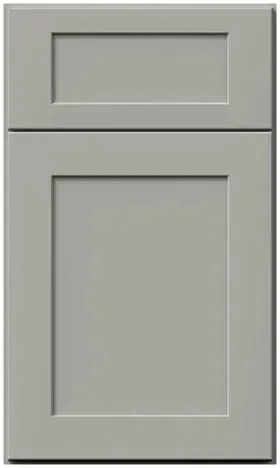
The step is flat at roughly $169 whatever the size, which tells you it is paying for the frame and the recessed centre rather than for material. That is the same five-piece construction as the door — ¾″ solid stiles and rails around a ⅜″ recessed centre — so a shaker-faced end reads as a continuation of the run, and a flat one reads as a wall.
Which you want depends on distance. Seen edge-on from three feet away, in a bathroom, a flat face is fine and the money is better spent elsewhere. Seen across a room, a flat end beside shaker doors looks like something ran out. Our guide to shaker against slab makes the same point about doors; ends obey it too.
Problem two: the gap where the run meets the wall

This is the most common reason a panel gets ordered and the most common reason the wrong part gets ordered. A cabinet run finishing against a wall almost never finishes flush, because walls are not straight and plaster is not plumb. What closes that gap is a filler, not a panel: GN BF3 at $26.00 for a 3″ base filler, GN BF6 at $43.55 for a 6″, GN WF330 at $26.00 through GN WF642 at $78.00 for wall heights, GN TF396 at $84.50 for a 96″ tall run.
A filler is designed to be cut. It arrives oversize on purpose so an installer can scribe it — hold it against the wall, run a compass or a block down the wall line to transfer the wobble onto the face of the filler, then cut and plane to that pencil line so the piece lands tight against plaster that is anything but flat. Do that with a $442.00 panel and you have spent $442.00 to make a filler.
The sequence matters. Scribe before fixing, cut proud and creep up on the line, and check the door swing has clearance to the wall before anything is screwed — a run pushed 3/8″ tight to plaster can leave a hinge-side door catching. If filler, panel and scribe are still fuzzy as terms, the piece we wrote on exactly that separates the three.
Problem three: a run that ends in open floor
The hardest end to get right is the one with nothing beside it — a vanity run stopping short of the tub, a base run ending at a doorway, an island return. Here the eye follows the cabinet down to the floor, and the panel has two extra jobs: it has to reach the floor cleanly, and it has to agree with the toe kick.
Order the panel to the finished height you actually have, not the nominal one, and fit the toe kick after the panel is standing, not before. GN TK8 runs $55.90 for an 8-foot length, GN TK8-3/4 is $58.50 in the ¾″ thickness, and GN TKC caps at $7.80 tidy the end grain where the kick dies into the panel. That last $7.80 part is the one people leave off the order and then look at every day.
If the end is going to carry any weight of detail — an island face, a peninsula people sit at — the panel is not the only option. GN PP-BASE, the base pilaster, is $227.50 and GN CP36, a 36″ corner post, is $312.00; both give a vertical break at the corner that a plain panel cannot. That is a different article, but it is worth knowing the parts exist before you default to a sheet.
Every cut edge needs factory banding, and not the white roll from the hardware store
Panels get cut on site. Depth changes, a floor slopes, a soffit intrudes, and a panel gets ripped to fit. The moment you cut one, you have exposed a raw core edge, and how that edge is treated is the difference between a finished job and an obvious one.
GNK-EDGE-BAND is listed at $7.15 and it is the cheapest insurance on the whole order. It is banding made in this finish, which matters more here than it would on a white: a mid-tone gray has a specific depth to it, and a generic white or almond iron-on band beside it does not read as a slightly-off gray — it reads as a mistake, at exactly the eye-level edge people run a hand along. Order banding with any panel that might be cut, and order the GNK-TOUCH-UP-KIT at $62.40 with it if the job has any site work in it at all.
Two practical notes from installs. Cut with the finished face up on a track saw or face down on a table saw, whichever keeps the blade exiting through the raw side — tear-out on a painted face cannot be sanded out. And band the edge before the panel goes on the wall; doing it in place, with a heat source, next to a finished door, is how a good panel gets a scorch mark.
What to send us so the right part arrives
- The cabinet code the panel is going on, not the room dimension. These are catalogued against the box.
- Which side — left or right as you face the run — and whether the end is against a wall, open, or turning a corner.
- Finished floor height at that end, and whether the floor is going in before or after the cabinets.
- Whether a toe kick, a filler, or both are already on the quote, so nothing gets bought twice.
- Whether anything on the end will be cut on site, so banding goes in the same box.
Everything here is pre-assembled and ships in 7 days to 3 weeks with the Fabuwood limited lifetime warranty, KCMA certification and AWI Premium Grade construction behind it. The cabinets these panels finish are listed under vanities and base cabinets, and the rest of the trim range sits in decorative accessories. If you want to see the finish against your floor before any of this is decided, a door sample is the cheap first move.
Common questions
- Do I need a finished end panel on every exposed cabinet side?
- Only where the side will be seen. A box between two neighbours needs nothing. A box at the end of a run, beside an appliance, beside a doorway or turning a peninsula needs either a skin or a panel, because the factory only finishes the faces the catalogue expects to show.
- What is the difference between an end skin and a finished end panel?
- A skin is a thin finished sheet glued and pinned over the box — GN SK BASE is $62.40, wall skins are $50.05. A panel is a framed part with its own face, from $386.75 at the 24″ size. A skin stops a side being bare; a panel gives the end a face that matches the doors.
- Can a cabinet end panel be cut on site?
- Yes, and most are. Cut so the blade exits through the raw side rather than the painted face, then band the fresh edge with GNK-EDGE-BAND at $7.15 before the panel is fixed. A cut edge left raw is the detail that makes an otherwise good install look rushed.
- Can I use a generic iron-on edge band on a gray cabinet panel?
- Not if it will be seen. This finish is a specific mid-tone gray, and a white or almond band next to it does not look like a near-match, it looks like an error — usually at hand height on an end people walk past. Use the banding made for the line.
- How do you scribe a cabinet panel to an out-of-square wall?
- Hold the piece plumb against the wall, run a compass or a scribe block down the wall so the wobble transfers onto the face, then cut just proud of that line and plane back to it. Do the scribing with a filler where you can — fillers are supplied oversize for exactly this, and cost $26.00 rather than $400-plus.
- Is the flat panel worth $169 less than the shaker one?
- In a bathroom, seen edge-on from a few feet, usually yes. Across an open room, a flat end beside shaker doors reads as a part that ran out. The step is roughly $169 at every size, so it is a fixed decision rather than a proportional one.
- What should I send you to get the right end part quoted?
- The cabinet code, which side it is, whether the end is open or against a wall, the finished floor height there, and whether a filler or toe kick is already on the quote. That is enough for us to price the correct part first time.
Keep reading
The guides behind the numbers on this page.
- End Panels, Scribe Molding and Fillers Explained
The three parts this page is most often confused with, separated properly.
- Cabinet Terminology and Abbreviations
If skin, scribe and reveal are new words, start here.
- How to Read Cabinet SKU Codes
Why the trailing code on a panel is a cabinet size, not a room size.
- Fabuwood Cabinet Sizes and Specs
The heights and depths a panel has to be ordered against.
- Kitchen Cabinet Materials and Construction
What is behind a painted face, and why a cut edge matters.
- Gray Kitchen Cabinets: Finding the Right Shade
Where this mid-tone sits, and why near-matches show on it.
- Cabinet Molding Types
Toe kicks, caps and the trim that finishes a panel at the floor.


