

A bathroom is not a small kitchen: planning a Galaxy Nickel vanity around the plumbing
Reviewed September 2026 · Captivating Cabinets
Almost every vanity page opens with a list of widths, which is the last decision, not the first. Start instead with what the room does to the cabinet. A bathroom box is three inches shallower and half an inch shorter than the kitchen box it is descended from; it has a P-trap, two supply stops and a drain line running through the middle of its best storage; it sits in saturated air for twenty minutes every morning and then dries out; and it is read from two feet away with a light pointed at it, not from across a room. Four differences, and together they decide the height, the depth, the width, the drawer count and the finish. This page works through them in that order, with the real cabinet prices at each step and a straight answer on what a mid-tone gray does in a small bathroom that a white one does not.
Where a vanity stops behaving like a base cabinet

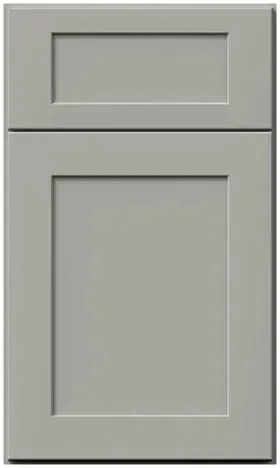
Under the paint, these are the kitchen cabinets. Same contemporary five-piece shaker door with ¾″ solid stiles and rails 2½″ wide around a ⅜″ recessed centre panel, same ½″ select solid-wood carcass with a natural wood-veneer interior, same Blum Compact Clip hinges at 110° with soft close, same ⅝″ dovetailed drawer boxes on Tandem plus Blumotion full-extension runners. Same KCMA certification, same AWI Premium Grade, same limited lifetime warranty, same pre-assembled delivery in seven days to three weeks. Nothing about the build changes when a box crosses the hallway.
What changes is the job. Set the two side by side and the differences are small numbers with large consequences.
| Kitchen base cabinet | Bathroom vanity cabinet | |
|---|---|---|
| Depth | 24″, with a 4½″ toe kick built into the box | 21″ — three inches given back to the floor, which is why a hall bath keeps its walkway |
| Height | 34½″, landing a normal counter at the familiar 36″ | 34″, finishing around 35″–36″ with a top on: modern comfort height |
| What occupies the interior | Shelves, or drawers packed to the back wall | A trap, two stops and a drain line through the centre of the useful space |
| Viewing distance | Eight to ten feet, across a room, in mixed light | Two feet, daily, under a fixture aimed straight at the door |
| Air | Warm and dry between meals | Saturated for twenty minutes every morning, then dry again |
| Price of the 30″ sink cabinet | GN SB30, $461.50 | GN VSB30-34, $461.50 — the same money for the smaller box |
That last row catches people out, and it is worth saying plainly: you do not get a discount for the three inches of depth you lose. Bath boxes are priced as cabinets, not by volume, so the argument for a vanity over a kitchen base is never cost. It is clearance, plumbing and the fact that a 24″-deep box in a 5′ × 8′ bathroom eats the space the door needs to swing. Both sets of dimensions are published in the Fabuwood size and spec tables, and if your room is tight enough that three inches decide it, measure before you shortlist anything.
Thirty-four inches, not thirty-two: who each height suits
There is one height in this range and the SKU tells you so — the -34 that closes GN VSB30-34 and GN VDB24-34 is the box height in inches. With a stone top and a normal overhang that finishes at roughly 35″ to 36″, the same place a kitchen counter lands, which is exactly the point of comfort height: an adult stops bending to wash their face. Older vanities ran 30″ to 32″, and the gap between those two standards is the single most common surprise in a bathroom remodel.
The taller standard suits almost everybody, and the exceptions are worth naming honestly. A bath used mainly by small children is easier at the lower height, though a step stool solves that for the six or seven years it matters and a 34″ box does not have to be replaced when they grow. Anyone shorter than about five foot two may find a 36″ finished counter puts the basin rim high; stand at a kitchen counter for a minute and you will know. And if the room is being fitted for seated use, this range is not the answer — there is no lowered box in the bath family here, and a genuine roll-under vanity is a different cabinet with a different clearance under the bowl. Ask and we will quote around it rather than sell you the wrong height.
Depth is the more consequential number and there is only one of those too: 21″. Three inches shallower than the kitchen box, because 21″ is the standard bathroom clearance and because a deeper cabinet pushes the basin further from the person using it. If you have ever leaned over a vanity to reach a tap, the vanity was too deep. The practical arithmetic runs like this: a 21″ box plus a 22″ top with its inch of front overhang puts the counter edge about 22″ off the finished wall. Measure from that line to whatever is opposite — the toilet, the tub apron, the door leaf as it swings in — and you have the clearance you will actually live with. If the number is under about two feet, the room is telling you to take a narrower cabinet rather than a shallower one, because the shallower one does not exist here.
Sizing to the room: the width ladder, and the point where two bowls start to make sense
Widths run 12″ to 60″ across six families, so the ladder is finer than the 24/30/36/48 fixed sizes a big-box vanity comes in. Do the subtraction before you pick a rung. Take the full wall, remove the door swing, remove the trim, and remove 15″ from the toilet centreline to the nearest vanity edge — that last figure is the one people forget, and it is the difference between a bathroom that works and a bathroom where you knock your elbow every morning. Whatever survives is the width you are shopping for.
| Wall left after the subtraction | The build | Codes | Cabinets |
|---|---|---|---|
| 24″–30″, powder room | One sink base, doors below, a false drawer front hiding the plumbing | GN VSB24-34 or GN VSB30-34 | $438.75 – $461.50 |
| 30″–36″, hall or kids’ bath | A sink-and-drawer combo: one carcass, one bowl, one working drawer stack | GN VSD30DL or DR, GN VSD36DL or DR | $757.25 – $783.25 |
| 42″–48″, family bath | A wider combo, or a sink base with a genuine drawer stack beside it | GN VSD48, or GN VSB30-34 + GN VDB18-34 | $975.00, or $1,134.25 |
| 60″, primary, two people at once | The one-piece double bowl — no seam under the stone | GN VSD60DOUBLE | $1,046.50 |
| 60″, primary, one bowl and more storage | A single basin with drawers running either side of it | GN VSD60SINGLE | $1,196.00 |
| The 12″–18″ left over beside any of them | A narrow cabinet rather than a filler strip — bottles standing up, or hot tools in a drawer | GN VB12FD, or GN VDB12-34 | $328.25 – $601.25 |
The threshold worth arguing about is the second basin. Two bowls need 60″ of vanity to be comfortable; at 48″ to 59″ you can physically fit two, and you will regret it, because the pair ends up with no counter between them and no drawer worth the name. One bowl plus a generous drawer stack beats two cramped basins every time in that range. Above the run, the 24″ vanity wall cabinet — GN WVS2430 at $490.75 — is the usual way to claw back the storage a double bowl costs you, hung over the toilet or set between two mirrors.
Handing is decided by the room, not by taste. Read it from the doorway: the drawer stack on a DL or DR combo should open into clear floor, never into the toilet, the tub apron or the swing of the door you just walked through. Both hands cost the same here, $757.25 at 30″ and $783.25 at 36″, so there is nothing to trade off — just get it right on the order, because it is not something a fitter can reverse on site.
Drawers or doors, and why the trap usually decides

Kitchen storage is bulky: pans, appliances, a bin. Bathroom storage is small and numerous — bottles, tubes, brushes, a hairdryer, a box of plasters — and small numerous things are lost behind a door and found in a drawer. On the evidence of the rooms we draw, drawers beat doors for everything in a bathroom except cleaning supplies and a spare toilet roll. So the honest advice is to buy as much drawer as the plumbing permits.
That last clause is the constraint, and it is worth being blunt about. Directly under the basin there is a trap, a tailpiece and two stops, and a full-extension drawer cannot travel through them. That is what a sink base is: GN VSB21-34 through GN VSB42-34, $422.50 to $542.75, doors below and a false drawer front across the top that looks like storage and is not. Nothing is wrong with the cabinet; it is shaped around the pipework on purpose. Either side of the bowl, though, the plumbing is gone and a drawer stack is free to be a drawer stack.
Four ways to spend the money, in ascending order of usefulness. A vanity base, GN VB12-34 to GN VB30-34 at $364.00 to $555.75, gives you one working drawer over a door — the conventional answer, and the least interesting one. A full-height door base is cheaper and often better: GN VB24FD is $438.75 against $484.25 for the door-and-drawer GN VB24-34, and the tall single door swallows a stack of towels or bottles standing upright where a shelf-and-drawer split will not. A drawer base is the expensive, correct answer where it fits: GN VDB12-34 to GN VDB33-34, $601.25 to $877.50, every inch of the box on runners. And the combos do both jobs in one carcass — GN VSD36DR at $783.25 is a sink base and a drawer stack that arrive as a single cabinet, which is $292.50 more than the same-width GN VSB36-34 and buys the only drawers most hall baths will ever have.
One gap in the ladder to know about: there is no 30″ vanity drawer base in this range. It runs 12″, 15″, 18″, 21″, 24″, 27″ and then jumps to 33″. If your layout wants exactly 30″ of drawers, use a 27″ stack with a 3″ filler or move to the 33″ and take three inches off elsewhere — the full family is listed on the vanities page.
A painted box in a wet room: what actually causes the damage

The humidity worry people arrive with is mostly the wrong worry. Steam from a shower is warm, brief and leaves again through the extractor; a solid-wood-framed door with a UV-cured finish on a plywood carcass handles it the way it handles a kitchen full of boiling pans. What ends bathroom cabinets is liquid water sitting somewhere it is not seen, and there are exactly three places it does that.
- The cabinet floor under the basin. A stop valve that weeps a drop an hour, or a waste connection finger-tight instead of tight, puts water on the deck of the sink base and nobody looks until the toekick smells. This is what kills the cabinet in the cabinet-lifespan piece, and it is why we tell fitters to leave the sink base empty for the first fortnight and put a hand in there once a week.
- The counter-to-door gap. Water runs off the front edge of the top, over the drawer front, and into the gap at the top of the door. Wipe the deck rather than letting it drip — two seconds after shaving, not a scheduled chore — and this never becomes anything.
- The toe kick, from the mop. The recess at the bottom of the box is ¾″ plywood, not a separate plastic strip, and it is finished. It will take a wet floor. What it will not take is standing in one, so a bath that gets sluiced rather than wiped wants the vanity kept off the floor or the water kept off the vanity.
Two ordering decisions follow from that list. First, ventilation is a cabinet spec, not just a comfort one: an extractor that actually changes the air is the cheapest protection any painted cabinet in the room will get. Second, think about what the box stands on. A plinth under the vanity looks like furniture and stands in every splash and mop stroke; a plain toe kick sits in shadow and is easier to keep dry. The vanity accessories checklist works through that choice in detail, and the care guide covers what to wipe a painted door with — a damp cloth and a mild cleaner, never anything abrasive, never a wet cloth left lying on the deck.
Why a mid-tone gray is the small bathroom’s most-requested vanity

Here is the pairing people ask us for more than any other in a small bathroom: a mid-tone gray vanity, a white or pale-veined top, white tile above it. It is requested so often because it solves a problem no white vanity solves. A small bath done entirely in white has no colour anywhere and reads as a hospital; a small bath done in a real colour gets darker and smaller. A gray box under a white top splits the difference — the room gets a definite colour, but it sits at knee height where a dark mass would close the space in, and everything above the counter line stays bright. That is the whole trick, and it is why the look survives in rooms of five feet by eight.
The practical argument is better still, and it belongs specifically to a bathroom. This is the surface a household touches with wet hands, toothpaste on its fingers and moisturiser still on its palms, forty times a day at a range of two feet. A white door broadcasts every one of those marks; this depth of gray forgives them, in the same way it forgives scuffs and handprints in a kitchen. For a family bath, a rental turnover or a flip, that is not decoration — it is the difference between a vanity that looks clean between wipes and one that never does. The gray shade guide sets out where this depth sits between the lighter grays and the charcoals, and it answers the out-of-style question honestly: the gray-on-gray room of a decade ago dated badly, a mid-tone gray used as a neutral against wood, white and warm metal did not.
Now the counterpoint, because it is real and it is the inverse of the advantage. Gray shows dust, and it shows dried water spots. A splash that evaporates on a white door leaves nothing; on a gray one it can leave a faint pale ring, and a week of dust reads as a film on a horizontal top rail where on white it would be invisible. In practice this is thirty seconds with a damp cloth, but if nobody in the house will do the thirty seconds, know it going in. A useful test: look at the top of your current bathroom door frame. If it is grey with dust, a gray vanity will tell on you.
Pairing, briefly, because the top and the metal are ordered separately and both change the result. White quartz is the high-contrast, most-photographed partner and the safest specification. A warm wood floor, or a wood-framed mirror, is what keeps the room from going cold — this finish is a neutral that does not drift blue or brown, which means it takes its temperature from whatever you put beside it. Both brushed nickel and brass sit well on it; matte black is graphic and works here where it is a risk on a warmer finish. One thing to watch that is specific to this depth of gray: under very warm 2700K bulbs a mid-tone can read slightly dull, so a bathroom fixture at 3000K to 4000K keeps it crisp — the opposite of the advice we give on the warmer off-white. Grays shift more with light than any other family, so judge a door sample at $25.00 in the actual bathroom at night before committing.
What the cabinet price does not include
Every figure on this page is a cabinet. That is a feature of buying cabinetry rather than a boxed vanity unit — you choose a quartz top instead of accepting cultured marble, and the top outlasts the alternative by decades — but it means the quote in front of you is not the bill. Five lines are yours to add, and one of them is usually forgotten.
- The countertop. Sold and templated by a fabricator, not by us. Order the cabinet first and template after installation; a top templated off a drawing fits a drawing.
- The basin. Undermount, drop-in or vessel changes the cut-out and sometimes the faucet centres. The fabricator wants the sink in hand before cutting.
- The faucet, and the stops and supply lines behind it.
- Pulls and knobs. Cabinets ship undrilled for hardware; pick the metal at the same time as the top, because the two together decide whether a gray run reads warm or cool.
- A finished end, if a side of the cabinet faces the room. This is the forgotten line. A vanity that ends against a wall needs nothing; one that ends in a doorway or beside a bath needs its exposed side finished, and that is quoted against the cabinet rather than ordered off the shelf. It is also not what the "side panel" listings in the accessories department are — those are platforms, and the accessories checklist explains the difference before you buy the wrong thing.
A worked example, so the shape of a real bill is visible. A 36″ hall bathroom in this finish: GN VSD36DR at $783.25 for the cabinet, plus a flat platform at $253.50 if you want it standing like furniture, plus your top, basin, faucet and pulls. Cabinets alone for a typical single-bowl bathroom land between about $440 and $1,050 here; a 60″ double run sits near $1,050 to $1,200 before the stone. The wider collection — the full Galaxy Nickel range, with its base cabinets, wall cabinets and tall cabinets — is the same door if you are doing a kitchen in the same trip. Send a wall width and a photo and we will draw it free; contractors fitting out several bathrooms at once should start at Captivating Pro.
Common questions
- What is the standard height of a bathroom vanity?
- These are 34″ tall, finishing around 35″–36″ once a countertop is on — modern comfort height, the same working height as a kitchen counter. Older vanities ran 30″ to 32″, and the difference between the two standards is the most common surprise in a bathroom remodel. There is one height in this range; the -34 in a code like VSB30-34 is that number.
- How deep is a bathroom vanity cabinet, and can I use a kitchen base instead?
- Vanities here are 21″ deep against 24″ for a kitchen base, and 34″ tall against 34½″. You can physically stand a kitchen base cabinet under a basin, and in a large bathroom some people do, but you give back three inches of floor and the box is not shaped around a trap. In a small bath those three inches are often the door swing.
- How wide does a vanity need to be for two sinks?
- 60″. At 48″ to 59″ two basins will physically fit and you will regret them — no counter between the bowls and no drawer worth having. In that range take one bowl and a real drawer stack instead. The one-piece 60″ double, GN VSD60DOUBLE, is $1,046.50 for the cabinet; the single-bowl 60″ with drawers either side is $1,196.00.
- Why does the cabinet under the sink have doors instead of drawers?
- Because the trap, the tailpiece and two stop valves occupy exactly the space a drawer would travel through. A sink base — GN VSB21-34 to GN VSB42-34, $422.50 to $542.75 — has a false drawer front across the top for that reason. Put the drawers either side of the bowl, where the plumbing has gone, or buy a sink-and-drawer combo that does both in one carcass.
- Does a gray vanity work in a small bathroom?
- It is the combination we are asked for most. A mid-tone gray box under a white top gives a small room a definite colour at knee height, where it cannot close the space in, while everything above the counter stays bright. It also hides toothpaste, splashes and fingerprints that a white door broadcasts at a range of two feet.
- What is the downside of gray bathroom cabinets?
- Dust and dried water spots show more than they do on white. A splash that evaporates invisibly on a white door can leave a faint pale ring on gray, and a week of dust reads as a film on a top rail. Thirty seconds with a damp cloth fixes it, but if nobody will do the thirty seconds, buy the brighter white.
- Will bathroom humidity damage a painted vanity?
- Shower steam is rarely the problem — it is warm, brief and leaves through the extractor. What ends vanities is liquid water sitting unseen: a weeping stop valve on the cabinet floor, drips off the counter edge into the door gap, and standing mop water at the toe kick. Fit a real extractor, wipe the deck, and check under the basin weekly for the first fortnight.
Keep reading
The guides behind the numbers on this page.
- Fabuwood Bathroom Vanities: Sizes, Styles and Buying Guide
Every configuration the brand builds, and the five decisions in the order a designer makes them.
- Fabuwood Cabinet Sizes and Specs
The dimension tables this article argues from — bath depth against kitchen depth, in writing.
- Gray Kitchen Cabinets: Finding the Right Shade
Where this mid-tone sits between the lighter and the charcoal grays, and the out-of-style question answered straight.
- How Long Do Kitchen Cabinets Last
Why the cabinet under a basin is the one that fails first, and what kills it.
- How to Clean and Care for Cabinets
The weekly two minutes that keep dried water spots off a painted door.
- How to Match Cabinets, Countertops, Backsplash and Flooring
Tile, top and floor around a gray box — run the white-card test before the top is ordered.
- Kitchen Cabinet Samples: How to Order and Evaluate
A bathroom is the hardest room to judge a door in. This is how to do it anyway.
- Types of Base Cabinets
The kitchen families these bath boxes are shortened, narrowed versions of.


