
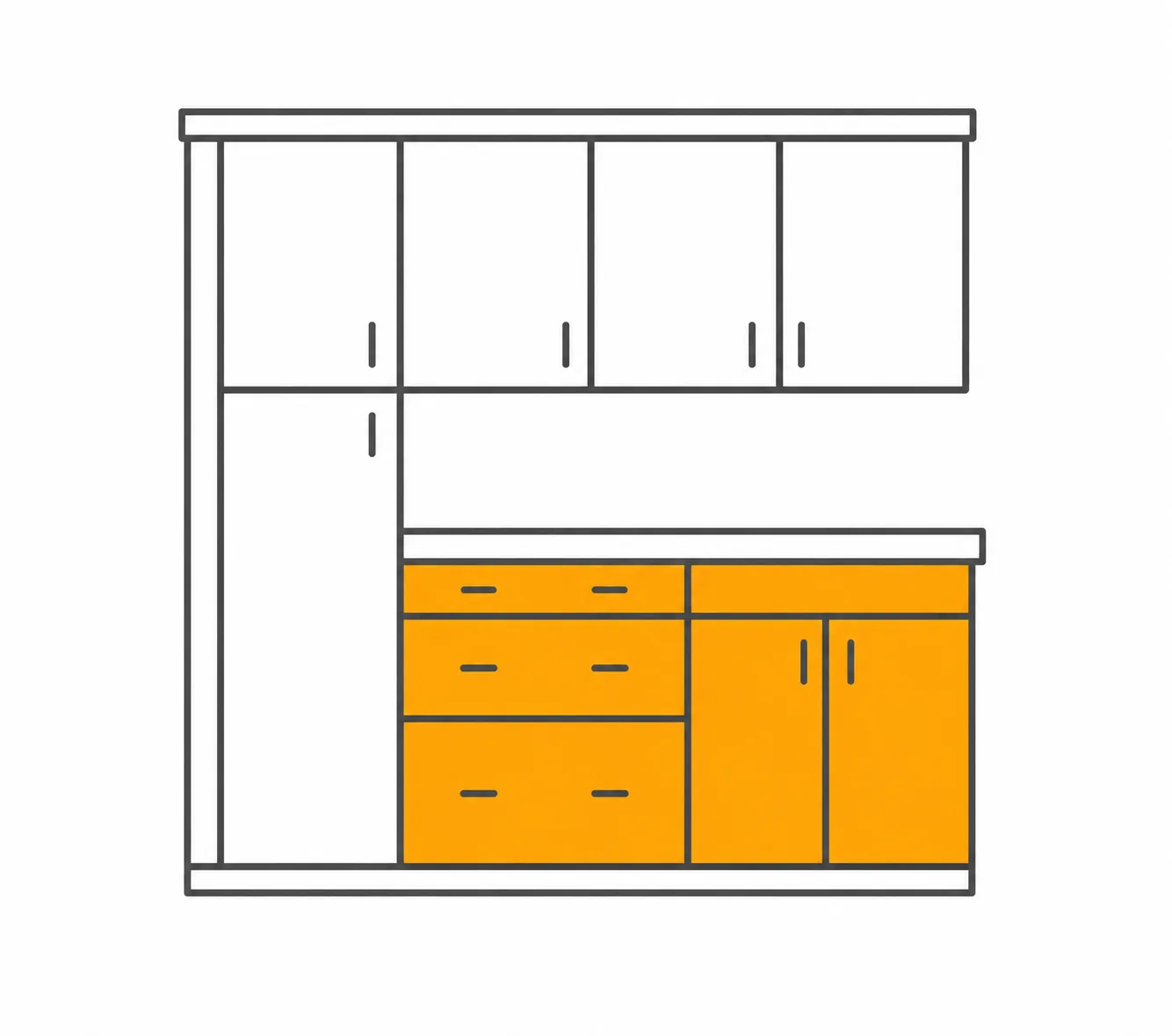


No wall for a pantry? A Galaxy Pistachio Green 2 drawer base cabinet as the dry-goods drawer
Reviewed September 2026 · Captivating Cabinets
A tall pantry cabinet needs a stretch of wall two feet wide and eight feet high, and a lot of kitchens simply do not have one. The food then goes into wall cabinets, where the back row is over your head and out of sight, or into a door base, where it is at ankle height and out of sight. A Galaxy Pistachio Green 2 drawer base is the third answer: two deep drawers that pull all the way out, so every packet, tin and canister is seen from above and reached without kneeling. This page is about using it as the kitchen’s pantry — how to load it, what it weighs when full, and where it should and should not sit.
The pantry that fits under a counter
The case for a drawer pantry is visibility. A cupboard shelf shows you the front row and hides the rest. A drawer that runs out to its full length shows you the whole of its contents at once, from above, and nothing is ever “at the back”. For food, which goes out of date when it is forgotten, that matters more than for pans.
The two-drawer box is the right shape for it because both tiers are deep. A three-drawer bank gives up height to a shallow top drawer that suits cutlery better than cereal; two deep tiers give room for boxes standing on end and canisters with their lids on. The box is 34½″ high and 24″ deep like every Galaxy base, comes pre-assembled, and runs in three widths.
| Width | Box · price | Pantry it replaces, roughly |
|---|---|---|
| 24″ | GPG DB24-2 · $724.75 | The food half of a small cupboard: tins, jars and a row of canisters |
| 30″ | GPG DB30-2 · $835.25 | A household’s everyday dry goods, one drawer for tall and one for short |
| 36″ | GPG DB36-2 · $1,017.25 | A full pantry for a small kitchen, with room for bulk packs |
There is no two-drawer box narrower than 24 inches. If the only space you have is narrower, a three-drawer bank from 12″ upward holds jars and tins, just in more, shallower rows.
Loading a food drawer so the labels read from above

The one rule is that everything stands up and is labelled on top. A shelf is read from the front; a drawer is read from above. Lay a box of pasta flat in a drawer and you can read it; stand it on end and you can fit three times as many in the same space — but only if the name is on the lid or the top edge.
- Bottom drawer: the tall things. Cereal boxes standing spine-up, flour and sugar in canisters, bottles of oil and vinegar standing upright in a row, the bag of rice decanted into a tub with a lid.
- Top drawer: the short things. Tins in rows with the labels facing up, jars of spice and sauce, snack packets in a shallow tub, tea and coffee. This drawer is opened most, so the daily things go at the front.
- Clear, square containers beat round ones: they tile the drawer floor without wasted corners, and you can see how much is left.
- Onions and potatoes keep best somewhere cool, dark and ventilated, and away from each other. A drawer is dark, but it is not ventilated — keep them in open-weave baskets if they go in at all, and never next to the oven.
Measure your tallest canister with its lid on before you choose. The interior height of each tier is not a published figure, so tell us what the tallest thing is and we will check it against the spec sheet rather than let you find out on delivery day.
A full food drawer is heavy
Pans are heavy; food is heavier than people expect. A few bags of flour and sugar, a dozen tins, a big bottle of oil and a sack of rice add up quickly, and the bottom drawer of a pantry base carries the lot on every opening. That is where the hardware earns its place. The drawers run on Blum Tandem plus Blumotion runners — concealed, full-extension, soft-close — and the drawer boxes are ⅝″ solid wood with dovetail joints, which is the construction that holds its shape under a sustained load rather than racking at the corners.
What the catalog does not publish is a load rating per drawer, so we will not quote one. The practical advice is simple: put the heaviest things in the bottom drawer and towards the front half, where the runner carries them best and your arm is not reaching over them, and keep bulk packs spread across the width rather than piled at one side. The dovetail drawer guide explains why the joint matters, and the soft-close guide covers what a damped runner does with a heavy drawer at the end of its travel.
Where the pantry drawer goes, and where it must not
Food wants to be near where it is prepared and away from where it is heated. That puts the pantry drawer in a narrow band of any plan.
| Position | Verdict | Why |
|---|---|---|
| Beside the main prep counter | Best | Ingredients come out onto the surface they are used on |
| Between the fridge and the prep counter | Good | Fridge and dry goods in one trip |
| At the end of an island facing the kitchen | Good | Reachable from the prep side, clear of the hob |
| Directly beside a range or wall oven | Avoid | Warmth shortens the life of flour, oils and spices |
| Under a cooktop | Avoid | The best drawer position in the kitchen is wasted on food, and it runs warm |
| Beside the dishwasher | Avoid | Steam from the open door, and it competes with the plates drawer |
In a small kitchen that means one 30″ or 36″ box beside the prep counter, and the pans go somewhere else — which is fine, because pans are happy in a door base with a roll-out. If you do have a wall for a pantry later, the tall cabinet page carries the full-height options in this finish.
Inserts that add a shallow tier to a deep drawer
A deep drawer’s weakness as a pantry is that small things sink to the bottom and get lost under the tall ones. The fix is an insert that adds a shallow tier above them. Two are listed in this finish for exactly these boxes: GPG DTD-DB30 BLUM at $884.00 for the 30″ and GPG DTD-DB36 BLUM at $932.75 for the 36″, tiered inserts that run on their own Blum hardware. They cost real money, so buy one where the pantry drawer is the busiest drawer in the kitchen, and ask us which tier of the box it is designed to go in before you order.
Cheaper routes exist. Wider organiser inserts are listed at GPG DPS-18/27 for $256.75 and GPG DPS-30/33 for $302.25, and a plain set of clear stacking tubs from a kitchen shop does a lot of the same work. The drawer insert page has every insert with the drawer widths each is listed for.
Two wide green fronts, opened all day
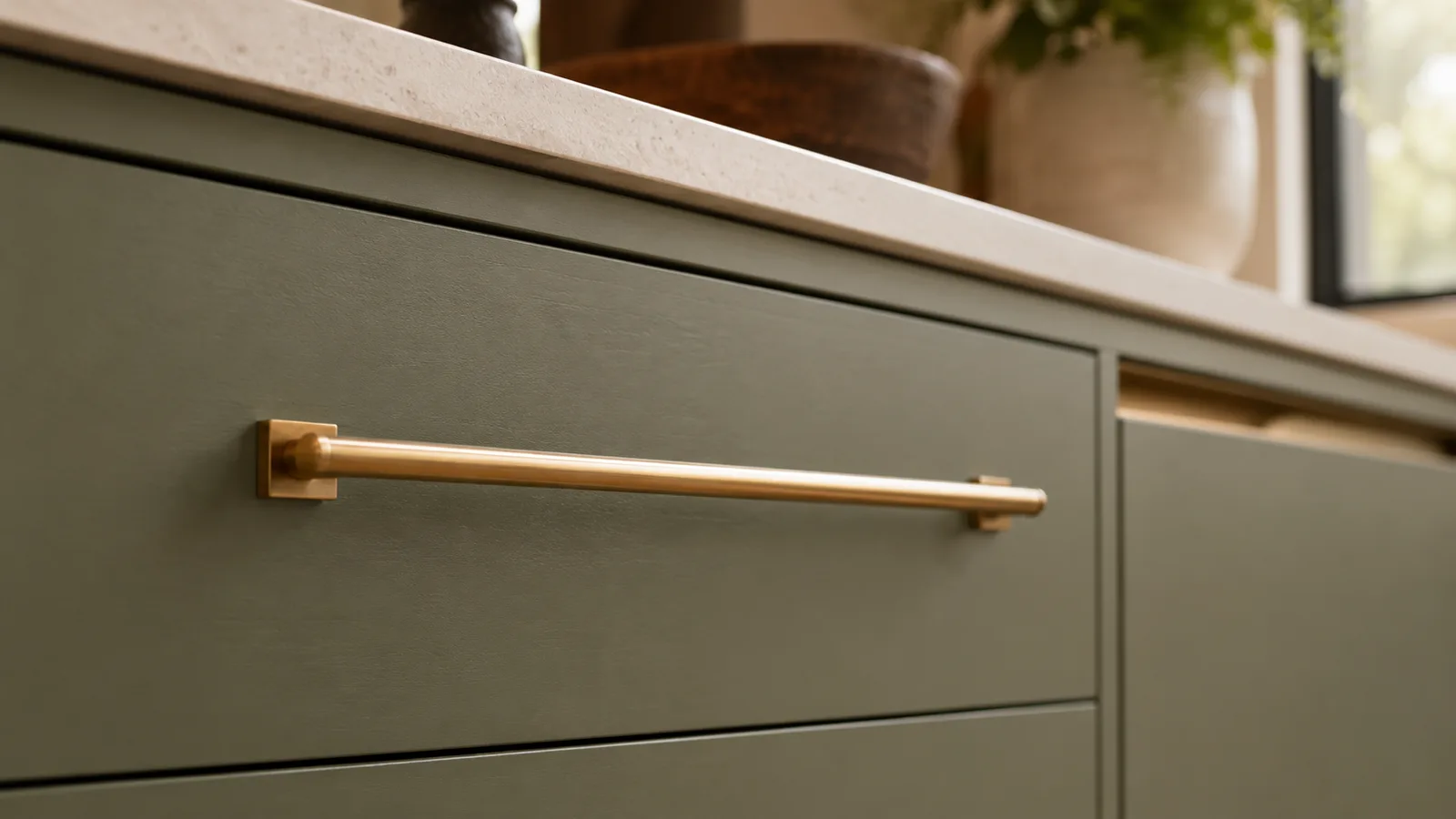
A pantry drawer is opened more than almost any other front in the kitchen, and on a 30″ or 36″ box those fronts are two of the widest single panels of the finish below the counter. Two practical consequences. First, choose a long pull, or two pulls per drawer on the 36″, so the drawer comes out square rather than twisting on one end. Second, choose the pull finish knowing it will be touched hundreds of times a week: brass warms this greyed sage and wears to a softer patina, black reads crisper and shows less, polished nickel keeps the whole thing cool.
The green itself is a muted sage rather than the bright green the name suggests, and it moves with the light, so look at a door sample on the counter where the pantry drawer will go before you commit to the pulls — ask your designer about credit for it. Open the drawer and the colour stops: the boxes inside are natural wood, which is part of the look.
Ordering a pantry drawer
The boxes come assembled, drawers fitted, in about 7 days to 3 weeks. Tell the free 3D design service that the drawer is your pantry and list the tallest container; a designer replies within one business day, and the drawing and quote follow within 24–48 hours. Contractors fitting pantry drawers in small units get 20–40% off through Captivating Pro. The rest of the finish, uppers and tall cabinets included, is on the collection page.
Common questions
- Can drawers replace a pantry cabinet?
- In a small kitchen, yes. One 30″ or 36″ two-drawer base holds a household’s everyday dry goods, seen from above and reached without kneeling. A tall pantry still holds more; drawers are the answer when there is no wall for one.
- How do you organise food in a deep drawer?
- Stand everything up and label it on top: cereal and pasta on end, flour and rice in lidded canisters, tins in rows with labels facing up. Tall things in the bottom drawer, daily things at the front of the top one.
- Can a kitchen drawer hold flour, rice and canned goods?
- The drawers are ⅝″ dovetailed solid wood on Blum full-extension soft-close runners. A per-drawer load rating is not published, so keep the heaviest items in the bottom drawer, spread across the width.
- Where should a pantry drawer go?
- Beside the main prep counter, or between the fridge and the prep area. Keep it away from the range, the wall oven and the dishwasher, whose heat and steam shorten the life of dry goods.
- How much is a 36 inch two-drawer base in this finish?
- GPG DB36-2 is $1,017.25 on our grid on the review date. The 30″ is $835.25 and the 24″ $724.75.
Keep reading
The guides behind the numbers on this page.
- Small Kitchen Design and Layout Ideas
Other ways to find storage in a kitchen with no pantry wall.
- What Dovetail Drawers Tell You About Cabinet Quality
Why the joint matters in a drawer that carries food every day.
- Soft Close vs Self Closing Cabinet Drawers Explained
What a damped runner does at the end of a heavy drawer’s travel.
- Green Kitchen Cabinets: Sage, Pistachio, and Moss Shades and Pairings
Which pulls and counters sit best with a greyed sage.


