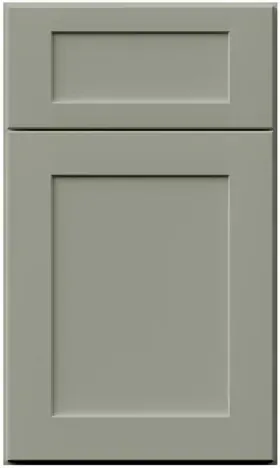


Platters, cake stands and the slow cooker: a Galaxy Pistachio Green full height double door base at the dining end
Reviewed September 2026 · Captivating Cabinets
Prices quoted in this article were read off the grid on the review date; the live price grid on this page governs.
Every household owns a shelf-load of things it uses four times a year: the turkey platter, the cake stand, the big salad bowl, a slow cooker, a roasting pan, the gravy boat nobody can find in December. They are big, some are fragile, and they all end up in the same place on the same day — on the counter nearest the table. The Galaxy Pistachio Green full height double door base, two doors and no drawer tier, is the box we put at that end of the kitchen to hold them. This article is about using it as a serving cabinet: what goes in, how to measure a platter against a box before you order, and what the green face does when the dining table can see it.
A cabinet for the things used a few times a year
The serving pieces are a storage problem because of their shape, not their number. A platter is wide and flat. A cake stand is tall and top-heavy. A slow cooker is heavy and has a cord. None of them divides into drawer tiers, and none of them wants to live in a wall cabinet where it has to be lifted down over a counter.
Two doors and no drawer give the one shape that holds all of them: a single cavity the full height of the box, 34½″ tall overall and 24″ deep, with a ¾″ plywood shelf dividing it. Flat and heavy things go on the cabinet floor, lighter and taller pieces on the shelf, and nothing needs lifting above the waist. Because the pieces are rarely used, the box does not need to be in the working part of the kitchen — which is exactly why it belongs at the end nearest the table, where the serving happens.
Measuring a platter against a cabinet
Measure the pieces before choosing the width, and measure them the way they will be stored. The label on the box is its outside width; the face frame, and the point where the two doors meet, take some of it back, and the clear opening is not published. Tell us your largest piece and we check it against the spec sheet before the order goes in. As a rule of thumb, though, the table below covers most serving collections.
| Piece | Typical size | How it stores | Width we would draw |
|---|---|---|---|
| Oval turkey platter | 18″–22″ long | Flat on the cabinet floor, or on edge in a rack | 30″ or wider |
| Round cake stand | 10″–12″ across, 5″–8″ tall | On the shelf, with the dome beside it | 24″ and up |
| Slow cooker | Around 15″ long with handles | On a roll-out, so it slides rather than lifts | 27″ and up |
| Roasting pan with rack | 16″–18″ long | Flat, under the platters or beside them | 30″ and up |
| Punch bowl or big salad bowl | 12″–16″ across | On the floor, with smaller bowls nested inside | 24″ and up |
| Chafing dishes | A frame plus a pan | Taken apart and stacked | 33″ and up |
Store platters on edge if you have more than two: a simple freestanding plate rack on the cabinet floor keeps them upright and lets you lift one out without unstacking the rest. And put the heaviest thing, usually the slow cooker, low and at the front.
Six widths at full depth, five at twelve inches
The door-only doubles run from 24″ to 39″ at full depth, and from 24″ to 36″ in the 12″-deep version. Prices below are the figures displayed on the review date; the product grid above is the authority if they have changed.
| Width | Full depth · price | 12″ deep · price |
|---|---|---|
| 24″ | GPG B24FD · $403.00 | GPG B24FD-12D · $396.50 |
| 27″ | GPG B27FD · $442.00 | GPG B27FD-12D · $429.00 |
| 30″ | GPG B30FD · $461.50 | GPG B30FD-12D · $442.00 |
| 33″ | GPG B33FD · $468.00 | GPG B33FD-12D · $455.00 |
| 36″ | GPG B36FD · $490.75 | GPG B36FD-12D · $477.75 |
| 39″ | GPG B39FD · $526.50 | — |
For a serving cabinet the 30″ and 36″ are the natural widths: wide enough for a long platter lying flat, narrow enough that the doors do not dominate the end of a run. The step from 30 to 36 is $29.25, which is cheap for six more inches of platter room. For the slow cooker, a roll-out does the lifting — GPG ROD-B30 BLUM H is $279.50 and GPG ROD-B36 BLUM H is $286.00 on the roll-out page, both high-sided so a bowl or a cooker does not slide off as the tray comes out. The 12″-deep boxes are a different piece of furniture: a shallow sideboard in the dining room itself, which the collection page covers with the rest of the finish.
Seen from the table

In an open plan, the end of the kitchen nearest the dining area is the part the table looks at. A full-height double is the quietest face the base line makes there: two tall five-piece doors, no drawer tier and no line of pulls across the top, so it reads more like a sideboard than a run of kitchen boxes. That is one reason we put it here even when the storage could go somewhere else.
It is also where the colour meets the furniture. This finish is a muted, greyed sage — close to #929488 off the swatch, not the bright green the name suggests — and green beside wood is about the most dependable pairing there is. It sits well with an oak or walnut dining table, with a butcher-block counter on the serving end, and with brass, black or nickel on the doors; brass leans it warm, black makes it read more modern. The wood species guide covers the tones the table might be. What changes with the light is the green itself, so bring a door sample into the dining room and look at it from the table in the evening, under the pendant.
The counter on top becomes the buffet
The reason to keep the serving pieces at this end is that the counter above them does the serving. On the day, the slow cooker comes out of the box and onto the counter above it, the platters come out and get loaded a foot from where they are stored, and the dining table is a step away. Plan the counter for that: a heat-resistant trivet zone for a warming tray or a cooker, and enough clear length for two platters side by side.
Two practical points. A slow cooker or a warming tray needs an outlet on that stretch of counter; an electrician can tell you what local code requires above a counter, but it is much cheaper to add one before the backsplash goes up than after. And if this end of the run is open to the dining room, its side is on display — GPG BEP, the base end panel, is $149.50 on the decorative accessories page, and it should be on the same order as the box so the green matches exactly.
What does not belong in the serving cabinet
A box that is opened a few times a year attracts clutter, and the serving pieces lose their place to it within a season. Keep three things out. Everyday dishes belong in drawers near the dishwasher, not at the dining end, or the serving box becomes a second plate cupboard and the platters migrate to the garage. Heavy small appliances used weekly — the stand mixer, the food processor — belong near the prep counter, where they are used. And table linen belongs in a drawer: folded cloths laid on a cabinet floor crease and collect dust, while a shallow drawer in the double door base or a drawer bank keeps them flat.
If there is room left once the serving pieces are in, the honest use of it is the overflow of the same family: spare glasses for a crowd, the tiered stand for a birthday, the big jug. Keep the category tight and the cabinet stays useful on the one day a year you really need it.
Ordering the serving end
Galaxy boxes come pre-assembled, with the doors already hung, in about 2 weeks. Send us the dining-room side of the plan as well as the kitchen, and the free 3D design service will show the doors open with the chairs in place; a designer replies within one business day and the full drawing and quote follow within 24–48 hours. For the same box with a drawer tier across the top, see the double door base page; for narrower door-only boxes, the full height single page. We’re builders who sell cabinets, and the serving end is a detail we have learned to draw from the table side first.
Common questions
- What is the best cabinet for storing serving platters?
- A door-only base with no drawer tier, 30″ or 36″ wide, at the end of the kitchen nearest the table. Platters store flat on the cabinet floor or on edge in a rack, and nothing has to be lifted down from overhead.
- Will a 20 inch platter fit in a 30 inch base cabinet?
- Lying flat, in most cases — but the clear opening is less than the 30″ label and is not published. Tell us the platter’s size and we check it against the spec sheet before you order.
- Can I store a slow cooker in a base cabinet?
- Yes, low and at the front, or on a high-sided roll-out so it slides out rather than being lifted from the back: GPG ROD-B30 BLUM H is $279.50 and ROD-B36 BLUM H is $286.00.
- Do green kitchen cabinets go with a wood dining table?
- Green and wood is one of the most reliable pairings, and this muted grey-sage suits oak and walnut. Judge a door sample from the table under your own evening light before deciding.
- How much is a 36 inch base cabinet with no drawer?
- GPG B36FD is $490.75 on our grid on the review date; the 12″-deep B36FD-12D is $477.75.
Keep reading
The guides behind the numbers on this page.
- Cabinet Wood Species: Oak, Maple, Walnut & More
The tones a dining table or butcher-block top might bring to the sage.
- How to Match Kitchen Cabinets With Countertops, Backsplash and Flooring
Choosing the counter that becomes the buffet.
- Green Kitchen Cabinets: Sage, Pistachio, and Moss Shades and Pairings
Where a greyed sage sits among the greens, with pairings.
- Kitchen Layouts Explained From Single-Wall to G-Shaped
Which plans put an end of the kitchen in view of the table.


