
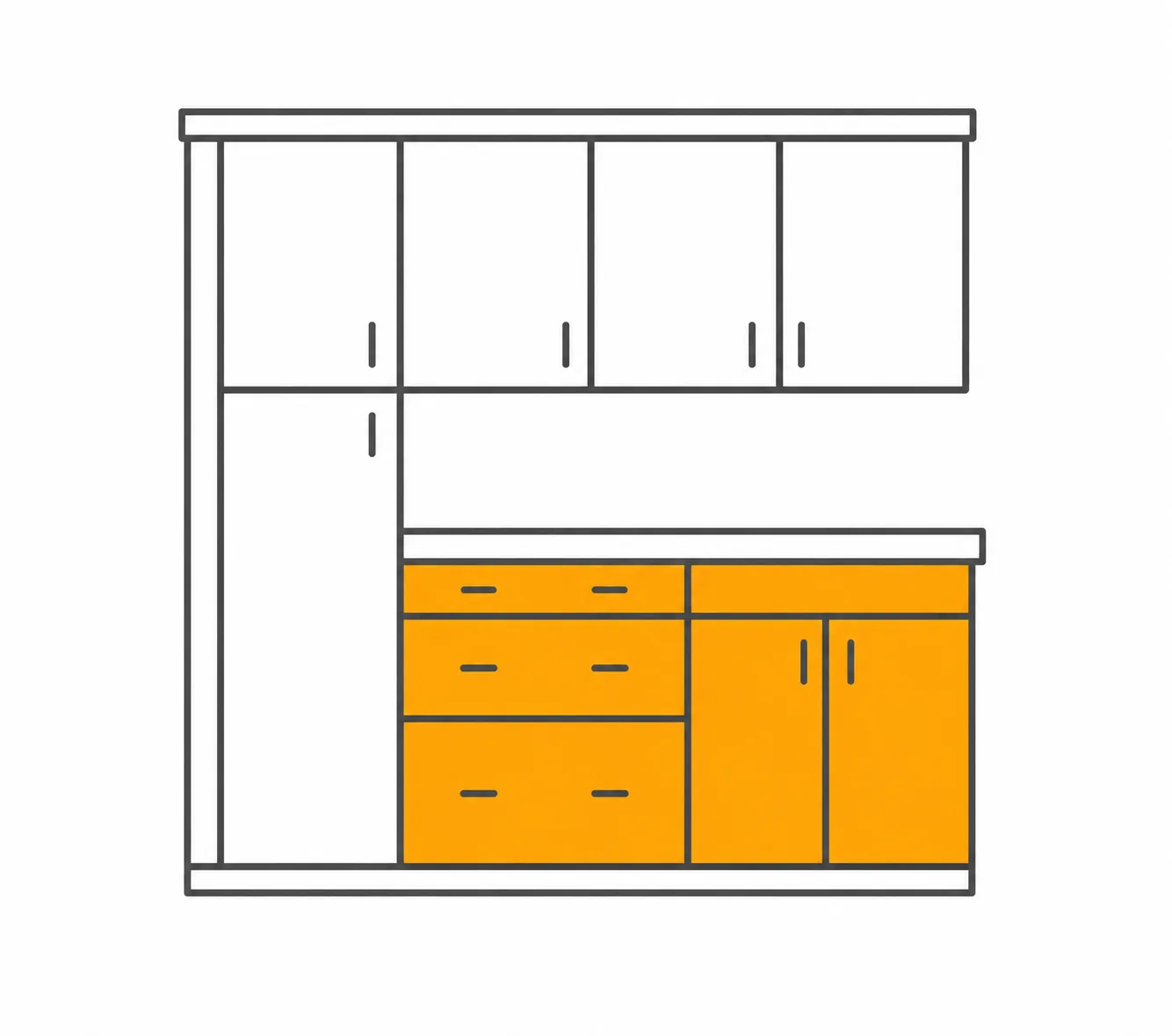


Hip, knee and ankle: loading a Galaxy Pistachio Green 4 drawer base cabinet by reach
Reviewed September 2026 · Captivating Cabinets
Four drawers in one box means four different heights from the floor, and those heights matter more than the drawers’ size. The top one is at your hip and costs nothing to open. The bottom one is at your ankle and costs a full bend every time. A Galaxy Pistachio Green 4 drawer base, in 15″, 18″ or 21″, is the only box in the line that gives you four separate reach bands in one column, and this page is about loading it by reach: what belongs at each height, who in the household can comfortably use which drawer, and how the choice of pull changes the effort for stiff hands and bad backs.
Four drawers, four heights from the floor

The box is 34½″ high on its toe kick, and its four fronts divide that into four bands. The exact interior height of each drawer is not a published figure, so we will not quote one, but the bands are easy to picture against a body. The top drawer sits around the hip of most adults, the second at the top of the thigh, the third at the knee, and the bottom one a hand’s width above the floor.
What that means in practice is effort. Opening the top drawer is a flick of the wrist while standing upright. The second needs a slight lean. The third needs a bend at the waist or a crouch. The bottom needs a full crouch or a kneel for anything at the back. Every item in the box costs the effort of the drawer it lives in, every time it is used — so the whole art of loading one is putting the things used most often where the effort is least.
An allocation, drawer by drawer
The table below is the allocation we suggest for a four-drawer box beside the main prep counter. The inserts are the ones listed in this finish for drawers of these widths; four shallow tiers are shallower than the drawers most inserts are built for, so confirm with us that the one you want fits the tier you want it in before ordering.
| Drawer | Height band | What goes in | Insert listed for this width |
|---|---|---|---|
| Top | Hip | Cutlery or the utensils used at every meal | GPG CD-15/18 · $201.50 (15″–18″); GPG CD-21/24 · $273.00 (21″) |
| Second | Upper thigh | Cooking tools, measuring cups, the thermometer; or coffee pods | GPG UT-15/24 · $227.50; GPG KCUP-18 · $224.25; GPG KCUP-21/24 · $266.50 |
| Third | Knee | Wraps, foil and bags; tea towels; weekly baking kit | None needed — rolls lie flat across the width |
| Bottom | Ankle | Rarely used things: spare batteries, the takeaway menus, candles; or a child’s own drawer | None — keep it simple to open |
The pattern is simple. Things touched at every meal go in the top two; things touched weekly go in the third; things touched a few times a year go in the bottom. More inserts, including ones listed for 18″ to 24″ drawers such as GPG DKI-18/24 at $214.50, are on the drawer insert page.
Who in the house uses which drawer
The reach bands move with the person. A tall adult finds the top two easy and the bottom two tiresome; a shorter adult finds the top drawer at waist height rather than hip, which is if anything easier. The two groups a four-drawer box suits particularly well are at opposite ends of life.
For someone with a stiff back, bad knees or a new hip, the case is the same one that makes drawers better than doors in general, taken one step further. Nothing is at the back of a cupboard; nothing needs a kneel to find. Load the top two drawers with everything used daily and use the bottom two as overflow, and the whole box can be run without bending at all. If you are planning a kitchen to stay in for the long term, that is the reason to put a four-drawer box where a door box might otherwise go.
For children, the bottom drawer is the one they can reach and the top one the one they cannot. That makes the bottom drawer a natural place for their own things — plastic plates and cups, a snack tub — so they can help themselves without climbing, and keeps the knives at the top, above their eyeline. It also makes the bottom drawer the one to think about if there is anything in the box you would rather a toddler did not find.
Pulls for stiff hands, and where to put them on the low drawers

Pull shape matters more on a column of four drawers than anywhere else, because it is repeated four times in a small space and because the low ones are opened at arm’s length. Bar pulls and D-shaped pulls, which let you hook a whole hand or a few fingers through, are much easier for stiff or arthritic hands than knobs, which have to be pinched. Long pulls let you open a drawer with the side of a hand or a wrist when your fingers are full or wet. On a 15″ to 21″ front, one bar pull per drawer, centred, is the usual choice.
Placement is where the reach argument comes in. On the top drawer, centre the pull on the front. On the two lowest drawers, mounting the pull high on the top rail rather than in the middle of the front brings it an inch or two closer to your hand, which is a real saving on the drawer you open from a crouch. Consistent placement across a run looks tidier; placement by reach is kinder to the people using it. Tell us which you want and the drawing shows it.
On this finish, a greyed sage with a muted tone, the pull colour is part of the look: brass warms it, matte black sharpens it, polished nickel keeps it cool and quiet. Four stacked fronts carry four pulls in a small area, so whichever you choose will be read as a column. Hold the pull against a door sample before you buy a set of them — ask your designer about sample credit.
Three widths, priced
The four-drawer box comes in three widths only; anything wider moves to three deeper drawers. Prices are the figures shown on the review date.
| Width | Box · price | Against the three-drawer at the same width |
|---|---|---|
| 15″ | GPG DB15-4 · $780.00 | $152.75 more than GPG DB15 |
| 18″ | GPG DB18-4 · $799.50 | $152.75 more than GPG DB18 |
| 21″ | GPG DB21-4 · $832.00 | $159.25 more than GPG DB21 |
The extra front is the whole difference in price, and it buys one extra reach band. Whether that is worth it depends on the household: for someone who will not bend to a low drawer, it is an extra drawer at thigh height they will actually use; for everyone else, the three-drawer box is the better value and gives deeper tiers. The drawers run on the same Blum full-extension soft-close runners and ⅝″ dovetailed solid-wood boxes as the rest of the line.
Where the four-drawer box sits in a reach plan
In a kitchen planned around reach, the four-drawer box goes beside the main prep counter, with its top drawer holding the tools used there, and the heavy pans go into a two-drawer box under the cooktop where the drawers are deep and wide. Anything used rarely goes into a door base at the end of a run. The free 3D design service will lay out the whole base run by what you use most — a designer replies within one business day, and the full drawing and quote follow within 24–48 hours. The boxes arrive pre-assembled in about 7 days to 3 weeks. For deep drawers see the two-drawer page, and for the whole finish the collection page. We’re builders who sell cabinets, and the reach plan is something we learned from fitting kitchens for people who could no longer kneel.
Common questions
- What should go in each drawer of a four-drawer base?
- By reach: things used at every meal in the top drawer, cooking tools in the second, wraps and towels in the third, rarely used items or a child’s own things in the bottom. Heavy things only in the top two.
- Are drawers better than cupboards for a bad back?
- Yes. Nothing is at the back of a shelf, and with daily things in the top two drawers of a four-drawer box you can use the whole column without bending.
- Are knobs or pulls better for arthritis?
- Pulls. A bar or D-shaped pull can be hooked with several fingers or the side of a hand; a knob has to be pinched. Long bar pulls are the easiest of all.
- Where should pulls go on the bottom drawers?
- High on the top rail rather than centred, if you want to reduce bending. It brings the pull a little closer to your hand on the drawer you open from a crouch.
- How much is an 18 inch four-drawer base in this finish?
- GPG DB18-4 is $799.50 on our grid on the review date. The 15″ is $780.00 and the 21″ $832.00.
- Do drawer inserts fit a four-drawer base?
- Some do. Inserts are listed by drawer width, but four tiers are shallower than most drawers, so ask us to confirm the insert fits the tier you want before ordering.
Keep reading
The guides behind the numbers on this page.
- Types of Base Cabinets: Sizes & Standard Dimensions
The four-drawer box beside the rest of the base line.
- Soft Close vs Self Closing Cabinet Drawers Explained
Why a damped runner matters on a drawer you open from a crouch.
- Kitchen Cabinet Samples: How to Order & Evaluate
Choosing pulls against a real door rather than a photograph.
- Green Kitchen Cabinets: Sage, Pistachio, and Moss Shades and Pairings
Brass, black or nickel on a greyed sage, and why.


