


The French-country brief: a Galaxy Horizon decorative onlay and the five choices that have to agree with it
Reviewed September 2026 · Captivating Cabinets
Prices quoted in this article were read off the grid on the review date; the live price grid on this page governs.
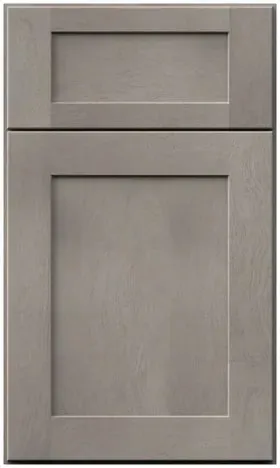
Fabuwood's own copy for this finish reaches for a specific style. On the door page it says "Horizon's soft taupe tones and delicate woodgrain bring a timeless elegance to French country style". A plain shaker door does not say French country on its own; it says transitional, which is what most shaker says. The Galaxy Horizon decorative onlay, GH VDO at $425.75, is the smallest part that tips a vanity from one to the other, a carved piece applied to a door. It only works if the rest of the bathroom agrees with it. This page treats the onlay as the opening line of a brief and follows it through the five decisions that finish the sentence.
Why a taupe stain suits the style in the first place
French country, in the version most people picture, is rustic furniture made refined: painted or limed wood that looks as though it has been in a house for a long time, stone, linen, aged metal, a curve or a carving here and there. Two things about this stain make it a natural fit.
First, it is a stain, so the grain shows. The Galaxy centre panel is MDF with a wood-veneer face, and the frame is solid wood, so under the grey-taupe you see wood texture rather than a flat film of colour. French country leans on that sense of material.
Second, it is soft rather than crisp. Fabuwood describes it as a grey stain "accented with soft pink undertones", and homeowners report that it reads warmer in sun and cooler on overcast days. One Houzz commenter even passed on it for an island because she saw an "uneven tone". For most modern styles that liveliness is a caution. For French country it is the point, since the style is built on surfaces that look lived with.
The onlay as the opening line

An onlay is applied carving, a single decorative piece fixed to a flat surface, usually the centre panel of a door. Used once, on the door the eye lands on first, it tells anyone walking in that the vanity is meant to be read as furniture. That is the whole job in a French-country bathroom: not decoration everywhere, but one clear signal that sets the tone for everything else.
At $425.75 it costs roughly what a 21-inch vanity sink base does in this finish (GH VSB21-34, $422.50). That comparison is useful. It is the price of a cabinet, so it should do something a cabinet cannot: change the character of the room. If the rest of the room is going to stay modern, the money is better spent elsewhere.
One point specific to a stain. The onlay is a separate part, stained to match, and Fabuwood says colour variation between stained parts is normal. On a carved surface the stain also gathers slightly differently in the recesses than on a flat panel. Look at the onlay against the door it will sit on before it is fixed, in the bathroom's own light.
The five choices that have to agree with it
Once the onlay is on the quote, the rest of the room either supports it or undermines it. Here is the brief in one table. The middle column is what Fabuwood has actually shown with this finish in its own photographs; the right-hand column is our general advice, marked as such.
| Choice | Shown by Fabuwood with this finish | Our general advice for the style |
|---|---|---|
| Vanity top | Marble, and black countertops | A honed white or cream marble or marble-look top; black reads more modern |
| Hardware and metal | Gold hardware, copper accents | Aged or unlacquered brass bin pulls or knobs; one metal throughout |
| Mirror | Not shown | An arched or softly curved frame, in wood or aged metal, not a frameless rectangle |
| Lighting | Not shown | Warm-white bulbs (2700K) in sconces with fabric or glass shades |
| Floor | Not shown | Stone-look or terracotta-toned tile, or a warm wood-look plank |
Two of the rows deserve a sentence each. Lighting matters more on this finish than on most, because the grey-taupe shifts with light; under warm bulbs it leans towards its taupe side, which is the side French country wants. And one metal throughout is worth the discipline: a brass knob, a brass sconce and a brass mirror frame read as a scheme, while brass knobs with a chrome faucet read as two bathrooms.
How to overshoot, and how to avoid it
The risk with a style this recognisable is doing all of it at once. A carved onlay, a scalloped mirror, a toile wallpaper, a chandelier, a skirted stool and distressed everything is a theme, not a room. The style works best as a lean rather than a costume.
- One onlay on one door. Not one on every door, and not a pair on a pair.
- Keep the pulls simple. Carved or ornate hardware next to a carved onlay competes with it; a plain bin pull or a round knob lets the onlay lead.
- Let the stain carry the age. The grain and soft tone already give the vanity a lived-in quality; there is no need for a separately distressed mirror or antiqued tile.
- Leave the walls quiet. A plain limewash-effect or warm off-white wall does more for this style than pattern.
- Choose one curve. An arched mirror or a curved sconce is enough to soften a room of straight shaker lines.
Which bathroom it suits
A powder room is the easiest place to try it. It is small, used briefly, often without a window, and a single carved vanity with a warm sconce and a curved mirror is a complete scheme in forty square feet. It is also the room where the investment is smallest if you later change your mind.
A primary bathroom takes more thought, because the vanity is long and the onlay is small relative to it. On a double vanity the temptation is symmetry, one onlay under each basin. Resist it; one onlay on a central door or on the single door nearest the entry reads as a considered piece, while two read as pattern. If you are unsure, the free 3D design will show the vanity with the onlay placed where you are considering, and a designer replies within one business day.
The onlay is listed with the rest of this finish's vanity parts on the vanity accessories page, and a door sample at $35.00 is the right first purchase before any of the above. Hold it next to the marble you like and under the bulb you plan to use.
Will it date?
Every style dates eventually. French country has been through several cycles, and the carved, heavily distressed version of the 1990s is the one people now remember unkindly. The lighter version described here, one carving, one metal, real stone and wood, has aged better, largely because it is closer to how old furniture actually looks than to a catalogue of French motifs.
The finish itself has been around for a while, since about 2017, and we have found no reports of homeowners calling it dated. The safest way to keep the room flexible is to put the style into the parts that are easiest to change. The mirror, the lights, the hardware and the paint on the walls can all be swapped in an afternoon. The onlay, once fixed, is part of the door, so keep it to one, and if you ever tire of the look the rest of the room can move on without it looking stranded.
If the kitchen is going the same way
The hue card that started this page never mentions bathrooms; it describes a space, and most of Fabuwood's own photographs of this finish are kitchens. Some people want the same brief in both rooms. The same restraint applies: one onlay in a kitchen belongs on the range hood or the end of an island, where the eye already stops, not scattered across a run of wall cabinets. The Horizon collection has the full range of cabinets and trim if the plan extends that far, and our transitional cabinets guide is a useful counterweight, since it explains what the same shaker door looks like without the carving.
Common questions
- How do I make a bathroom vanity look French country?
- Give it one clear furniture cue, such as a single carved onlay on the door the eye lands on first, then support it with a marble top, aged brass hardware, a curved mirror, warm light and a stone-look or warm wood floor. Keep the rest simple.
- Does a grey stained vanity suit French country style?
- This one does. Fabuwood's own copy says its soft taupe tones and woodgrain suit French country, and a stain shows grain in a way a paint does not, which gives the lived-in texture the style relies on.
- How much is the vanity decorative onlay?
- GH VDO is $425.75 at review, roughly the price of the 21-inch vanity sink base in this finish.
- Should I put an onlay on both sides of a double vanity?
- Usually not. One onlay reads as a considered piece; two in a symmetrical pair start to read as pattern. Put one on a central door or the door nearest the entry.
- What hardware goes with a grey-taupe stained vanity?
- Fabuwood shows this finish with gold hardware and copper accents. For French country, aged or unlacquered brass bin pulls or knobs, with the same metal on the faucet and lights, is our general suggestion.
- Will the onlay match the door exactly?
- It is stained to match, but it is a separate stained part, and Fabuwood notes colour variation between stained parts is normal. Check it against the door in the room's own light before it is fixed.
Keep reading
The guides behind the numbers on this page.
- Transitional Kitchen Cabinets: How to Actually Build the Look
The style a plain shaker door defaults to, and how it differs from this brief.
- Kitchen Cabinet Molding Types and Where Each One Belongs
Other applied pieces that push a room towards traditional.
- Gray Kitchen Cabinets: Finding the Right Shade
Warm and cool greys, and why warm light matters on a taupe-leaning one.
- Kitchen Cabinet Samples: How to Order & Evaluate
How to test a sample against a top and a bulb before you commit.


