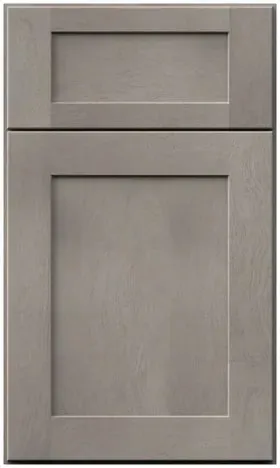



What lives underneath: robot vacuums, pets and bath mats under Galaxy Horizon bun feet
Reviewed September 2026 · Captivating Cabinets
Prices quoted in this article were read off the grid on the review date; the live price grid on this page governs.
Putting a vanity on feet is usually a style decision: it makes a cabinet look like a piece of furniture. What it also does, every day after the installer leaves, is create a strip of open floor under the bathroom's biggest object. That space gets visited by a robot vacuum, a cat, the edge of a bath mat, a rolling hair tie and a mop. The Galaxy Horizon bun feet, GH TBF (taper) and GH CBF (cove) at $42.90 each, are small parts with a daily consequence, so this page is about the gap they make and what to plan for before choosing them.
The gap, and the number nobody publishes
Bun feet fit under a vanity platform, the plinth a cabinet stands on, and lift it off the floor. The height of that lift decides almost everything on this page, and it is the one figure the listing does not give. Fabuwood does not publish a height for either foot on these product pages, and we are not going to estimate it. If the gap matters to you, and after reading this it may, ask us for the foot height before you order and we will get it.
Two other things to confirm at the same time. The handles for these listings call them a toe base filler and a cabinet base filler, while the titles say bun feet for a platform; we check which part the code ships as. And the listing does not say whether the price is per foot or per set. A platform needs one at each corner, and a long one may want more, so confirm the count with the platform code before the order goes in.
Robot vacuums: the in-between height is the problem
A robot vacuum meeting a footed vanity has three possible outcomes. If the gap is well above the robot's tallest point, it drives under, cleans and comes out; that is the best case. If the gap is well below the robot, it bumps the platform edge and turns away, which is also fine. The bad case is the gap that is only just too low. The robot starts under, its bumper clears but its top does not, and it wedges itself. Many robots have a raised sensor turret on top, so the tallest point is higher than the body.
So the check is simple, and worth doing before the feet are chosen. Measure your robot at its highest point, turret included. Ask us for the foot height and add the floor finish you will have. If the two numbers are close, either set a no-go zone in the robot's app for that stretch of floor, or plan to use a different robot in future. If there is plenty of clearance, the footed vanity is a place the robot will clean better than you would.
| What lives there | What to check | What to plan |
|---|---|---|
| Robot vacuum | Robot height at its tallest point against the gap | Clear it comfortably or block it with a no-go zone |
| Cat or small dog | Whether the gap is big enough to hide in | Decide if that is a problem before the feet go on |
| Bath mat | Whether the mat edge will tuck under the platform | Place the mat in front of the feet, not between them |
| Floor register | Whether a heat or air register sits under the vanity footprint | Talk to the HVAC installer early; feet leave it open, a toe kick closes it |
| Mop and stick vacuum | Whether the head fits under the platform | Measure the head; a flat mop usually fits where a vacuum does not |
| Lost small things | Hair ties, caps, cotton buds | A monthly sweep with a flat tool |
Pets, and the space they will claim
A dark gap under a cabinet is an invitation to a cat. That can be charming or a nuisance, depending on whether you want to find her there at 6 a.m. Small dogs push toys under it and then ask for them back. Pet hair drifts into any sheltered strip of floor, and the space under a vanity is the most sheltered strip in a bathroom.
None of this argues against feet. It argues for deciding in advance. If you would rather the space stayed empty, a platform on a toe kick closes it; the toe kick page lists GH TK8 at $55.90 for an 8-foot run. If you are happy with the gap, the only real work is a regular sweep, which is the next section.
Bath mats and floor vents

A bath mat is the small daily annoyance people do not foresee. Laid in front of a footed vanity, its edge tends to creep under the platform, catch on a foot and ruck up. The fix is placement: put the mat far enough forward that it stays clear of the feet, or choose a thin, flat mat that slides under cleanly.
Floor registers are the more serious one. In many bathrooms the heating or cooling register sits in the floor near the vanity wall. A vanity on a toe kick needs the register moved or ducted into the kick. A footed vanity leaves the floor open, so a register under it still breathes, but it blows under a cabinet rather than into the room. Either way, it is a question for whoever installs the ductwork, and it is cheaper to settle before the floor is laid.
Cleaning under it without scuffing the feet
A footed vanity is easier to clean under than a toe-kick vanity is to clean around, because there is no crevice where the kick meets the floor. What it adds is four small objects at mop height that every tool will eventually hit.
On a paint, a knock at the foot shows as a chip of lighter primer. On this finish it shows differently: Horizon is a stain, so a scuff through the topcoat can reveal paler wood at the edge of the turning. Fabuwood makes no spray cans for stained finishes. The repair is the touch-up kit for this finish, TOUCH UP KIT at $62.40, which carries a fill stick for a dent, a marker to recolour, and a scraper to level the fill. Build the colour in light passes and let each dry, and a scuffed foot disappears at normal viewing distance.
The best prevention is on the other side. Robot vacuums with a soft bumper are kinder to furniture feet than ones with a hard shell, and a mop with a rubber-edged head does less damage than a bare plastic one. Our care guide covers the cleaning products that are safe on the finish itself: mild cleaner on a cloth, never sprayed directly onto the wood.
When to settle all this
Almost everything on this page is cheap to decide early and awkward to change late. The floor register has to be placed before the subfloor is finished. The floor finish under the vanity, whether it runs right to the wall or stops at the platform, has to be decided before the tiler starts, and on a footed vanity it should run through, because the floor beneath is on show. The robot vacuum question needs the foot height, which needs a question to us. And the pet question needs nothing more than an honest conversation at home.
Put those four on the list at the design stage and the feet become a pleasure rather than a daily negotiation.
Taper or cove, seen from the floor
Most advice on choosing between the two profiles is about style, and it is covered well elsewhere. Seen from the floor, the difference is shape. A taper narrows towards the floor, so less of the foot sits at the level where a vacuum or mop head travels. A cove foot keeps more of its width low down, with a curved profile that reads as more traditional. If a robot or a mop will be working around the feet every day, the taper presents the smaller target at floor level; if the look is the priority, pick the profile you prefer and plan around it.
Both are listed at the same price on the bun feet page, and the platforms they go under are on the side panel page. If you are unsure how either looks under a particular vanity, the free 3D design will draw the vanity on both, and a designer replies within one business day.
Common questions
- Will a robot vacuum fit under a vanity with bun feet?
- It depends on the foot height and your robot. The listing does not publish the foot height, so ask us for it, then measure your robot at its tallest point, sensor turret included. If the two are close, set a no-go zone rather than risk the robot wedging.
- How tall are the bun feet for a vanity platform?
- The height is not published on these listings. Ask us before you order and we will confirm it for the exact part.
- Are the bun feet sold individually or as a set?
- The listing does not say. GH TBF and GH CBF are $42.90 each at review; confirm the count and pricing against your platform code before ordering.
- Is it harder to clean under a footed vanity?
- Usually easier, because there is no crevice where a toe kick meets the floor. The trade-off is four feet at mop height that tools will hit over time.
- How do I fix a scuffed stained cabinet foot?
- Use the finish's touch-up kit ($62.40): fill any dent with the stick, recolour with the marker in light passes, and level with the scraper. Fabuwood does not make spray cans for stained finishes.
- Can I have a footed vanity over a floor heating register?
- Often, since the feet leave the floor open, but the register then blows under the cabinet. Discuss it with your HVAC installer before the floor goes down.
Keep reading
The guides behind the numbers on this page.
- Parts of a Kitchen Cabinet: Every Component Named, From Toe Kick to Crown
Where platforms, kicks and feet sit in the anatomy of a cabinet.
- How to Clean and Care for Your Kitchen Cabinets
The cleaners and cloths that are safe on a stained finish.
- Fabuwood Bathroom Vanities: Sizes, Styles & Buying Guide
Vanity heights, and how a platform and feet change them.
- Kitchen Cabinet Molding Types and Where Each One Belongs
The toe kick and base trim that a footed vanity replaces.


