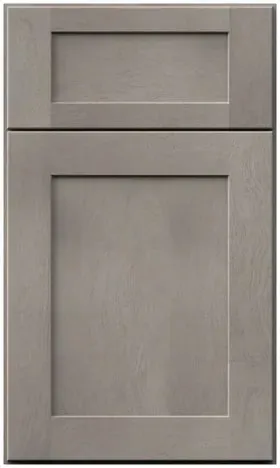



One order, one batch: why a Galaxy Horizon side panel should ship in the same box as its vanity
Reviewed September 2026 · Captivating Cabinets
Prices quoted in this article were read off the grid on the review date; the live price grid on this page governs.
Most vanity parts get chosen in one sitting. The side panel is the exception: it is the piece people leave off the first order because the cabinet already looks finished in the drawing, then add a month later when the vanity is standing on a bare floor and the gap at the bottom suddenly looks raw. On a painted finish that delay costs nothing but time. On the Galaxy Horizon grey-taupe it can cost a match, because this is a stain, and Fabuwood says in its own spec book that colour varies between stained parts. So this page is about timing more than about codes: what goes in the same box, and what to do if it cannot.
Why a stain makes the ordering sequence matter
A paint is a film. It sits on top of whatever is underneath and looks the same on every part that came out of the same formula. A stain works the other way round: it soaks into the surface, and what you see is the colour plus the wood beneath it. The Galaxy door is a solid wood frame around a ⅜″ centre panel that Fabuwood's spec book describes as "MDF/veneer" — MDF with a wood-veneer face — which is why the grain reads through on every part, flat or framed.
Wood does not take stain identically from board to board. Fabuwood's note on its stained finishes says so plainly: "Due to the nature of wood and the complex finishing processes used to generate stained finishes, there may be variations in color which are considered normal." The same warranty adds that replacement cabinets "may not match display samples and/or existing cabinets." Neither sentence is a defect clause you can claim against. They are a description of the material.
In practice, parts made and finished together sit closer to one another than parts made weeks apart. Nobody publishes a tolerance, and we will not invent one. What we can say is what the manufacturer says, and what follows from it: the platform or side panel is the widest unbroken stained surface on a vanity, it runs along the floor where the light from a window lands on it, and it is the part most likely to be ordered on its own. That combination is exactly where a difference would show first.
What belongs in the same shipment
The simplest rule is that every stained part meeting the floor goes on one order with the cabinet it finishes. Below is that list for a 36″ vanity, with displayed prices at review. None of these parts is expensive on its own, which is exactly why they get split off and bought later.
| Part | Code | Price | Why it rides with the vanity |
|---|---|---|---|
| Flat-faced panel | GH VPF V36 / GH SPF V36 | $253.50 | Largest stained plane at floor level |
| Shaker-faced panel | GH VPCF V36 / GH SPCF V36 | $422.50 | Frame and recessed centre, like the doors |
| Taper or cove bun foot | GH TBF / GH CBF | $42.90 each | Four small turned parts, easy to forget |
| Toe kick, 8 ft | GH TK8 | $55.90 | Only if the vanity sits on a kick instead |
| Toe kick cap | GH TKC | $7.80 | Tidies the kick where it dies into a panel |
| Edge banding | EDGE-BAND | $7.15 | For any edge cut on site |
| Touch-up kit | TOUCH UP KIT | $62.40 | Stick, marker and scraper for a stain |
The panel prices step with width: $217.75 flat and $386.75 shaker at V24, $234.00 and $406.25 at V30, $269.75 and $442.00 at V42, $289.25 and $455.00 at V48, $321.75 and $490.75 at V60, and $409.50 and $578.50 for the TP1821 tall-pantry size. The complete list sits on the vanity accessories page, and the cabinets they go under are on the vanities page.
The last two rows are the ones we would add to any Horizon order with site work in it. The touch-up kit is the only touch-up route this finish has — Fabuwood's spec book says spray cans are not made for stained finishes — and it is far easier to have it in a drawer before the installer nicks a corner than to order it after.
Which way the grain runs at the floor

On a door, the grain on the stiles runs up and down and the grain on the rails runs across; that change of direction at every corner is part of what makes a five-piece door look built rather than moulded. A platform turns the whole thing on its side. Its long face runs horizontally along the floor, so its grain runs with the length of the vanity, and it sits directly under a row of vertical door stiles.
That is not a problem. It is a difference worth knowing before you see it, because under a stain the eye picks up grain direction as a slight shift in tone. Light raking across horizontal grain reads a touch differently from the same light running down vertical grain. On a paint you would never notice; here, a small tonal step between the plinth and the doors above it is the finish behaving as intended.
The shaker-faced version softens this. Its frame and recessed centre repeat the door construction, so the plinth carries the same mix of directions the doors do. The flat face presents one broad plane of stain. Neither is wrong: a flat face under a shaker vanity reads as a plinth, a separate piece of furniture the cabinet stands on, and a shaker face reads as the cabinet continuing to the floor. Decide which of those two stories you want, then pick the face.
If the panel has to come later anyway
Sometimes it cannot be helped. The vanity was bought for a rental and the platform is a phase-two upgrade; a floor went in higher than planned and the first panel no longer suits; a moving van dented one. Here is how we handle a Horizon part ordered after the cabinet it has to sit beside.
- Tell us the date and order number of the original vanity, so the new part is quoted against the same finish and code, not a similar one.
- Photograph the installed vanity twice, once in daylight and once under the bathroom's own lights, with a white sheet of paper in the frame. Horizon reads cooler on an overcast day and warmer in sun, as homeowners who have lived with it report, and the paper tells us which light we are looking at.
- When the part arrives, stand it in the room for a day before fixing it. Judge it at the height you will see it from, not on the floor of a garage.
- Expect a difference within what Fabuwood calls normal. If it reads as a different colour rather than a different board, call us before it is installed, not after.
- Place a later part where the eye does not compare it straight across with a door. A platform under a vanity is well placed for this; a panel set flush beside a door edge is not.
None of this is a reason to avoid the panel. It is a reason to put it on the first order when you can, and to plan around the stain when you cannot. If you want to see how the platform, feet and vanity look together before anything is bought, a free 3D design will draw all of it with codes attached. A designer replies within a business day, and the full design and quote follow in 24 to 48 hours.
Sunlight on the plinth, and the colour-change clause
A vanity platform is at floor level, and in many bathrooms that is exactly where a low window drops its sunlight. Fabuwood's warranty lists colour change from "exposure to UV light, smoke, certain household cleaners, sunlight" as outside what it covers, and says finishes "may darken or lighten over time." That clause applies to every finish, painted or stained, but it is a second reason to keep one batch together: two parts that age side by side in the same light change together.
If a new part joins an old one years later, the gap is both batch and age. Our own general advice, not a published Fabuwood rule: if the vanity sits in a sunny room, a sheer blind on the low window is kinder to every stained surface in it than any amount of care after the fact.
Cutting a stained panel on site
A panel ripped down for a sloping floor or a short run exposes a raw edge, and on a stain that edge is a strip of pale core beside a coloured face. Band it with EDGE-BAND at $7.15 before the panel is fixed, not after, while you can still work flat on a bench.
Where the cut edge meets the floor it will also be the edge a mop hits every week. If the banding lifts or the corner chips, that is what the kit's marker and fill stick are for. Colour the damage in thin passes and let each dry; a stain touch-up blends by building up, not by one heavy coat. Our cabinet care guide covers the routine cleaning side of this, and the difference between panels, fillers and scribe is laid out in Cabinet End Panels, Scribe Molding & Fillers Explained.
Common questions
- Should I order the vanity side panel at the same time as the vanity?
- Yes, on a stained finish especially. Fabuwood says colour variation between stained parts is normal, and parts on one order are the closest you will get to a set. The platform is the widest stained surface on a vanity, so it is where a difference would show first.
- Do stained cabinet parts vary in colour?
- They can. Fabuwood's spec book notes that the nature of wood and of stain finishing means colour variation is considered normal, and its warranty says replacement parts may not match existing cabinets. It is the character of a stain, not a fault.
- Can I add a matching panel to my vanity later?
- You can, and we will quote it against your original order number. Photograph the vanity in daylight and under the room's lights, let the new part sit in the room for a day before fixing, and place it where it is not compared straight across with a door.
- How much is a Horizon vanity side panel?
- At review, flat faces run from $217.75 (V24) to $321.75 (V60) and shaker faces from $386.75 to $490.75; the TP1821 tall-pantry size is $409.50 flat or $578.50 shaker.
- Can I touch up a stained vanity panel with spray paint?
- No. Fabuwood does not make spray cans for stained finishes. The touch-up kit for this finish ($62.40) has a fill stick, a marker and a scraper, and a stain repair is built up in thin passes.
- Why does the plinth look a slightly different tone from the doors?
- Usually grain direction. A plinth's grain runs horizontally along the floor while door stiles run vertically, and light picks the two up differently under a stain. A shaker-faced panel repeats the door construction and narrows that effect.
Keep reading
The guides behind the numbers on this page.
- Kitchen Cabinet Samples: How to Order & Evaluate
How to judge a stained sample in more than one light before committing.
- Cabinet Skin Panels and Gables
The thinner finishing parts, and where each belongs on a run.
- Brown Kitchen Cabinets: Stains, Shades & Pairings
Why stains behave differently from paint, explained on the warmer end of the range.
- Fabuwood Bathroom Vanities: Sizes, Styles & Buying Guide
The vanity widths each panel code is cut to fit.
- How to Clean and Care for Your Kitchen Cabinets
Blot, do not wipe: the cleaning rules that keep a stained plinth even.


