

The bowl above it: how the basin and faucet decide whether a Galaxy Horizon U-shaped sink base has room
Reviewed September 2026 · Captivating Cabinets
Prices quoted in this article were read off the grid on the review date; the live price grid on this page governs.
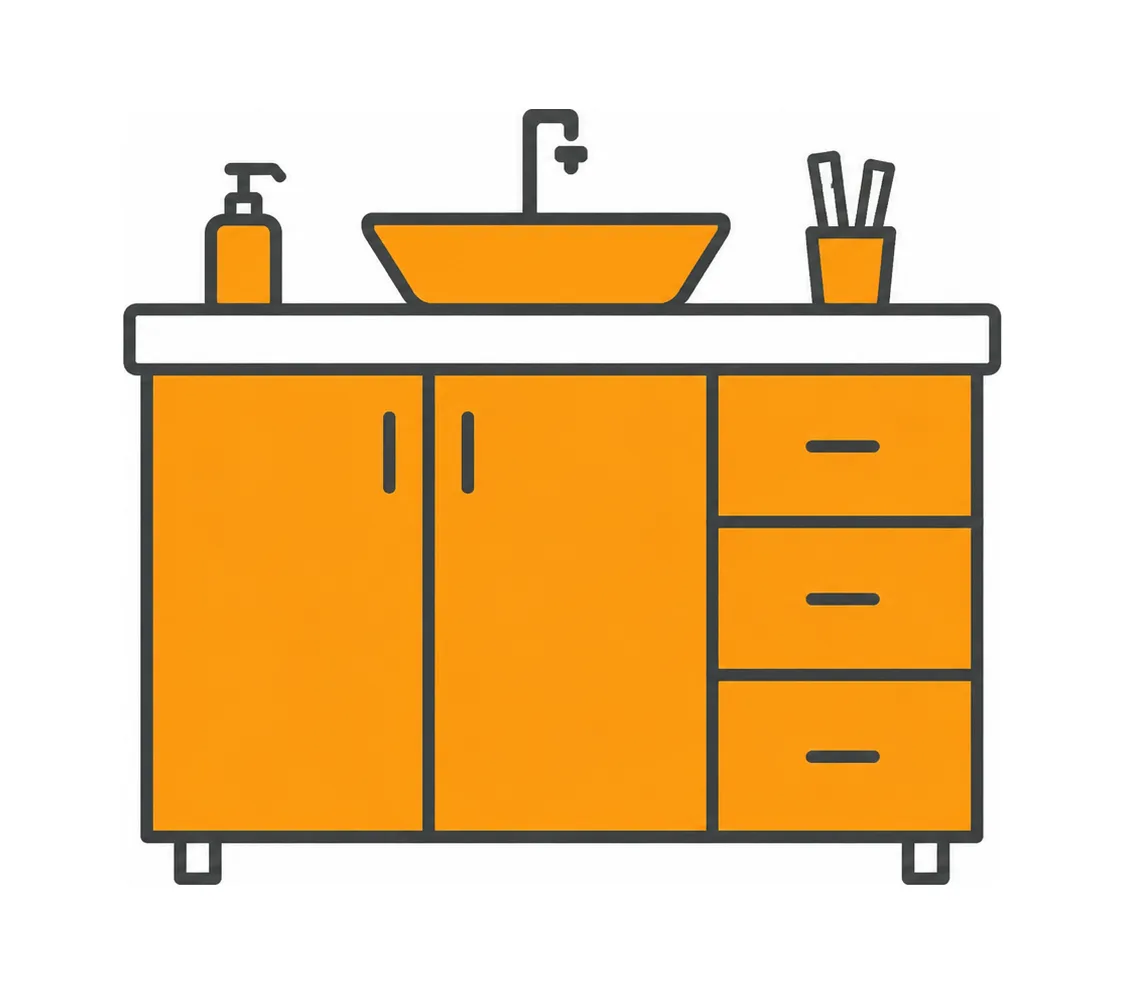
A notched pull-out is shaped around the drain, but the drain is not the only thing that comes down into a sink cabinet. The bowl itself hangs below the top; the faucet's valves and supply lines hang behind it; a pop-up rod and an overflow sit where you might have pictured a shelf. The Galaxy Horizon U-shaped sink base, GH UVTCPO-30 BLUM at $646.75, goes inside a 30-inch vanity sink base, and how much it can hold is decided less by the cabinet than by the basin and faucet you choose to put above it. So this page starts at the top of the vanity and works down.
The part, briefly, and one label to check
The organizer is a pull-out with a U-shaped cut that lets it slide forward either side of the drain. In this finish it pairs with the 30-inch sink base, GH VSB30-34 at $461.50, for $1,108.25 of cabinet before a top. The 30-inch sink-and-drawer combos, GH VSD30DL and VSD30DR at $757.25, already put drawers beside a narrower sink section and are a different answer to the same wish for organised storage.
The product title calls this a U-shaped sink base; the page address calls it a tip-out tray cabinet. Those describe different things. We confirm what the code ships as against your order before it goes in, and if you have plans that depend on one reading, tell us.
Everything that hangs below a vanity top
Before comparing basins it helps to list what can occupy the top of the cabinet interior. None of these are exotic; every bathroom has most of them.
- The bowl. An undermount or drop-in basin sits in the cabinet, so its depth comes straight out of the vertical space.
- The overflow. Most bathroom basins have one, and it adds a channel down the front or back of the bowl.
- The drain tailpiece and trap. These are what the U-cut is built around, running down and back to the wall.
- The pop-up linkage. A traditional pop-up drain has a rod that runs back from the tailpiece to the faucet; push-button drains do not.
- The faucet valves and supply lines. A widespread faucet has two valve bodies under the top, one each side of the bowl, plus a mixing line between them.
- The shut-off valves, on the wall at the back of the cabinet.
The organizer has to fit under all of the first five and in front of the sixth. The notch handles the trap. Everything else is up to you.
Four kinds of basin, and what each leaves for the pull-out
| Basin type | What sits below the top | Effect on the notched pull-out |
|---|---|---|
| Undermount in a stone or quartz top | The full bowl depth, plus overflow and tailpiece | Usually the tightest fit; bowl depth decides the upper clearance |
| Drop-in (self-rimming) | Most of the bowl, rim resting on the top | Similar to undermount; the rim adds nothing below |
| Vessel on the top | Only the drain tailpiece, and no overflow on many models | The most room; the pull-out sees a tailpiece and little else |
| Integrated top-and-bowl | A moulded bowl, depth varies by product | Depends entirely on the product; ask for its section drawing |
We are not publishing a clearance figure for the organizer because Fabuwood does not publish one on this listing, and bowl depths vary widely between products. The way to be sure is simple: once you have picked the basin, send us its spec sheet, and we will check it against the organizer's drawing before anything is ordered.
The faucet is the part people forget

Faucets change the picture as much as basins do. A single-hole faucet puts one body and two supply lines at the back centre, in the same zone as the drain. A centreset (4-inch) faucet is similar. A widespread faucet, the 8-inch style with separate handles, puts a valve body under each handle, left and right of the bowl, and a hose running between them. Those valves hang down precisely where the arms of a U-shaped organizer run.
A wall-mounted faucet removes the question altogether. Its valves live in the wall, and a vessel sink with a wall faucet leaves the most unobstructed space under a vanity top of any combination. It also needs the plumbing to be planned into the wall, which is a decision for the design stage and for the plumber, not for the week the cabinet arrives.
None of this means a widespread faucet cannot live with the organizer. It means the faucet's spec sheet should go to your designer alongside the basin's, so both are checked against the unit at the same time.
Pick the top and basin first, then the organizer
Most people choose a vanity in the order they see it: cabinet, then colour, then top, then taps. For this part the order should run the other way. Choose the top material and the basin, then the faucet, and only then confirm the organizer, because each of the first three changes how much room the last one has.
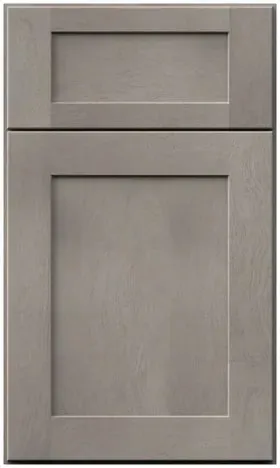
On this grey-taupe stain, the top is also the biggest colour decision after the cabinet. Fabuwood's own photographs pair Horizon with marble and with black countertops; a white marble-look quartz with an undermount basin is the conventional route, and a black top is the more graphic one. Either suits the finish. Just remember that an undermount bowl in a stone top is the tightest of the four basin types for the organizer, so it is the case most worth checking.
If you would rather have all of this worked out for you, the free 3D design will draw the vanity with the top, basin and organizer together; send the basin and faucet you like and a designer will check them.
Adding it under a basin that is already installed
Sometimes the top, basin and faucet already exist and the organizer is being added afterwards to a 30-inch sink base in this finish. The order of choice is then fixed for you, which makes the check simpler rather than harder: everything that hangs down is already there to be measured.
Empty the cabinet, and measure from the underside of the bowl, or the lowest point of the faucet valves if they hang lower, down to the cabinet floor. Note where the trap runs back to the wall, and how far the shut-off valves stand out from it. Photograph the inside from the front with a tape measure in shot, and send those numbers to us with the cabinet code. That is enough to confirm whether the organizer will slide past everything, and it takes ten minutes with the doors open.
If it will not fit, the answer is rarely a new basin. A plain shelf, a pair of small bins, or a slimmer caddy either side of the trap is usually the better fix in a finished bathroom.
Why fewer things under the top is also safer
There is a second benefit to a simpler arrangement under the basin. Every joint under a vanity is a place a slow leak can start, and a pull-out full of bottles pressed against a supply line is a good way to loosen one over time. A vessel or push-button drain with fewer parts leaves a cleaner space that is easier to look into and wipe down.
The cabinet floor under the organizer is veneered plywood with a natural finished interior, not the exterior stain, and it should be kept dry like any cabinet interior. A small leak mat under the unit is cheap insurance. For the outside, the rule that suits this stain is Fabuwood's own: blot splashes on the doors rather than wiping them, and keep cleaner off the wood. The vanity accessories page lists the organizer with the rest of the parts for this finish, and the sink bases are on the vanities page.
Common questions
- Which bathroom sink leaves the most storage under the vanity?
- A vessel sink, because the bowl sits on top of the counter and only the drain tailpiece comes through. Paired with a wall-mounted faucet it leaves the most open space of any combination.
- Does an undermount sink take up cabinet space?
- Yes. The whole bowl hangs below the top, so its depth comes out of the cabinet's vertical space. It is usually the tightest fit for an under-sink organizer, so it is the case to check against the organizer drawing.
- Can a widespread faucet work with a U-shaped vanity organizer?
- Often, but check it. A widespread faucet has a valve body under each handle, left and right of the bowl, which is where the organizer's arms run. Send the faucet spec sheet to your designer with the basin's.
- What size cabinet does the U-shaped sink base organizer fit?
- It is listed for a 30-inch vanity sink base. In this finish that is GH VSB30-34 at $461.50, making $1,108.25 with the organizer at review.
- Should I choose the vanity top before the cabinet accessories?
- For an under-sink organizer, yes. Choose the top and basin, then the faucet, then confirm the organizer, because each of those changes the space it has.
- Is the UVTCPO-30 a tip-out tray or a U-shaped pull-out?
- The title says U-shaped sink base and the page address says tip-out tray. We confirm what ships against your order before it goes in.
Keep reading
The guides behind the numbers on this page.
- Fabuwood Bathroom Vanities: Sizes, Styles & Buying Guide
Sink base widths and depths, and how tops sit on them.
- How Long Do Kitchen Cabinets Last?
Why the sink cabinet is usually the first box to fail, and how to avoid it.
- Gray Kitchen Cabinets: Finding the Right Shade
Warm and cool greys, and the tops that sit well on each.
- Types of Base Cabinets: Sizes & Standard Dimensions
How sink bases differ from standard bases, in kitchen and bath.


