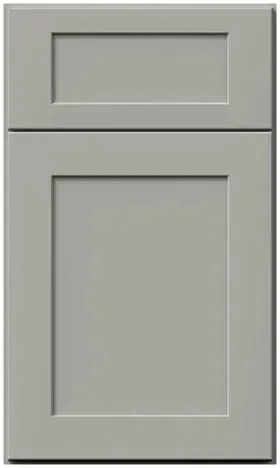


Glass over a shaker door: an honest verdict on the curved canopy, and what it asks of you weekly
Reviewed September 2026 · Captivating Cabinets
This is the one shell in the finish that is not, stylistically, from the same family as the door in front of it. A curved glass canopy is a contemporary object — a tension-fixed pane of toughened glass cantilevered off a body, with the visual language of an appliance rather than of joinery. Sitting above a five-piece shaker run with a recessed centre panel, it is either a deliberate, confident contrast or an accident. This page is about telling those apart before the order, and about the weekly obligation the glass brings with it.
The style verdict, and the three-room test that settles it

The honest starting position: a curved glass canopy and a traditional shaker kitchen do not naturally belong together, and most of the installations where it looks wrong are ones where somebody hoped it would read as a neutral. It does not read as a neutral. It is the most contemporary object you can put on this wall, and it announces itself.
That is not an argument against it. Contrast between a transitional door and a contemporary appliance is a legitimate and very current way to build a kitchen, and this finish is unusually good at it — a balanced mid-tone grey is a neutral that sits happily under a modern object without either fighting it or disappearing behind it. What the contrast needs is company. One contemporary element in an otherwise traditional room looks like a mistake; three look like a decision.
So the test: count the contemporary moves already made in the room. A slab or large-format backsplash rather than a subway tile. Flat, square hardware — bar pulls rather than knobs or cup handles. No crown moulding, or a simple square profile rather than a stepped one. A flat-panel or waterfall island. Uppers to the ceiling with no light rail. If two or more of those are already true, the glass canopy belongs. If none of them are — if there is crown, beaded detail, cup pulls and a traditional tile — then the chimney or designer shapes are the coherent choices and this one is the odd object in the room. The contemporary versus transitional guide is a fuller version of that count.
What is listed, and the premium at the top of the width ladder
Nine listings — three widths, each painted, Timber or Walnut, at a single price per width. Note where the ladder starts and ends: there is no 30″ version, and this is the only shell besides the plain box that reaches 48″.
| Width | Painted | Timber | Walnut | Displayed price |
|---|---|---|---|---|
| 36″ | GNK RHCA36 | GNK RHCA36 TIMBER | GNK RHCA36 WALNUT | $3,532.75 |
| 42″ | GNK RHCA42 | GNK RHCA42 TIMBER | GNK RHCA42 WALNUT | $3,789.50 |
| 48″ | GNK RHCA48 | GNK RHCA48 TIMBER | GNK RHCA48 WALNUT | $4,062.50 |
At 48″ the comparison is stark: $4,062.50 here against $2,596.75 for the plain shell in the same width, a difference of $1,465.75 on two hoods that take the same blower and move the same air. That is the number to be comfortable with, because at 48″ there is no third option — no other family goes that wide.
The wood-tone versions cost the same as the painted one, which produces the most interesting object in the list: a canopy that is part glass and part Walnut, over a mid-tone grey run. That combination does the warm-object job the parent hood page describes while still reading as contemporary, and it is the version we would specify if the kitchen has any wood in it at all.
The weekly obligation nobody mentions at the point of sale
Glass is the least forgiving surface in a kitchen and a hood canopy is the worst place to put it, because the material that lands on it is not dust. It is airborne cooking oil, condensing out of the rising plume onto the first cool surface it meets. On a painted wood canopy a fortnight of that is invisible. On glass it is a haze you see from across the room the moment the light is behind it, and the underside — the face directly over the burners — collects it fastest.
None of that is a reason not to buy it, provided it is a decision rather than a surprise. The regime is simple and short: a warm damp cloth with a little dish soap on the underside once a week, a proper glass cleaner on the outer face when it looks hazy, and a mild degreaser rather than more scrubbing when the film has gone tacky. What to avoid is equally short — no abrasive pads, no blades or scrapers, nothing solvent-based near the joint between the glass and the body, and no spraying cleaner directly at a light or a control panel. Spray the cloth instead. The care guide has the same rules for the painted parts.
One consolation: the glass makes maintenance obvious rather than hiding it, and a hood you can see is dirty is a hood whose filters get cleaned. The single biggest cause of a good hood going weak is a clogged filter, which is a $71.50 problem that people ignore for years on shells where nothing shows.
The light you cook by, and four things to confirm before ordering
A hood is the primary task light over the range. It is on every time anybody cooks, it is the light you judge food by, and on a curved glass canopy it behaves differently from a flat one — the glass reflects and spreads it rather than letting it fall straight down, which some people find softer and others find glary when they are standing at the burners looking up into it.
Our listings publish a width, a title and a price. They do not publish the lamp type, the number of lamps, whether the lighting dims, or whether the lamps are user-replaceable, and we are not going to guess at any of those on a page you might order from. Ask for four things on the manufacturer’s spec sheet before the order goes in: what the lamps are, how many there are, whether there is more than one brightness level, and how a lamp is changed. The last one is the question people wish they had asked, because a hood whose light has failed and cannot be relamped is a hood you replace.
Whatever the answer, do not let the hood be the only light on that wall. Under-cabinet lighting on the flanking wall cabinets costs very little and keeps the counter either side of the range usable when the hood light is off — and on a mid-tone grey run, the colour temperature of those strips changes how the whole wall reads. Match them to the ceiling lights rather than buying whatever was in the box; the matching guide covers why that matters more than people expect.
A transparent element in the middle of a painted wall
There is one compositional consequence worth understanding. Every other shell here is an opaque object in the cabinet colour, so it belongs to the run visually even when its shape differs. A glass canopy is partly transparent, which means the wall behind it — the tile, the grout, the outlet, whatever is up there — is part of the hood. That changes the backsplash from a background into a component.
Practically: carry the tile all the way to the ceiling behind this shell rather than stopping it at the cabinet line, because the stopping point will be visible through the glass. Keep the area behind and above the canopy clear of switches and outlets if the electrician has any choice, and if one has to be there, get it low and to one side. And choose a quiet tile — this is the one wall where a busy pattern will be read twice, once directly and once through glass.
The grey helps here more than it does anywhere else in the hood range. A balanced mid-tone frames a transparent element without competing with it, which is why this combination photographs well and why a very dark or very white kitchen makes the same canopy look either heavy or invisible.
Common questions
- Does a glass range hood work with shaker cabinets?
- It works as a deliberate contrast, not as a neutral. Count the contemporary moves already in the room — slab backsplash, bar pulls, no crown, flat-panel island, uppers to the ceiling. Two or more and the canopy belongs. None and the chimney or designer shapes are the coherent choices.
- How often do you have to clean a glass range hood?
- The underside wants a warm damp cloth with a little dish soap weekly, because that face collects condensing cooking oil rather than dust. The outer glass gets a glass cleaner whenever it hazes. No abrasives, no scrapers, and spray the cloth rather than the hood.
- What does a curved glass hood cost?
- The shells are $3,532.75 at 36″, $3,789.50 at 42″ and $4,062.50 at 48″, before a blower and a duct cover. At 48″ that is $1,465.75 more than the plain shell in the same width, and the two move identical air.
- Is there a 30 inch curved glass range hood?
- Not in this finish — this family starts at 36″. For a 30″ canopy the chimney, designer and slim shapes all list one. This family does, however, reach 48″, which only the plain wall-mount shell also does.
- What lighting does the hood come with?
- Our listing publishes a width, a title and a price, not the lamp type or count, so ask for the manufacturer’s spec sheet before ordering. The four things worth confirming are what the lamps are, how many, whether there is more than one brightness level, and how a lamp is replaced.
- Do the Timber and Walnut versions cost extra?
- No — all three tones are listed at the same displayed price in each width. A glass-and-Walnut canopy over a mid-tone grey run is the version we would specify if the kitchen has any wood in it, because it reads contemporary and still warms the wall.
Keep reading
The guides behind the numbers on this page.
- Contemporary vs Transitional Kitchen Cabinets
The fuller version of the three-room test on this page.
- How to Clean and Care for Kitchen Cabinets
What is safe on the painted parts of a hood that sits in the plume.
- Glass Cabinet Doors Buying Guide
How glass behaves elsewhere in a kitchen, and what it asks for.
- How to Match Kitchen Cabinets, Countertops, Backsplash and Flooring
The backsplash becomes part of the hood when you can see through it.
- Gray Kitchen Cabinets: Finding the Right Shade
Why a balanced mid-tone frames a contemporary object so well.
- Kitchen Cabinet Styles: Popular Designs and Color Trends for 2026
Where mixing a modern appliance with a traditional door currently sits.
- Kitchen Cabinet Samples: How to Order and Evaluate Before Buying
Judging the contrast on the actual wall in the actual light.


