

The display band: choosing the height of a Galaxy Nickel glass front upper, and how many a run can carry
Reviewed September 2026 · Captivating Cabinets
Every other upper cabinet in this catalogue obeys one rule: buy the tallest box the wall will take, because height is cheap and the top shelf is free storage nobody has to look at. A glass front upper breaks that rule, and it breaks it hard. The top bay of a 42-inch glass box sits eight feet off the floor with a light on it, and it is the one shelf in the kitchen you cannot fill with the spare roasting tin. Everything in this cabinet is on show, which means the question stops being how much can I store up there and becomes how much of this box will anyone ever look at. That band is narrower than people expect, and it decides the height.
The band your eye actually reaches, measured off the floor

Uppers start at 54 inches off the floor — a 36-inch counter plus the 18-inch backsplash gap. A standing adult’s eye is somewhere between 58 and 68 inches. So the comfortable looking band, the zone where you see into a cabinet rather than up at it, runs from about 54 inches to about 72: roughly the bottom eighteen inches of the box and a little more.
Run the arithmetic on the four heights and the picture is stark. A 30-inch box tops out at 84 inches and puts essentially all of itself inside the band. A 36-inch box tops at 90 and keeps two of its three bays there. A 42-inch box tops at 96, and its top bay is a full foot above the line where anyone is looking — visible from across the room as a shape, never inspected, and permanently lit if you have paid for a strip in there.
None of which makes the tall box wrong. It makes it a different purchase: bought because the run beside it is 42 inches and the glass has to match, or because you want a tall lit lantern as an object. Not bought because it holds more, since the part that holds more is the part nobody sees.
Five widths, four heights, and where the money goes
The grid is five widths — 15, 18, 24, 30 and 36 inches — against four heights: 30, 36, 39 and 42. Twenty combinations, all of them stocked in this finish, priced as displayed on the review date.
| Width | 30″ high | 36″ high | 39″ high | 42″ high |
|---|---|---|---|---|
| 15″ — GDW15xx | $97.50 | $117.00 | $126.75 | $139.75 |
| 18″ — GDW18xx | $117.00 | $139.75 | $146.25 | $162.50 |
| 24″ — GDW24xx | $165.75 | $201.50 | $107.25 ⚠ | $234.00 |
| 30″ — GDW30xx | $201.50 | $234.00 | $126.75 ⚠ | $279.50 |
| 36″ — GDW36xx | $234.00 | $279.50 | $146.25 ⚠ | $321.75 |
Read the 39-inch column and then read it again. Three of those five figures sit below the 36-inch box directly to their left, and the same inversion is there in the list prices, so it is not a discount artefact. GNK GDW2439 at $107.25 against GDW2436 at $201.50 is the clearest case. We are flagging it rather than explaining it, because we would rather tell you a number looks wrong than have you find out on an invoice. Treat the three marked cells as figures to confirm with us before you plan around them; everything else in the grid steps the way you would expect.
What the rest of the table says is that width is the expensive dimension here and height the cheap one — the opposite of the pattern on the solid wall cabinet grid. From 15 to 36 inches wide at 36 high is $162.50; from 30 to 42 inches tall at 36 wide is $87.75. The extra width buys a shelf you can compose across. The extra height buys a bay above the sightline.
The glass box is never the odd height in the run
The mistake we correct most often on drawings: somebody picks a 36-inch glass unit because they like the proportion, drops it into a run of 42-inch solid uppers, and ends up with a six-inch step in the top line of the kitchen with a window in it. The eye goes straight there, and not kindly.
The rule has no exceptions worth the trouble: a glass front box matches the height of the boxes beside it, and the width is whatever the layout gives you. If the run is 30-inch uppers, the glass unit is 30. If the run is 42s because you went to the ceiling, the glass unit is 42 and you accept the dead top bay — or you leave the glass off that wall and put it where the run is shorter: over a bar, above a window, on the return into a dining space.
Depth has the same rule in the other axis, which is why nothing on this page belongs over a refrigerator: those boxes are 24 inches deep to sit flush with the appliance, and there is no glass version. The wall and tall sizes guide sets out which heights and depths exist together, and the double door wall page shows the solid boxes these have to line up with. The one unit that deliberately ignores the run height — a five-foot two-door column — is on the double door glass page.
One, two, or the number that turns a kitchen into a shop window
Count, not placement, is what goes wrong. A single glass unit reads as a deliberate moment. Two read as a pair if they are doing the same job in the same plane — either side of a window, or bookending a cooking wall — and as an accident if one is over the sink and the other is around a corner in a different light. Three is the ceiling for most kitchens. Four or more and the wall stops being cabinetry and starts being a display case.
- Either side of a sink window, at whatever height the run is. Two 15-inch or 18-inch units, GNK GDW1530 at $97.50 or GDW1830 at $117.00 each — the cheapest way to the effect, and the pair has an obvious reason to exist.
- One feature unit where the kitchen meets another room. A 24 or 30-inch box at the end of the run, GNK GDW2436 at $201.50 or GDW3036 at $234.00, so the last cabinet the dining side sees is the one with something in it.
- Above a coffee station or a bar, where the contents are already a matched set. A 30-inch box is the usual width, because that is the width of the counter zone under it.
- Across the diagonal at an inside corner — its own cabinet and its own argument, on the diagonal corner glass page.
- What we would not do: glass at both ends of a long run purely for symmetry, glass beside the range where oil and steam land on it, and glass on a wall you walk past with a hip rather than stand and look at.
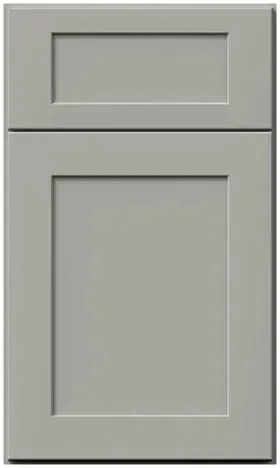
One thing belongs to this finish specifically. Cutting a clear opening into a mid-tone field is a stronger move than cutting one into a white field, because the value gap between a painted grey door and a cabinet interior is wider — for you if the box is lit and composed, against you if it is neither. The glass doors type page takes that argument the whole way.
What goes on the order beside the box
Three lines are not in the cabinet price and belong on the same order.
- Light, if the glass is clear. A puck set sized to the box — GNK LED W15 at $91.00, LED W24 at $113.75, LED W30 at $130.00, LED W36 at $146.25 — or a 48-inch interior strip, GNK LED CAB INT 48" STRIP at $221.00, plus the $204.75 driver. The wireless switch at $221.00 puts the display on its own circuit.
- A spare shelf or two, so the bays can be set to the objects rather than the objects to the bays. GNK AS-W24 is $37.05, AS-W30 is $45.50 and AS-W36 is $60.45, with clips at a few cents each. Cheapest improvement available to a glass cabinet, and almost nobody orders it.
- The glass and mullion specification in writing, because the titles do not carry it — the glass buying guide explains what you are choosing between.
Everything in this finish, glass and solid, is listed together on the Galaxy Nickel collection; if you are pricing a whole kitchen rather than one box, send us the wall, and trade buyers working through several kitchens should start at Captivating Pro.
Common questions
- What heights do glass front wall cabinets come in?
- 30″, 36″, 39″ and 42″, across widths of 15″, 18″, 24″, 30″ and 36″. Hung at the normal 54″ start, a 30″ box tops out at 84″, a 36″ at 90″ and a 42″ at 96″ — which puts the top bay of the tallest box about a foot above where anyone actually looks.
- Should a glass cabinet be the same height as the cabinets next to it?
- Yes, with no exception worth the trouble. A glass box at a different height puts a step in the top line of the run with a window in it, and the eye finds it immediately. Match the height to the neighbours and let the layout decide the width.
- How many glass front cabinets should a kitchen have?
- One reads as deliberate, two read as a pair when they are doing the same job in the same plane, three is the practical ceiling. Past that the wall becomes a display case. The limit is not taste, it is maintenance: each one is a cabinet you have agreed to keep shop-tidy for fifteen years.
- What does a glass door wall cabinet cost?
- From $97.50 for a 15″ × 30″ to $321.75 for a 36″ × 42″ on our displayed figures at review, with a 24″ × 36″ at $201.50 and a 30″ × 36″ at $234.00. Width costs more than height here: 15″ to 36″ wide is $162.50, while 30″ to 42″ tall is $87.75.
- Why do some 39-inch glass cabinets cost less than the 36-inch ones?
- We do not know, and we would rather say so. GNK GDW2439 shows at $107.25 against $201.50 for GDW2436, and the same inversion appears at 30″ and 36″ wide and in the list prices too. It looks like a pricing error rather than a specification difference. Confirm those three figures with us before planning around them.
- Is a glass cabinet a good idea in a gray kitchen?
- It is a stronger move than in a white one, for better and worse. The value gap between a mid-tone painted door and a cabinet interior is wide, so a lit, composed box becomes the brightest thing on the wall and an unlit jumbled one becomes a dark rectangle. Light it, or choose a glass that reads as a panel.
Keep reading
The guides behind the numbers on this page.
- Glass Cabinet Doors: Buying Guide
Glass types and mullion patterns — the specification the titles leave out.
- Wall and Tall Cabinets: Sizes and Buying Guide
Which heights and depths exist together, so the glass box lines up.
- Gray Kitchen Cabinets: Finding the Right Shade
Why an opening cut into a mid-tone field behaves differently.
- Important Kitchen Dimensions Before Buying Cabinets
Counter height, backsplash gap and where 54 inches comes from.
- 27 Kitchen Cabinet Ideas
Finished rooms with one glass cabinet, and rooms with four too many.
- How to Read Cabinet SKU Codes
Reading GDW2436 as width then height before you order the wrong one.
- How to Clean and Care for Kitchen Cabinets
Glass shows fingerprints, a mid-tone shows dust. Both take thirty seconds.


