

Two deep drawers, three widths: sizing the pot drawer under your cooktop
Reviewed September 2026 · Captivating Cabinets
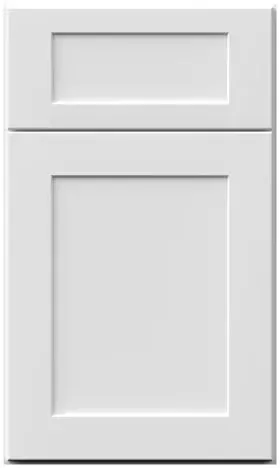
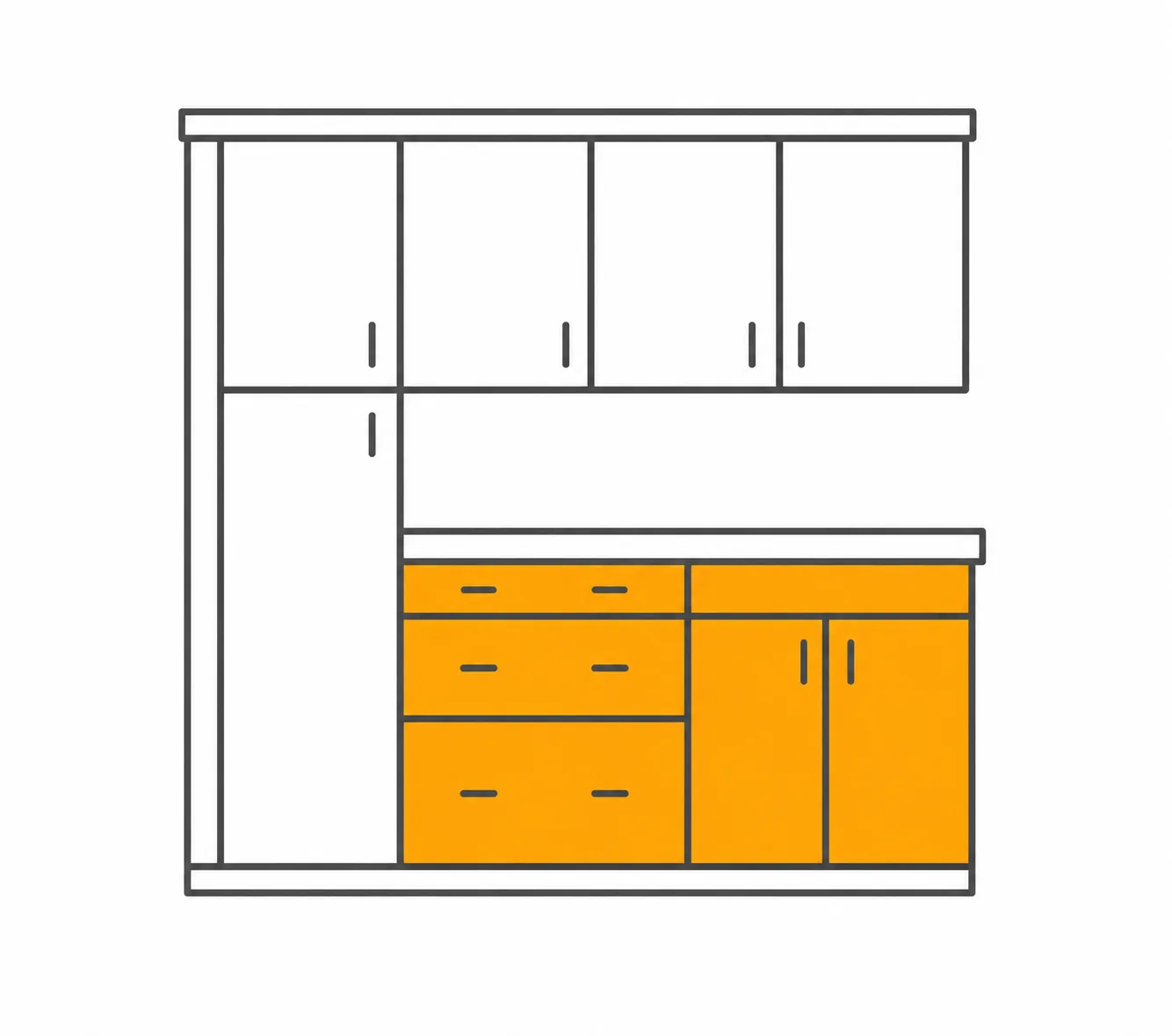
A two-drawer bank is the cabinet you put under a cooktop, and the only one in this catalog that gives you a drawer tall enough for a stockpot with the lid on. A Fabuwood Galaxy Frost 2 drawer base cabinet comes in exactly three widths — 24″, 30″ and 36″ — and that short list is not an oversight. It is the whole logic of the configuration.
Why the narrow widths do not exist
The catalog carries three SKUs in this shape: GF DB24-2, GF DB30-2 and GF DB36-2. No 12″, no 15″, no 18″ version, and no dealer can order you one.
The box is 34½″ tall, of which roughly 30″ is drawer face once the toe kick is taken out. Split that between two fronts and each lands near 15″ tall — the tallest drawer face Fabuwood puts on a base. Put a face that tall on a 12″-wide box and you have built a bucket: deep, narrow, and awkward to reach into from above, which is the only way you reach into a drawer.
So the rule that falls out across the whole drawer-base family is an inverse one. Drawer count goes up as width comes down — the four-drawer units stop at 21″, the two-drawer units start at 24″, and the three-drawer units cover the whole 12″-to-36″ range in between. Nobody publishes that, and it is the fastest way to sanity-check a cabinet list someone else drew for you.
- GF DB24-2 — 24″ wide, currently around $725. The default under a 30″ slide-in range flanked by narrower cabinets.
- GF DB30-2 — 30″ wide, around $835. The one we spec most: it sits square under a 30″ cooktop.
- GF DB36-2 — 36″ wide, around $1,015. Worth it only if you own a wide pot set; otherwise the extra buys air.
Prices move, and the live table above this article is the authority. They are here because competitor pages for these SKUs publish a spec bullet list and no number at all.
What actually fits in a drawer that deep

Two measurements decide whether a pot goes in, and neither is printed on a spec sheet. The first is clear height inside the box: a 15″ front gives roughly ten to eleven inches of open space once the drawer bottom and the front overlay are accounted for. The second is interior width, about five inches under the nominal cabinet width on a framed cabinet — the face frame stiles and runner clearance eat the difference.
| Cabinet | Interior width, roughly | What it swallows |
|---|---|---|
| GF DB24-2 | About 19″ | A 12″ skillet with the handle turned, a 6- to 8-quart Dutch oven with the lid on, a nested set of mixing bowls |
| GF DB30-2 | About 25″ | Two 12″ skillets side by side, or a skillet plus an 8-quart stockpot standing upright |
| GF DB36-2 | About 31″ | A full pot set with the lids stored on edge behind them rather than stacked on top |
Front to back you have about 21″ of run in a standard 24″-deep box, and full-extension runners bring all of it clear of the face frame. Nothing in a drawer bank is ever behind anything else.
Lids are what ruins these drawers. Stacked flat on the pots they cost three of the ten inches you have. Stood on edge along the back of a 30″ or 36″ box they cost nothing — a real argument for the wider unit even when your pot count does not demand it.
Loaded weight is why the hardware line matters here

Every cabinet in this finish rides on Blum Tandem plus Blumotion full-extension concealed runners, with ⅝″ solid wood drawer boxes dovetailed at the corners. On a wall cabinet that spec is a nicety. Down here it is the product.
The bottom drawer of a pot cabinet is the heaviest moving part in a kitchen, opened and shut several times a day for twenty years. Side-mount epoxy glides — what a cheaper quote is usually hiding — sag under that load and eventually drop the front out of alignment with its neighbor. Undermount runners carry the weight from below and stay square.
Soft-close matters for a second reason nobody mentions: a drawer this heavy has momentum, and a hard shove bounces a full stockpot against the front from the inside. Damping absorbs that. Our notes on soft-close versus self-closing hardware explain the mechanical difference, and the dovetail joint guide covers why the corner joint is the first thing to check on a competing quote.
Where a Fabuwood Galaxy Frost 2 drawer base cabinet belongs
One per kitchen is usually right, under the cooktop or immediately beside the range. Past that, the other configurations do the job better and cost less.
Order three drawers instead when it is general storage
A shallow top drawer over two deeper ones is more useful in almost every position that is not under a cooktop, because you get a utensil drawer for free. It is also the only configuration that runs the full 12″-to-36″ width range, so it is what closes out an odd run. See the three-drawer lineup and pricing.
Order four drawers when the gap is under 24 inches
At 15″, 18″ and 21″ wide, four shallow drawers turn a leftover space into spice, wrap and utensil storage instead of a filler panel. Not a pot cabinet — the clear height is about half what you get here. The four-drawer page works through what fits.
Order a door base for anything tall or plumbed
Small appliances, tall boxes, the trash pull-out and anything sharing a wall with plumbing want an open bay behind a door. Door bases also cost roughly a third less per box. Compare the single-door and double-door options before you default to drawers everywhere.
Dividers that fit these widths
Cutlery and K-Cup inserts in this same paint are sized by the cabinet they drop into, and all three widths here are covered: GF KCUP-21/24 fits the 24″ box, GF CD-27/30 the 30″, and GF CD-33/36 the 36″. Worth knowing now, because a shallow divider tray in the top drawer of a pot cabinet is a common and quite bad idea — it turns your only deep drawer into a mediocre utensil drawer.
If you do want them, use them to separate lids from pots rather than to subdivide a whole drawer. Everything in stock is on the cabinet accessories page, and the pull-out organizer guide covers the alternatives that mount inside a door base instead.
How they ship, and the one thing to check on arrival
Galaxy is the fastest-shipping series Fabuwood makes — 7 days to 3 weeks against 3 to 5 weeks for the rest of the Allure line — and every unit arrives pre-assembled with the boxes fitted and the runners adjusted at the factory. That is genuinely useful here: aligning four drawer fronts across a narrow box is fussy work, and you are not doing it.
It also makes these the heaviest cartons in the shipment. A drawer bank has the same box as a door cabinet plus three or four dovetailed drawers and two runners per drawer, so the freight weight roughly doubles. Have somewhere to put them: a garage or a spare room, not a hallway.
Common questions
- What widths does the two-drawer configuration come in?
- Three: 24″, 30″ and 36″, as GF DB24-2, GF DB30-2 and GF DB36-2. All are 34½″ high and 24″ deep. There is no narrow version — below 24″ Fabuwood builds three- and four-drawer banks instead, because two 15″-tall fronts on a narrow box would be unusable.
- How deep are the drawers?
- Each front is roughly 15″ tall, which leaves about ten to eleven inches of clear height inside the box. Front to back you get about 21″, and the full-extension runners bring all of it clear of the face frame. Measure your tallest pot with its lid on before you commit.
- Is two drawers or three drawers better under a cooktop?
- Two, if you are storing pots. Three splits the same 30″ of drawer face into one shallow drawer and two mid-depth ones, which is better for general storage and worse for anything over about eight inches tall. Under a cooktop, height is the whole reason you picked a drawer bank.
- What do these cost compared with a door base of the same width?
- Expect roughly half again as much. A 24″ two-drawer unit runs around $725 against about $470 for a 24″ door base. You are paying for two dovetailed boxes and four undermount runners that a door cabinet does not have.
- Do the drawers pull all the way out?
- Yes. Blum Tandem plus Blumotion full-extension concealed runners are standard on every unit, not an upgrade, so the back of the drawer clears the face frame. That is the practical reason a drawer bank beats a shelf behind a door.
- Can I add dividers later?
- Yes — GF KCUP-21/24, GF CD-27/30 and GF CD-33/36 cover the 24″, 30″ and 36″ boxes respectively, in the same finish. They drop in without tools. Confirm the actual interior width of your drawer first; it runs about five inches under the nominal cabinet width.
Keep reading
The guides behind the numbers on this page.
- Types of Base Cabinets: Sizes and Standard Dimensions
Every base configuration in one place, drawer banks included.
- Fabuwood Cabinet Sizes and Specs: The Complete Dimension Guide
The full width and depth tables behind the SKU codes on this page.
- Fabuwood Cabinets Price List (2026)
Line-by-line pricing if you are building a box list yourself.
- Soft-Close vs Self-Closing Cabinet Drawers
What the damper actually does when a drawer is carrying 40 pounds.
- What Dovetail Drawers Tell You About Cabinet Quality
The corner joint to inspect before you accept a cheaper quote.
- Beam-Mounted Pull-Out Cabinet Accessories
The door-base alternative when a pot will not fit a drawer.
- Important Kitchen Dimensions Before Buying Cabinets
Take these six measurements before the cooktop cabinet is fixed.
- Pre-Assembled Kitchen Cabinets: A Dealer’s Buying Guide
Why factory-fitted runners are worth more on a drawer bank.


