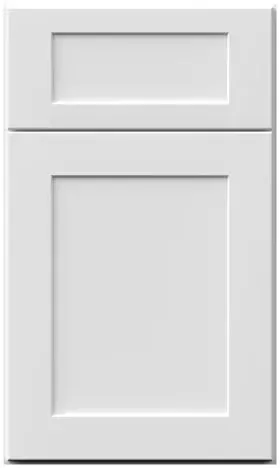
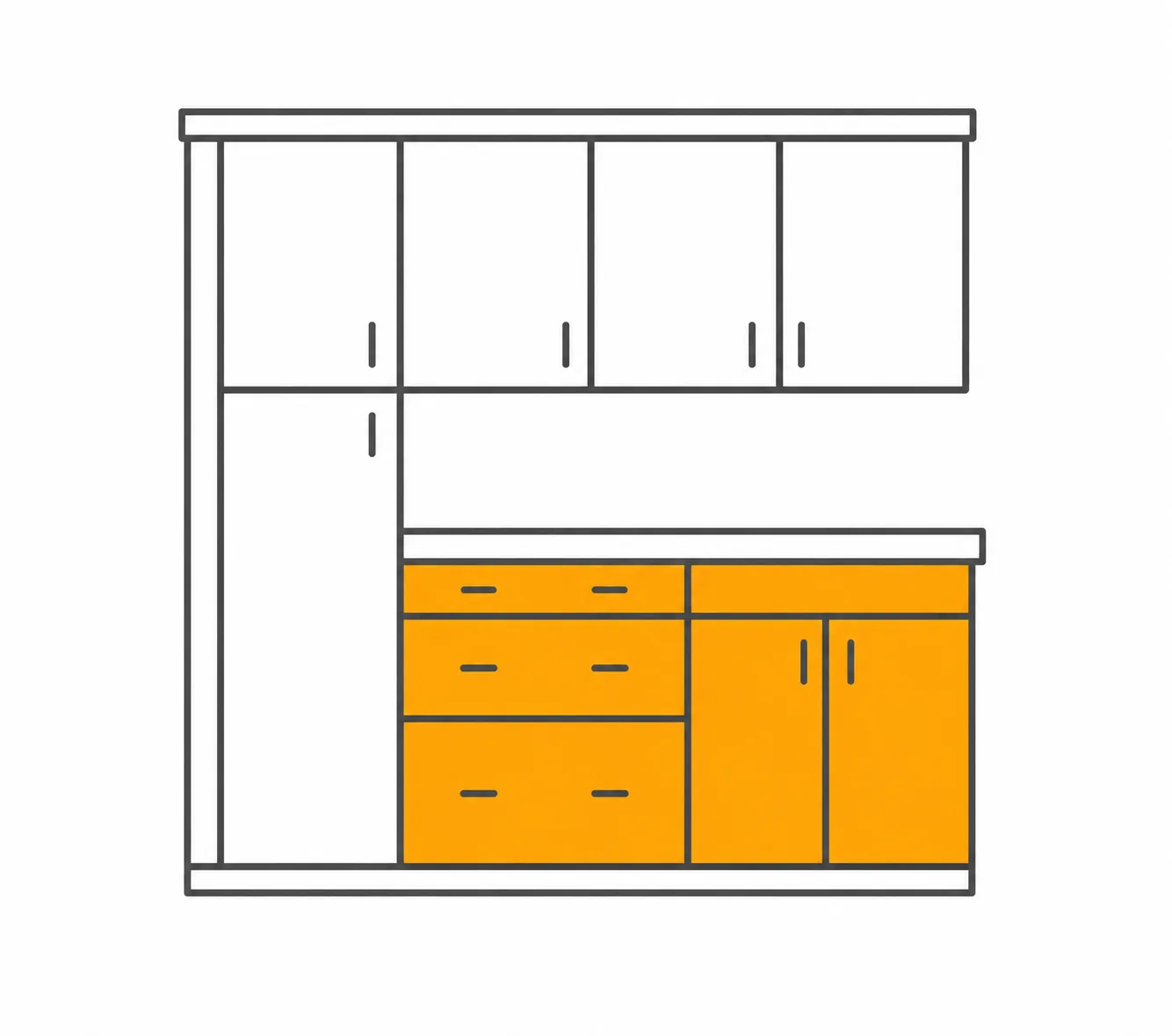


What you actually get from a Fabuwood Galaxy Frost corner base cabinet
Reviewed September 2026 · Captivating Cabinets
Every L-shaped kitchen has one 90° corner, and the cheapest way to close it is the blind box. A Fabuwood Galaxy Frost corner base cabinet in this catalog is always a blind unit — GF BLB36/39 through GF BLB48/51 — and the number that decides whether you are happy with it is not the price. It is how much of the interior disappears behind the cabinet standing next to it.
Why the trade calls it blind
Two runs of 24″-deep cabinets meeting at a right angle overlap in a 24″ × 24″ square. Something has to give up that square. In a blind unit, the box runs the full width but only part of the face carries a door; the rest of the front is a flat, unfinished panel that the perpendicular run butts into and covers. There is no door on that end. You cannot see it, hence blind.
The practical consequence: on a 42″ box, about 24″ of the far end is reachable only by opening the door, leaning in past the face frame and groping sideways in the dark. On paper you bought 42 inches of base cabinet. In daily use you have something closer to 30 inches, and a cave.
That is not a defect, it is the deal. This is the least expensive way to turn a corner in the whole catalog, it consumes no more wall than a standard base, and it holds an enormous amount of stuff you rarely need. The mistake is putting things you use every day in there.
The two numbers in BLB42/45 are the most useful thing on the label

Almost no distributor page explains this, and it is the single detail that rescues a run that does not add up. The first number is the width of the box. The second is the widest the box may be installed at, because the blind end is designed to be pulled away from the return wall. A BLB42/45 is a 42″ cabinet that can sit anywhere from tight in the corner to 3″ out into the run, with a filler covering the gap it leaves behind.
So the four units stocked in this white give you a continuous adjustment range rather than four fixed widths:
- GF BLB36/39 — 36″ box, installs 36″ to 39″
- GF BLB39/42 — 39″ box, installs 39″ to 42″
- GF BLB42/45 — 42″ box, installs 42″ to 45″
- GF BLB48/51 — 48″ box, installs 48″ to 51″
Use it deliberately. Cabinets step in 3″ and walls do not, so a run almost always ends with an awkward remainder. Pulling the blind box out by 1½″ or 2¾″ absorbs that remainder in the one place nobody looks, instead of leaving a fat filler at the end of the run where everybody does. If the SKU grammar is new to you, our cabinet SKU decoder walks through the rest of the type codes.
The filler is not optional and it is not decoration

Set the blind box tight against the return run and the door opens straight into the pull on the cabinet beside it. Add a bar pull and the collision gets worse, because the pull projects an inch and a half beyond the door face before the door has even started to swing. Add a drawer bank on the return and now the drawer front cannot clear either.
The fix is a strip of matching material between the two — GF BF3, the 3″ base filler, ripped down on site to whatever the geometry needs. Budget one at every inside corner as a matter of course. It is a cheap part and it is the reason the finished kitchen works; ordering the run without one is the fastest way to have an installer stop work and call you.
We go through the whole family of trim parts — fillers, scribe, finished end panels and where each belongs — in the end panels, scribe and fillers guide.
Hardware that buys the dead third back
A blind-base pull-out is a hinged carriage: the front tray rides out on runners, then the rear tray swings forward out of the blind zone and into the opening. Fabuwood builds them to match these boxes and hands them left and right — the site carries them under the same GF prefix, in the form GF BPO-BLB42/45-R, so the pull-out is matched to the exact cabinet it goes into.
Two honest caveats. It costs real money, and once you add it to a $700 box you are inside spitting distance of a rotating corner unit that never had a dead zone in the first place. And it steals a couple of inches of clear width for the mechanism, so a stockpot that just fits the empty cabinet may not fit the fitted one. Measure the pot.
If you would rather not retrofit anything, read our roundup of pull-out and beam-mounted accessories and pick the mechanism before the cabinet order goes in — everything is easier to add at the factory than in a finished kitchen.
Blind, angled or rotating
Three products solve the same square of floor and they are priced in that order. The comparison below is the one to read before you commit, because the difference between them is not really cost — it is how much wall you are willing to spend and how often you open that door.
| Blind corner (BLB) | Easy reach (ERB) | Lazy Susan (LSB) | |
|---|---|---|---|
| Stocked here | BLB36/39, BLB39/42, BLB42/45, BLB48/51 | ERB33, ERB36 | LSB33, LSB36 |
| Footprint it eats on each wall | 24″ — same as any base | 33″ or 36″ on both walls | 33″ or 36″ on both walls |
| Price band | $614 – $892 | $839 – $973 | $1,030 – $1,220 |
| What you can see with the door open | Roughly a third of the box is hidden behind the neighbor | The entire interior, though the back corner is a long reach | Whatever is facing you — spin for the rest |
| Volume you actually use | Biggest box, smallest usable share | Full square footprint, nothing given up to hardware | About a fifth is lost to the corners a round shelf cannot reach |
| Extra hardware | Blind-base pull-out, ordered separately and handed | None — fixed shelves | Rotating shelves included |
| Buy it when | The corner holds bulk you touch twice a year | You store trays, tall stockpots or anything a turntable will not carry | The corner holds anything you reach for daily |
| Full write-up | You are reading it | Easy reach bases | Lazy Susan bases |
Read the second row twice. The angled and rotating units are 33″ or 36″ deep, not 24″, so they push 9″ to 12″ further along both walls than the box on this page. In a galley or a small L that difference can cost you a whole 12″ base cabinet. In a generous kitchen it costs nothing and you should spend it. Our kitchen layouts guide shows where the corner lands in each plan shape.
Common questions
- What does "blind" mean on a corner base cabinet?
- It means one end of the box has no door. The cabinet run on the perpendicular wall covers that end, so the storage behind it is reachable only by leaning in through the door that does exist. Roughly a third of the interior sits in that zone.
- What is the difference between BLB36/39 and BLB39/42?
- The first number is the box width, the second is the widest it may be installed at once you pull it away from the corner and cover the gap with a filler. BLB36/39 is a 36″ box that installs anywhere from 36″ to 39″; BLB39/42 is a 39″ box with the same 3″ of travel.
- Do I need a filler with a blind corner base?
- Yes. Without one the door and its pull hit the cabinet on the return wall, and a drawer front next door cannot clear at all. Order GF BF3, the 3″ base filler in the same paint, for every inside corner and rip it to fit on site.
- Can I add a pull-out later?
- You can, and people do — the blind-base pull-outs are handed and sized to the specific cabinet, as in GF BPO-BLB42/45-R. Adding one after the fact costs more than specifying it up front, and it takes a couple of inches of clear width, so check your largest pot against the fitted opening.
- Is this cheaper than a lazy Susan?
- Considerably. These run $614 to $892 depending on width against $1,030 to $1,220 for a rotating unit. The rotating one also eats 33″ or 36″ of wall on both sides rather than the standard 24″, which is the cost that never shows up on the invoice.
- How do I know whether I need the left or the right version?
- Stand in the room facing the run and note which end of the box the adjacent cabinets will cover. That side is the blind end and it is cut at the factory, so it cannot be reversed after delivery. Send us your elevation if there is any doubt.
Keep reading
The guides behind the numbers on this page.
- Types of Base Cabinets: Sizes and Standard Dimensions
Every base configuration in one place, corners included.
- How to Read Cabinet SKU Codes
Decode BLB, ERB, LSB and the rest before you build a quote.
- Cabinet End Panels, Scribe Molding and Fillers Explained
Where each trim part goes and how much to order.
- Space-Saving Cabinet Solutions
The inserts that make a deep or awkward box usable.
- Beam-Mounted and Pull-Out Cabinet Accessories
What the corner mechanisms cost and how they mount.
- Important Kitchen Dimensions Before Buying Cabinets
The six measurements that decide whether a run fits.
- Fabuwood Cabinet Sizes and Specs
Full width, height and depth tables for the whole catalog.
- Kitchen Layouts Guide
How many corners each plan shape actually forces on you.


