

When to spend the money on a rotating corner, and when not to
Reviewed September 2026 · Captivating Cabinets
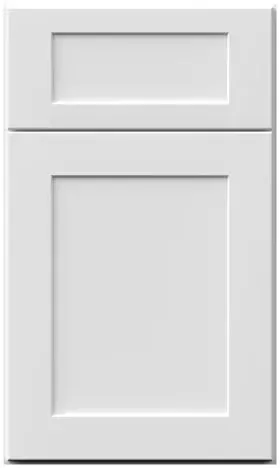
A fabuwood galaxy frost lazy susan cabinet is the most expensive way to close a corner in this catalog and, if the corner holds anything you touch daily, the only one worth buying. GF LSB33 and GF LSB36 run $1,030.25 and $1,220.05, and what you are paying for is not storage — the angled box next to it holds more — but the fact that the storage comes to you.
You are buying reach, not volume

Round shelves in a square box give up the four corners. The arithmetic is unforgiving: a circle inscribed in a square covers 78.5% of it, so roughly a fifth of the plan area you paid for is space the shelf never sweeps past. Fixed shelves in the same box would use all of it.
So on pure cubic inches this is the worst value of the three corner answers, and anyone selling you one on storage capacity is selling you the wrong argument. The right argument is reach. In a 36″ box the far back corner sits about 50″ from the door on the diagonal — a full body-length lean, in the dark, over a countertop edge. Rotating shelves reduce that to a wrist flick. You use what you can reach, and only what you can reach.
That is the whole decision. Bulk storage you open twice a year does not need to come to you and should not cost $1,220. Pans, mixing bowls, oils and everyday pots should, and will.
Two sizes, and the footprint is the part that matters
LSB33 is 33″ × 33″ in plan and LSB36 is 36″ × 36″, both at the standard 34½″ height. Note the depth: these are not 24″ boxes. They push 9″ or 12″ further along each wall than a normal base does, which is 18″ to 24″ of run taken out of the two walls combined before you have stored a thing.
Go with the 36″ unless the plan genuinely cannot spare the wall. The larger shelf swings a meaningfully bigger arc, the three extra inches of clear diameter is the difference between a stack of dinner plates fitting and not, and the price gap between the two is under two hundred dollars on a kitchen that runs four to six thousand. If you are working from a 10x10 kitchen budget, this is one of the few line items where the upgrade is obviously worth it.
Both units are pre-assembled with the shelves fitted, on Blum hardware throughout, and Galaxy ships in 7 days to 3 weeks. The carton is heavy and awkward — measure your doorways and stairs, not just your kitchen.
Three habits that keep it working

- Load flat-bottomed things. Anything that rocks — a round-bottom bowl, a bottle with a narrow base — walks toward the edge as the shelf turns and eventually tips off the back where you cannot see it.
- Keep the load balanced and off the rim. A shelf carries weight best near the center. Stack the cast iron toward the middle and leave the outer inch clear so nothing catches the face frame as it comes around.
- Nothing taller than the gap. A pitcher that just clears the shelf above at rest will not clear it once it has drifted half an inch outward. Measure the vertical gap and store to it, not to what fits standing still.
None of this is exotic; it is the same care any moving part in a kitchen wants. Our cabinet care guide covers cleaning painted white doors around a corner unit, where hands land on the same spot every day.
Against the other two corner answers
The premium over the fixed-shelf angled unit is exact and small: $191.75 at 33″ and $247.00 at 36″. Both boxes occupy the same footprint, so you are not spending any additional wall to get the rotation. Against a blind box the gap is much larger — $400 to $600 — and that one also gives you back 9″ to 12″ of run on each wall.
| Blind corner (BLB) | Easy reach (ERB) | Lazy Susan (LSB) | |
|---|---|---|---|
| Stocked here | BLB36/39, BLB39/42, BLB42/45, BLB48/51 | ERB33, ERB36 | LSB33, LSB36 |
| Footprint it eats on each wall | 24″ — same as any base | 33″ or 36″ on both walls | 33″ or 36″ on both walls |
| Price band | $614 – $892 | $839 – $973 | $1,030 – $1,220 |
| What you can see with the door open | Roughly a third of the box is hidden behind the neighbor | The entire interior, though the back corner is a long reach | Whatever is facing you — spin for the rest |
| Volume you actually use | Biggest box, smallest usable share | Full square footprint, nothing given up to hardware | About a fifth is lost to the corners a round shelf cannot reach |
| Extra hardware | Blind-base pull-out, ordered separately and handed | None — fixed shelves | Rotating shelves included |
| Buy it when | The corner holds bulk you touch twice a year | You store trays, tall stockpots or anything a turntable will not carry | The corner holds anything you reach for daily |
| Full write-up | Blind corner bases | Easy reach bases | You are reading it |
The short version: if the plan has the wall to spare, buy the rotation. If it does not, buy the blind box and put a pull-out in it, and keep only bulk in the corner. What you should not do is buy the angled unit purely to save two hundred dollars, spend the same footprint, and then spend five years reaching. The one exception is a corner that stores sheet pans and tall stockpots, which a turntable simply will not carry.
Common questions
- What size do I need, 33 or 36?
- Take the 36″ unless the plan cannot spare the wall. It swings a bigger shelf, holds a stack of dinner plates comfortably, and costs $189.80 more. Both are 34½″ high and both are as deep as they are wide.
- How much storage do the round shelves cost me?
- About a fifth of the plan area. A circle inside a square covers 78.5% of it, so the four corners of the box are dead space. Fixed shelves in the same footprint hold more — they are just much harder to reach.
- How much more is this than an easy reach cabinet?
- $191.75 more at 33″ and $247.00 more at 36″. The two share an identical footprint, so the premium buys rotation and nothing else. That is usually the easiest upgrade decision in the whole kitchen.
- Do the shelves come with the cabinet?
- Yes. These arrive pre-assembled with the rotating shelves fitted and the door hung, on Blum hinges with Blumotion soft-close. There is no separate hardware kit to order and nothing to build on site.
- Can I keep cast iron in it?
- Yes, but stack it toward the center of the shelf rather than the rim. Weight out at the edge makes the shelf harder to spin and encourages things to walk outward and catch on the face frame as they come around.
- Will it clash with the drawer bank next to it?
- It can. The flanking cabinets face into the same space and their pulls project into the door swing. Check the pull projection on both neighbors, and add a filler or choose a shorter pull on those two if the clearance is marginal.
Keep reading
The guides behind the numbers on this page.
- Space-Saving Cabinet Solutions
Where rotation beats a pull-out and where it does not.
- Types of Base Cabinets
The whole base lineup with corner options in context.
- What Is a 10x10 Kitchen? Cabinet Pricing Guide
Where a corner upgrade lands inside a benchmark budget.
- How Much Do Fabuwood Cabinets Cost?
Real 2026 numbers by series before you approve a quote.
- Why Blum Soft-Close Hinges Are Worth the Investment
The hardware carrying a heavy corner door every day.
- How to Clean and Care for Kitchen Cabinets
Keeping a white corner door clean where hands always land.
- Kitchen Island Clearance Guide
Aisle dimensions to test a wide corner door against.
- Important Kitchen Dimensions Before Buying Cabinets
Measure these before a 36″-deep corner goes on the order.


