

Apron-front cabinets: order the sink first, or do not order at all
Reviewed September 2026 · Captivating Cabinets
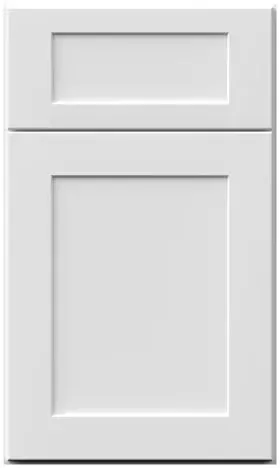
An apron-front cabinet is not a sink base with a different door on it. A Galaxy Frost farmhouse sink base cabinet has its top front rail removed entirely so the sink face can show, and the bowl is carried on a platform inside the box rather than hanging from the countertop — which is why the sink has to be chosen, specified and weighed before the cabinet is ordered.
What gets cut away, and what carries the load instead

On a normal base cabinet the rail across the top of the face frame ties the two stiles together and the countertop bridges over it. Take that rail out and the face frame becomes two vertical legs with nothing joining them at the top. That is the whole visual point of an apron sink — and it is also a real change to how the cabinet works.
The load path moves. Instead of the sink hanging from the underside of the stone, the weight goes down onto a support platform inside the box, then into the two side panels and the floor of the cabinet, then into the subfloor. The box has to be built for that from the start. It is not a modification, it is a different product line, and the price band shows it: these run $806.00 to $950.30 against $386.75 to $696.80 for a standard sink base in the same paint, with the same Galaxy door and the same Blum hardware. Roughly double the money, and the difference is entirely structure.
You need the sink model and its filled weight before you order
The question the installer will ask, and that most buyers cannot answer, is what the sink weighs when it is full. Apron sinks vary by a factor of five depending on material, and the heavy ones are the popular ones.
| Material | Rough dry weight | The catch |
|---|---|---|
| Stainless steel, 16–18 gauge | 25 – 45 lb | Easiest on the cabinet; dents and shows water spots |
| Composite granite | 50 – 80 lb | Middle of the road, and forgiving of dropped glassware |
| Copper | 40 – 70 lb | Light, but the patina is a maintenance decision |
| Fireclay | 100 – 150 lb | The classic look; brittle in transit and chips at the apron edge |
| Enameled cast iron | 150 – 200 lb | The heaviest thing in your kitchen that is not an appliance |
Then add water. A deep apron bowl holds somewhere around eight to twelve gallons, which is another 65 to 100 pounds, and the dishes go in on top of that. The worst realistic case — a cast-iron 36 filled to the rim — puts something north of 250 pounds on a cabinet whose front rail has been removed. That is the number the platform, the floor and the fasteners have to carry, and it is why the installer wants the spec sheet rather than the sink's marketing name.
Three widths, and how to pick between them
This page carries GF FS30, GF FS33 and GF FS36 — thirty, thirty-three and thirty-six inches wide, all at the usual 34½″ height and 24″ depth. That is the entire range, which makes the choice simple and the constraint real: if your sink needs a 39″ box, there is not one, and the layout has to change instead.
Apply the same three-inch rule as a starting point — a 33″ apron sink is a 36″ cabinet, a 30″ apron sink is a 33″ cabinet — and then confirm it against the sink's own drawing rather than trusting the rule. Check the apron height while you are there. Apron faces commonly run nine to ten inches tall, and the cut-away in the cabinet is a fixed height set at the factory. A taller-than-usual apron does not simply sit lower; it does not fit.
The other decision is whether the apron sits proud of the cabinet face or flush with it. Proud is forgiving and easy to install. Flush is the detail people want from photographs, and it is a fabrication job: the countertop shop has to have the actual sink on site to template around, and the tolerance is small enough that a plan-based template will not do it. Decide this before the cabinets are set, because it changes what the installer does with the fillers.
You cannot convert a standard sink base into one of these
This comes up every few weeks, usually after the cabinets are already in the garage. The answer is no, and the reason is not fussiness. The rail you would be cutting out is the structural member you would then need to replace, and the box behind it has no support platform, no reinforced sides and no allowance for the extra depth an apron bowl needs. Cutting it turns a warranted cabinet into a face frame with a gap in it, and voids the limited lifetime warranty in the process.
If a standard sink base has already been ordered and you have changed your mind, the fix is to order the right box, not to modify the wrong one. This is a program finish, so a single replacement cabinet arrives the same Frost white as the rest of the kitchen, and Galaxy is the fastest-shipping series Fabuwood makes at seven days to three weeks. One extra cabinet is cheaper than one ruined countertop, by a wide margin.
Worth knowing in the other direction too: if the apron look is what you want but the plumbing wall or the layout will not take it, a full-height door base gives you a similar uninterrupted face without the structural commitment. Compare the full-height door bases before you rule it out.
Sink base, farm sink, diagonal base or diagonal front?
Four different cabinets share the word "sink" in this finish and they are not substitutes for one another. Two of them are full cabinets, one is a full cabinet turned on an angle, and one is not a cabinet at all. Price is the fastest tell — if the numbers are that far apart, you are not comparing the same object.
| Cabinet | What is in the carton | Wall it consumes | Price band | Order it when |
|---|---|---|---|---|
| Sink base | Complete box, open bay, false drawer front across the top | 21″–42″ on one wall | $386.75 – $696.80 | The default. A drop-in or undermount bowl on a straight run |
| Farm sink base — you are here | Complete box with the top front rail cut away and the sink carried from inside | 30″, 33″ or 36″ on one wall | $806.00 – $950.30 | You have already picked a specific apron-front sink |
| Diagonal sink base | Complete box set at 45° across a corner, 36″ deep on the diagonal | 36″ on BOTH walls | $617.50 – $742.30 | There is a window in the corner, or the corner has no better job |
| Diagonal sink front | A face only — frame and door. No box, no sides, no back, and no floor unless you order the floor version | 36″ on both walls, and you build everything behind it | $100.75 – $274.30 | Your installer is site-building a corner sink cavity |
If the answer is still not obvious, send the room and we will draw it. A free 3D layout settles a corner argument in a way a product grid never will, and it is faster than returning a cabinet. Everything above is the same door, the same paint and the same hardware — see the full collection or the wider base cabinet range.
Common questions
- What size cabinet do I need for a 33 inch farmhouse sink?
- A 36″ box — GF FS36. As a rule the cabinet runs about three inches wider than the sink's outside dimension, but confirm against the sink manufacturer's drawing, because apron sinks are dimensioned inconsistently between brands.
- Can I put an apron-front sink into a regular sink base?
- No. The top front rail on a standard base is structural, and there is no internal platform to carry the sink. Cutting the rail out removes the structure and voids the warranty. Order the apron-front box instead — it exists in the same paint.
- Why do these cost so much more than a standard sink base?
- They run $806.00 to $950.30 against $386.75 to $696.80, and the gap is structure rather than finish. The door, the paint, the Blum hardware and the ½″ box are the same; the reinforced sides and the internal support platform are not.
- How much does a farmhouse sink weigh?
- Stainless runs 25 to 45 pounds, composite 50 to 80, fireclay 100 to 150, and enameled cast iron 150 to 200. Add another 65 to 100 pounds when the bowl is full. Have that number before you order the cabinet.
- Should the apron sit flush with the cabinet or proud of it?
- Proud is easier and much more forgiving on tolerance. Flush is the look most people are picturing, and it requires the countertop fabricator to template around the actual sink on site. Decide before the cabinets are set, not after.
- What widths are available in this finish?
- 30″, 33″ and 36″ — GF FS30, GF FS33 and GF FS36 — all at 34½″ high and 24″ deep. There is no 39″ or 42″ apron-front box in this line, so a larger sink means changing the sink or the layout.
Keep reading
The guides behind the numbers on this page.
- Types of Base Cabinets: Sizes and Standard Dimensions
How the apron-front box differs from every other base.
- Important Kitchen Dimensions Before Buying Cabinets
The measurements that decide whether a 36″ box fits the wall.
- How to Read Cabinet SKU Codes
Why FS36 and SB36 are not the same cabinet.
- Kitchen Cabinet Materials and Construction
What a ½″ box and a solid rail are actually doing.
- How Long Do Kitchen Cabinets Last?
Why anything under a sink ages faster than the rest.
- Fabuwood Cabinet Sizes and Specs
The full dimension tables behind these three widths.
- Pre-Assembled Kitchen Cabinets: A Dealer's Buying Guide
What arriving built changes when the box is this heavy.
- How Much Do Fabuwood Cabinets Cost?
Where a specialty box like this lands in a whole-kitchen quote.


