

What the FD suffix buys you, and what it costs
Reviewed September 2026 · Captivating Cabinets
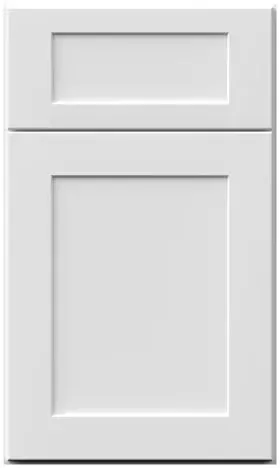
Add FD to a Fabuwood part number and one thing changes: the shallow drawer above the door disappears and the door runs the whole face. Galaxy Frost full height single door bases cover 9″ through 21″ in that configuration, and the reason to buy one is almost never the price difference.
Reading the part number

GF is Galaxy Frost. B is a base cabinet. The number is the width in inches. FD is the full-height door. Add -12D and the box is 12″ deep instead of 24″. That is the entire code, and it means GF B18 and GF B18FD are the same 18″ × 34½″ × 24″ carcass with two different fronts.
| Width | Standard | Full height | Full height, 12″ deep |
|---|---|---|---|
| 9″ | — | GF B09FD · $273.00 | GF B09FD-12D · $266.50 |
| 12″ | GF B12 · $364.00 | GF B12FD · $328.25 | GF B12FD-12D · $321.75 |
| 15″ | GF B15 · $377.00 | GF B15FD · $341.25 | GF B15FD-12D · $331.50 |
| 18″ | GF B18 · $409.50 | GF B18FD · $373.75 | GF B18FD-12D · $364.00 |
| 21″ | GF B21 · $432.25 | GF B21FD · $399.75 | GF B21FD-12D · $390.00 |
Deleting the drawer saves $32.50 to $35.75 depending on the width. On a kitchen with four of these boxes that is around $140 — real money, and still the wrong reason to specify them. Figures come off the live catalog and are net of our discount off list, so check the grid before you build a quote on them.
What you give up, and what you get back

What you lose is the best five inches in the kitchen. The shallow top drawer sits at hand height, opens without bending, and is where the spatulas, foil, tea towels and takeaway menus end up. A typical run has six or seven of them. Delete one and something has to move.
What you get back is a single uninterrupted volume, and a handful of things only fit in one. A stock pot standing upright. A stand mixer with the bowl still on it. A step stool. Sheet pans and cutting boards on edge in a 9″ box. And — the reason most designers reach for these — tall pull-out hardware. A door-mounted waste unit or a two-tier organizer needs the full face; the drawer box above is precisely what stops it.
There is a visual argument too. A run of full-height doors reads as one continuous field of paint with no drawer seams crossing it, which on a bright white is calmer than it sounds. That works when the whole run is full-height. It fails badly when one is dropped into the middle of a row of standard bases: the drawer line that runs across the front of every other cabinet stops dead at one box and picks up again on the far side. If you use these, use them at the ends of a run or use them for all of it.
The 12-inch-deep version nobody writes about
Five SKUs on this page are half the usual depth: GF B09FD-12D through GF B21FD-12D. Same 34½″ height, same door, 12″ front to back instead of 24″. Distributor catalogs list them without comment and no one explains what they are for, which is a shame, because they solve problems the standard box cannot.
- The back of a peninsula or island — storage facing the dining side without stealing the aisle behind it
- A galley narrow enough that a 24″ base on both walls would close the working aisle below 42″
- A mudroom, laundry or butler’s pass where you want counter height storage but not counter depth
- Against a wall with a radiator, a chase or a window seat that a full-depth box would foul
Now the part that surprises people: going shallow does not save you money. GF B21FD-12D is $390.00 against $399.75 for the full-depth GF B21FD — $9.75 apart. You are buying floor clearance, not a discount. Price them as equals and choose on the plan.
Where these belong in a run
Three placements earn their keep, and one to avoid.
- At the end of a run, against a wall. The narrow widths close out the remainder, and a full-height door there reads as a finished panel rather than a stubby half-drawer.
- Flanking a range or a wall oven. A pair of 9″ or 12″ boxes with vertical dividers puts sheet pans, cooling racks and cutting boards exactly where you use them.
- On the back of a peninsula, in the shallow version, where the storage faces the room and the aisle keeps its width.
- Not in the middle of a row of standard bases — a single FD box breaks the drawer line running across the front of the run, and it is the kind of thing you cannot unsee.
Roll-outs, dividers and waste frames in this paint are on the accessories page, and space-saving cabinet solutions covers which hardware needs a full-height door to work at all.
The other three door-base pages, briefly
Same three variables across all four pages: door count, drawer or no drawer, and depth.
| Page | What it is | Pick it when |
|---|---|---|
| Single door base | 9″–21″, one door, top drawer on the plain B | The run is narrower than 24″, or you want one clear opening for a pull-out |
| Double door base | 24″–48″, two doors, top drawer on the plain B | One wide box instead of two narrow ones, and you have the aisle for two swinging doors |
| Full height double door base | 24″–39″, two doors, no drawer | Bulk storage, an appliance garage or a double waste unit at counter height |
Wider than 21″ and still want the drawer gone? That is the two-door full-height page. Everything else in this white — sink bases, corners, wall and tall cabinets — is on the collection page.
Common questions
- What does FD mean on a Fabuwood cabinet?
- Full-height door. The cabinet has no drawer above the door, so the door covers the whole front of the box and the interior is one uninterrupted space. GF B18FD is an 18″ base with that front; GF B18 is the same box with a shallow drawer on top.
- Is a full-height door base cheaper than a standard one?
- Slightly — about $33 to $36 less per box in these widths. That is not a good reason to choose one. Specify it when something tall has to fit, when you want tall pull-out hardware, or when you want a run of doors with no drawer seam across it.
- What is the 12D suffix on GF B18FD-12D?
- Twelve inches deep instead of the standard 24″. Same height, same door, half the front-to-back dimension. It is meant for peninsula backs, tight aisles and utility walls, and it costs about the same as the full-depth version rather than less.
- Can I put a normal countertop on a 12-inch-deep base?
- Only with support. A standard countertop assumes a 24″ box plus roughly 1½″ of overhang, so on a shallow base about 13½″ of the slab is unsupported. Plan brackets, a support panel or a knee wall, and tell the fabricator before the template is cut.
- Will a waste pull-out fit one of these?
- Yes, and this is the usual reason people order them. A 15″ or 18″ full-height box takes a single waste unit cleanly, because there is no drawer box above to obstruct the frame. Check the clear opening against the unit before ordering.
- Can I mix these with standard bases in the same run?
- You can, but put them at the ends rather than the middle. The shallow drawer fronts on standard bases form a horizontal line across the run, and a single full-height door in the middle interrupts it in a way that reads as a mistake.
Keep reading
The guides behind the numbers on this page.
- How to Read Cabinet SKU Codes
FD, SDF, -12D and the rest of the suffix alphabet.
- Space-Saving Cabinet Solutions
Pull-outs that only fit once the top drawer is gone.
- Important Kitchen Dimensions Before Buying Cabinets
Aisle widths — which is what a shallow box is really buying.
- Small Kitchen Design and Layout Ideas
Where twelve inches of depth changes how a room works.
- Kitchen Cabinet Terminology: Parts and Abbreviations
Rail, stile, toe kick — the vocabulary a spec sheet assumes.
- What Dovetail Drawers Tell You About Cabinet Quality
What you are giving up when you delete the drawer.
- Cabinet End Panels, Scribe Molding and Fillers Explained
Finishing an exposed side on a shallow or end-of-run box.
- Types of Base Cabinets: Sizes and Standard Dimensions
The full base lineup, drawers and corners included.


