

Two microwave bases, and where everything else went
Reviewed September 2026 · Captivating Cabinets
Most catalogs use "specialty base" as a bin for everything that would not sort anywhere else. We would rather be plain about it: a galaxy frost specialty base cabinet here means one of two boxes, GF BMC24 and GF BMC30, and both of them are base microwave cabinets. Everything else you might expect to find under that label has its own page, mapped at the bottom of this one.
What a base microwave cabinet is
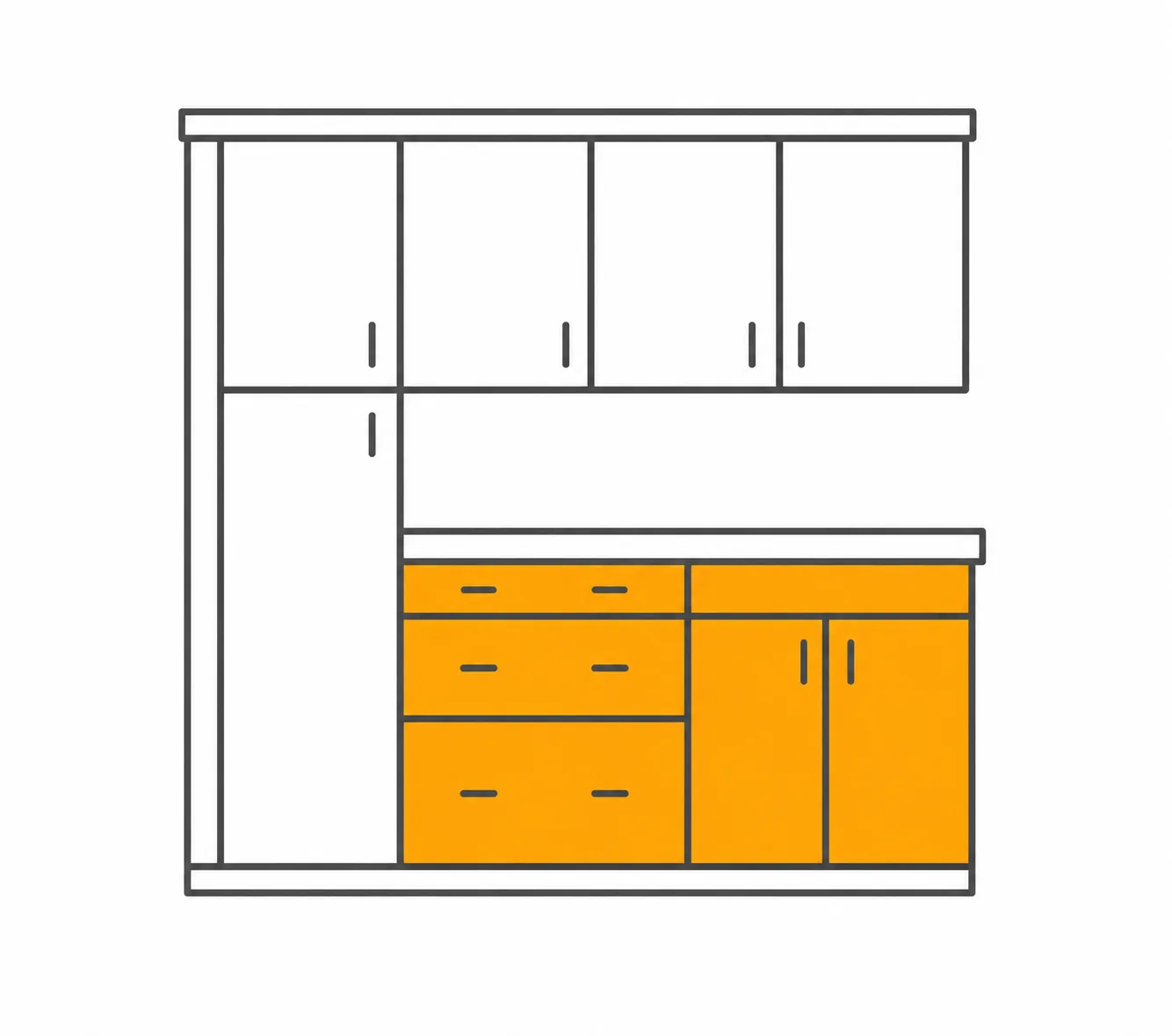
It is a standard base carcass — 34½″ high, 24″ deep — with an open bay sized to take a countertop microwave, in 24″ and 30″ widths, at $614.25 and $820.30. The appliance slides into the bay and stops being a countertop object. That is the entire product, and it does one thing extremely well: it gives you back about three square feet of the most valuable surface in the house.
The number to write down is the opening, not the cabinet. On the 30″ unit the maximum cutout is 28½″ wide by 18¾″ high. That is a maximum, not a target — your microwave has to fit inside it along with whatever clearance its manufacturer requires around the vents, which for most countertop units is a few inches at the back and sides. Take the appliance spec sheet, add the required clearances, and check the total against 28½″ × 18¾″ before you order the cabinet.
The 24″ version exists for tight runs and small appliances. If your microwave is a normal 1.6 cubic-foot countertop unit, order the 30″ and stop worrying about it — the price difference is about two hundred dollars and the alternative is a cabinet you cannot use.
Base, wall or over-the-range: an honest comparison
Putting a microwave over the range is the default in American kitchens and it is the worst of the three positions. It wastes the best ventilation location in the room on a recirculating fan that mostly does nothing, and it makes you lift a bowl of boiling soup down from above shoulder height. If you care about the cooking, put a real hood over the range and the microwave somewhere else.
Base position wins on safety and on counter space: you are pulling hot food out at waist height, moving down and toward yourself, and the counter above stays clear. It loses on ergonomics for anyone who does not want to bend — if there is someone in the house with a bad back or limited mobility, a base microwave is a daily irritation, and a wall cabinet or a microwave drawer is the better call. Our ADA base cabinets page covers the accessible heights.
One layout rule regardless of position: keep it out of the sink-to-range work triangle and put a landing surface within arm's reach of the door. A microwave with nowhere to set the hot dish down is a burn waiting to happen.
Three measurements to take before you order
- The appliance depth against the box depth. The carcass is 24″ deep and a typical countertop microwave is 18″ to 20″ deep, which leaves only a few inches behind it. That is the space the plug and the cord have to live in, and a rigid plug on a short cord can hold the appliance an inch proud of the face. Check the plug orientation on the spec sheet, and put the receptacle where the cord will actually reach.
- The door swing against the cabinet next to it. A microwave door hinges on one side and opens flat, sweeping wider than the appliance. In a base position it opens at hip height into the aisle. If the bay sits next to a walkway or a corner, check which side the hinge is on before you fix the cabinet position — you cannot reverse it later.
- The ventilation gap on every face. The 28½″ × 18¾″ cutout on the 30″ unit is a maximum opening, and your microwave needs its own manufacturer-specified clearance inside that. Add the required gaps to the appliance dimensions first, then compare. A unit that measures 28″ wide does not fit an opening that is 28½″ wide if it wants 2″ of air on each side.
Get all three right and the installation is unremarkable, which is the goal. Get the third one wrong and you find out on the day the cabinets go in, with an appliance you already own and a bay it will not sit in. If you would rather have somebody else check the arithmetic, send us the microwave model with a design request and we will confirm the fit against the cutout before the order is placed.
What you are buying for the money
| Component | What you actually get |
|---|---|
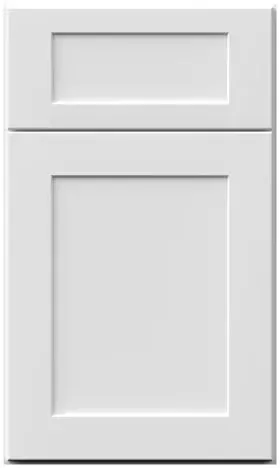
| Door | Solid wood door frame around a ⅜″ MDF center panel — the MDF is why a painted shaker face stays flat instead of moving with the seasons |
| Box | ½″ veneered plywood, natural wood veneer finished interior |
| Drawer box | ⅝″ solid wood, dovetailed |
| Drawer front | 5-piece recessed panel matching the door |
| Glides | Blum Tandem plus Blumotion full-extension concealed runners |
| Hinges | Blum, Quick-Release Technology with Blumotion soft-close |
| Assembly | Pre-assembled at the factory — dowel-and-glue plus pocket-screw joinery |
| Lead time | 7 days – 3 weeks; Galaxy ships faster than the rest of the Allure line |
| Warranty | Limited lifetime |
That specification is the same across every box on these six pages, which is worth knowing when you compare a corner unit or a bench against a competing quote. The drawer line is the one to hold a rival to: ⅝″ solid wood, dovetailed, on Blum runners, included rather than upsold. More on the line in our Fabuwood cabinets review, and see the whole paint on the Galaxy Frost collection.
Where everything else lives

If you arrived here looking for a corner cabinet or a bench, you are one click away. This is the full set of odd-shaped base boxes stocked in this white, with what each one costs and what it is for.
| Page | SKUs stocked | Price band | What it solves |
|---|---|---|---|
| Corner base (blind) | BLB36/39 – BLB48/51 | $614 – $892 | The cheapest 90° turn; about a third of the box is blind |
| Easy reach base | ERB33, ERB36 | $839 – $973 | A 45° door on a square box; everything visible, more wall used |
| Lazy Susan base | LSB33, LSB36 | $1,030 – $1,220 | Same footprint as the angled box; the shelves come to you |
| Return angle base | BRA24, BTL12, BTR12 | $419 – $713 | Closing a peninsula end or a run at 45° instead of square |
| Drawer bench seat | DBS24, DBS30, DBS36 | $338 – $551 | A 16⅜″-high open-top drawer box for banquettes and mudrooms |
| Base microwave (this page) | BMC24, BMC30 | $614 – $820 | Getting the microwave off the counter and out of the hood slot |
If you are still deciding between the three corner answers, start with the blind box page — it carries the full comparison table and the reasoning behind it. And if the run has not been drawn yet, send dimensions through a free design request and we will lay the corners out before anything is ordered.
Common questions
- What actually counts as a specialty base here?
- Two cabinets: the BMC24 and BMC30 base microwave units, at $614.25 and $820.30. Corner boxes, return angles and bench seats each have their own page rather than being dumped in this category.
- What size microwave fits the BMC30?
- The maximum cutout is 28½″ wide by 18¾″ high. Your appliance has to fit inside that together with the ventilation clearance its manufacturer specifies, so check the spec sheet rather than the outside dimensions of the microwave.
- Do I need an outlet inside the cabinet?
- Yes, and it has to be planned at rough-in. A dedicated 20-amp receptacle in the bay or the adjacent cabinet is the normal solution. Adding one after drywall means fishing a circuit through a finished wall.
- BMC24 or BMC30?
- The 30 for any normal countertop microwave — the extra width is about two hundred dollars and it removes the risk of an appliance that will not fit. Take the 24 only when the run genuinely cannot spare the width and your microwave is small.
- Is a base microwave better than an over-the-range one?
- For most kitchens, yes. It frees the best ventilation position for a real hood and you lift hot dishes down from waist height instead of above your shoulders. The exception is anyone who should not be bending, who is better served by a wall cabinet or a drawer microwave.
- Where are the corner cabinets?
- On their own pages — blind corner, easy reach and lazy Susan each get a full write-up, and the table above links all of them with prices and footprints so you can pick without opening six tabs.
Keep reading
The guides behind the numbers on this page.
- Types of Base Cabinets
Every base configuration, appliance boxes included.
- Fabuwood Cabinets Review
Construction, warranty and where the brand falls short.
- Fabuwood Cabinet Sizes and Specs
The dimension tables to check an appliance cutout against.
- Important Kitchen Dimensions Before Buying Cabinets
Landing space, aisle width and the numbers around appliances.
- Kitchen Cabinet Terminology Glossary
Plain definitions for BMC, BLB, ERB, LSB and the rest.
- Pre-Assembled Kitchen Cabinets Buying Guide
What arrives built, and what that changes on install day.
- How Much Do Fabuwood Cabinets Cost?
2026 pricing by series to sanity-check a specialty box.
- Space-Saving Cabinet Solutions
Other ways to get appliances and clutter off the counter.


