

Two doors that open into the room: planning a wide pantry around its swing
Reviewed September 2026 · Captivating Cabinets
A pair of full-height doors is the quietest thing you can put on a tall cabinet and the most disruptive thing you can put in a walkway. Closed, a wide two-door tower is one calm rectangle. Open, a thirty-six-inch one throws eighteen inches of door into the room from the floor to above your head — not a hinged flap at waist height like a base cabinet, but a plank taller than a person standing where you were standing. Twenty-four units live on this page, in three widths, two depths and four heights. The width you choose is a storage decision for about ten seconds and a floor-plan decision for the rest of the kitchen’s life.
What the second door is actually for
Below twenty-four inches the catalogue gives you one door; at twenty-four and above it gives you two. The reason is not decoration. A single leaf that wide and that tall becomes a lever: it is heavy at the handle, it wants to sag on its hinges over years of use, and it needs its full width of clear floor before it will open at all. Splitting the opening halves every one of those numbers.
You also get something you cannot get from one door, which is a view. Two leaves opened together give you an opening as wide as the cabinet, so you see the whole shelf at once instead of reading it through a slot. On a deep box that is the difference between knowing what you own and guessing at it. The hinges are the same 110° Blum Compact Clips used everywhere else in the line, six-way adjustable with soft close, and on a full-height door the soft close matters more than usual — there is a lot of mass arriving at the frame.
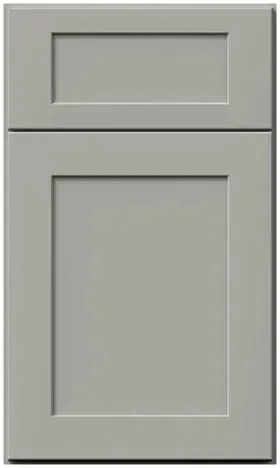
The one visual consequence worth planning for: a pair of doors puts a vertical joint down the middle of the cabinet, and on a mid-tone the shadow in that joint reads as a deliberate line rather than a defect. It divides a thirty-six-inch plane into two eighteen-inch ones, which is usually flattering. Two twenty-four-inch cabinets side by side give you three such lines instead of one. Neither is wrong; know which you are ordering.
Door swing is a floor-plan number, not a cabinet one

Each leaf is a little under half the cabinet width, and at ninety degrees it reaches into the room by roughly its own width. That is the whole calculation, and it is worth writing on the plan. Below, what it leaves you in a forty-two-inch aisle — a common gap between a tall run and an island.
| Pantry width | Each leaf | How far a leaf reaches into the room | Left of a 42″ aisle |
|---|---|---|---|
| 24″ — GN TP24… | about 12″ | about 12″ past the face | about 30″ to stand in |
| 30″ — GN TP30… | about 15″ | about 15″ | about 27″ |
| 36″ — GN TP36… | about 18″ | about 18″ | about 24″ |
Twenty-four inches is roughly the width of an adult’s shoulders. That is the floor of this table, and the thirty-six-inch box in a forty-two-inch aisle is sitting on it: you can stand at the open cabinet, but you cannot stand at it while someone passes behind you, and the dishwasher opposite cannot be open at the same time. Drop the aisle to thirty-six inches and the wide pair stops working altogether — you end up opening one leaf at a time, which is exactly the single-door problem you paid to avoid.
Three placements make it worse and are all common. A tall run that ends next to a doorway, where the outer leaf swings across the traffic. A tower in the inside corner of an L, where one leaf fouls the return. And a pantry directly opposite an oven tower, where the pantry door and an open oven door occupy the same four square feet. The island clearance guide has the walkway minimums to check yours against.
Shelf depth, and the rule that everything lives one deep
Now the inside. A twenty-four-inch-deep box gives you a shelf of roughly twenty-two inches front to back; the twelve-inch version gives you about ten. Worked from the external dimensions, since the listings publish the box and not the cavity — confirm before you order shelf inserts. Measured in the only unit that matters to a pantry, a standard can is about three inches across.
| Box | Shelf, about | One row across the front | If you fill it front to back |
|---|---|---|---|
| 24″ wide, 12″ deep | 22″ × 10″ | 7 cans | about 21 |
| 24″ wide, 24″ deep | 22″ × 22″ | 7 cans | about 49 |
| 30″ wide, 24″ deep | 28″ × 22″ | 9 cans | about 63 |
| 36″ wide, 24″ deep | 34″ × 22″ | 11 cans | about 77 |
The right-hand column is a fantasy and the column next to it is the truth. Nobody stores cans seven rows deep, because nothing in row four can be seen or reached, and a tin that cannot be seen is a tin that gets bought again. In practice a household uses the front row and stacks the rest of the depth with bulk that moves rarely — paper goods, cases of water, the big bag of flour, the appliance you use at Christmas.
Which gives you a cleaner way to choose the width than capacity: count how many things you need to see at once, not how many you need to keep. The thirty-six gives you eleven visible cans a shelf against the twenty-four’s seven — an extra four per shelf, for about $945 more at ninety-six inches and twenty-four deep. If what you are storing is bulk that moves twice a year, a deep twenty-four and better habits beat a thirty-six every time. If it is a family of five eating out of the pantry daily, the frontage is worth paying for.
The twelve-inch-deep box is the honest version of the one-deep rule: the whole cabinet is the front row. Twenty-one cans a shelf, all of them visible, none of them lost. That is not a lesser cabinet, it is a different one.
All twenty-four units, in one grid
Three widths, two depths, four heights, displayed prices at review. Every code is live on the tall cabinet page.
| Box | 84″ | 90″ | 93″ | 96″ |
|---|---|---|---|---|
| 24″ wide, 12″ deep — GN TP2412… | $1,241.50 | $1,296.75 | $1,306.50 | $1,365.00 |
| 24″ wide, 24″ deep — GN TP2424… | $1,270.75 | $1,326.00 | $1,332.50 | $1,397.50 |
| 30″ wide, 12″ deep — GN TP3012… | $1,443.00 | $1,612.00 | $1,660.75 | $1,781.00 |
| 30″ wide, 24″ deep — GN TP3024… | $1,475.50 | $1,641.25 | $1,686.75 | $1,807.00 |
| 36″ wide, 12″ deep — GN TP3612… | $1,677.00 | $2,002.00 | $2,470.00 | $2,314.00 |
| 36″ wide, 24″ deep — GN TP3624… | $1,712.75 | $2,031.25 | $2,548.00 | $2,343.25 |
Depth is close to free at every width — thirty-two dollars and fifty cents on the twenty-four-inch box at ninety-six, thirty-five on the thirty-six — so depth is never the line to trim. Width is where the money is, and it does not rise evenly: the step from twenty-four to thirty costs more than the step from eighteen to twenty-four, and the step from thirty to thirty-six costs more again. The thirty-six-inch rows also do not climb in a straight line with height. Read the exact figure for the height you want off the grid rather than interpolating it.
What to settle before a wide tower is ordered
- Draw the swing on the floor plan, both leaves, at ninety degrees, and then stand a person in the space that is left. If the person does not fit, the cabinet is too wide for the wall regardless of what the elevation says.
- Measure the ceiling in four corners and choose the height against the lowest one. The tall run will find the low corner before anything else in the kitchen does.
- Decide depth against the neighbours — the fridge, the base run, the walkway — rather than against the storage, since it costs almost nothing either way.
- Add a tall filler where the run meets a wall: GN TF396 at $84.50 for 3″ × 96″, GN TF696 at $152.75 for 6″. Two leaves need clearance to open past a side wall and a filler is what buys it.
- Finish any exposed side. GN SK TALL is $169.00 for a deep box, GN SK T12D $126.75 for the shallow one. The decorative trim page carries the pilasters and valances if the run wants dividing.
- Then send the wall for a free 3D design and check the swing on the drawing that comes back, not on the one you drew.
Everything arrives pre-assembled with both doors hung and the hinges already adjusted, in 7 days to 3 weeks. On a ninety-six-inch box with two full-height doors that is worth more than it sounds — hanging and aligning a pair of leaves that long is the job flat-pack owners remember. Trade orders go through Captivating Pro; a $25.00 door sample is the only honest way to judge the colour before a plane this size arrives.
Common questions
- How much clearance does a pantry cabinet door need?
- Roughly its own leaf width, plus room for a person. A 36-inch two-door pantry has 18-inch leaves, so in a 42-inch aisle you are left with about 24 inches to stand in — shoulder width, and nothing spare. A 24-inch box leaves about 30.
- Is one 36-inch pantry better than two 24-inch pantries?
- They store similar amounts but behave differently. Two 24s give you four 12-inch leaves, so nothing swings far and you open only the half you need; one 36 gives you two 18-inch leaves and a wider view of the shelf. In a tight walkway the pair wins.
- How many cans fit on a pantry shelf?
- A 36-inch box holds about eleven standard cans across the front of each shelf and could take about 77 if you filled it seven rows deep — which nobody does, because row four cannot be seen. Plan on the front row and use the depth behind it for bulk.
- How much does a double door pantry cabinet cost?
- From $1,241.50 for a 24-inch-wide, 12-inch-deep, 84-inch box to $2,548.00 for a 36-inch-wide, 24-inch-deep unit at 93 inches. The common 24 × 24 × 96 is $1,397.50.
- Should a pantry be 12 or 24 inches deep?
- Depth costs about $32 on a 96-inch box, so decide it on use and neighbours rather than price. Twelve inches means everything lives one row deep and nothing is lost; twenty-four roughly doubles the volume and asks you to rotate stock or fit roll-outs.
- Do both pantry doors open independently?
- Yes — each leaf is hung on its own pair of 110° Blum Compact Clip hinges with soft close, so you can work out of one side. Opening both together is what gives you the full-width view of the shelf.
Keep reading
The guides behind the numbers on this page.
- Kitchen Island Clearance Guide
The aisle minimums a pair of full-height doors has to live inside.
- Important Kitchen Dimensions Before Buying Cabinets
Walkways, reaches and the numbers to put on the plan first.
- Wall and Tall Kitchen Cabinets: Sizes and Buying Guide
The published widths, depths and heights behind this grid.
- Why Blum Soft-Close Hinges Are Worth the Investment
What the hinge is doing with that much door hanging off it.
- Space-Saving Cabinet Solutions
Getting the back of a deep shelf back, if you chose 24 inches.
- Kitchen Layouts Guide
Which wall a tall run belongs on in an L, a U and a galley.
- Pre-Assembled Kitchen Cabinets Buying Guide
Why a 96-inch box with two doors already hung is the one to buy built.
- Kitchen Cabinet Samples: How to Order and Evaluate
Judging the finish before a plane this wide is committed to.


