

One tall door, two feet of reach: fitting out a narrow pantry
Reviewed September 2026 · Captivating Cabinets
Sixteen units live on this page: two widths, fifteen and eighteen inches, each in a twelve-inch and a twenty-four-inch depth, each in four heights. One door on all of them. The shopping question looks like a width question and it is not — it is a question about how far your arm goes. A deep single-door tower is the only cabinet in the kitchen that is twice as deep as it is wide, and that proportion decides whether it becomes the most useful box in the room or the place food goes to be forgotten. This page is about the back third: what ends up there, what it costs to get it back, and the point at which the money would have been better spent on a different cabinet altogether.
A box that is deeper than it is wide
Start with the proportion. Take the fifteen-inch box in its deep version and work the interior off the external dimensions — the listings do not publish inside measurements, so treat these as planning figures — and you have roughly thirteen inches across by a little over twenty-two front to back. The shelf is nearly twice as deep as it is wide.
Compare that with any other shelf you own. A base shelf is eighteen inches deep behind a door that is often thirty wide — you see all of it at once. A wall cabinet is twelve deep. A fridge shelf is lit. A deep narrow tower is the one storage shape in the house where the geometry works against you, and it does so at every height at once, from ankle to eye.
The consequence is the same in every kitchen. The front eight inches of each shelf gets used daily, the middle eight weekly, and the back six become an archive — the second jar of the thing you already opened, the tin from two Christmases ago, the pasta shape nobody liked. You did not lose that space. You bought it, it is there, and you cannot see it.
The back third, and what it swallows

There is a test for whether you have this problem, and it works on the pantry you already own: open it and, without moving anything, name what is in the back row of the second shelf from the bottom. Most people cannot. That is the shelf below eye level and above the bend, the one you look into at an angle that shows the front and nothing else.
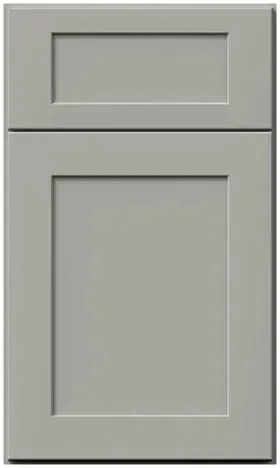
Three things make it worse in a narrow box specifically. Your shoulders do not fit in the opening, so you reach in with one arm and your hand arrives at the back travelling sideways. The interior is a natural wood veneer rather than the painted grey of the front, which helps — a dark interior at thirteen inches wide would be a hole you could not see into at all — but no interior colour puts light two feet back behind a closed door. And the back cannot come forward until the front comes out, so every retrieval is a two-step operation and therefore does not happen.
The twelve-inch version has none of this. Everything in it is one row deep and you read it like a bookshelf. It also holds roughly half as much. That is the trade, and the rest of this page is the two honest ways to resolve it.
Roll-outs, and the crossover the listing does not mention
The first answer is to stop making the shelf a shelf. A roll-out drawer fitted behind the door brings the back of the cabinet out to you: you look down into it instead of along it, and the two-step retrieval becomes one. It is the right fix, it does not change the face of the cabinet at all, and it is the specification that goes on most narrow towers we quote.
It is also not cheap, and the arithmetic is worth doing out loud before you commit, because it crosses over a line that nobody points at on a product page.
| What you actually order | Codes | Displayed price |
|---|---|---|
| 15″ wide, 24″ deep, 96″ high, shelves as it comes | GN TP152496 | $981.50 |
| The same box, three standard-height roll-outs | GN TP152496 + 3 × GNK ROD-B15 BLUM E | $1,547.00 |
| The same box, three high-sided roll-outs | GN TP152496 + 3 × GNK ROD-B15 BLUM H | $1,703.00 |
| 18″ wide, 24″ deep, 96″ high with three roll-outs | GN TP182496 + 3 × GNK ROD-B18 BLUM E | $1,755.00 |
| 24″ two-door pantry, 96″ high, shelves as it comes | GN TP242496 | $1,397.50 |
Read the last two rows together. A fitted-out fifteen-inch tower lands at $1,547.00 and an eighteen at $1,755.00, while the plain twenty-four-inch two-door box — nine inches wider, nearly half as much shelf again, and a pair of doors you can see across — is $1,397.50. If the wall will take twenty-four inches, spending the roll-out money on the narrow box is the wrong order of operations. Buy the width first. Fit it out later if you still want to.
If the wall will not take twenty-four inches, the sum reverses and the trays become the whole point of the purchase. A narrow tower gets bought because a wall left exactly that much room, and the back third is then the only extra storage available anywhere — $565.50 for three trays is a fair price for it.
Twelve inches deep is the other answer, and it is $26 cheaper
The second resolution is to refuse the problem. Order the shallow version, accept less volume, and get a cabinet where every single item is visible and reachable without moving anything. At fifteen inches wide and ninety-six high that is GN TP151296 at $955.50 against GN TP152496 at $981.50 — twenty-six dollars apart, which tells you the factory does not consider depth a feature worth charging for.
Where the shallow box is genuinely the better cabinet: a dry-goods pantry opened three times a day, where speed matters more than capacity; a spice and baking column beside an oven tower; a route that has to squeeze past a doorway; and any household that has decided, honestly, that it will not rotate stock. Where it is the wrong call: anywhere the tower stands at the end of a twenty-four-inch base run and is meant to read as part of it. The shallow box has a different job. Do not buy it to save the twenty-six dollars.
- Small appliances — a stand mixer, a slow cooker — do not belong in a twelve-inch box. They belong at the bottom of a deep one, on a roll-out, at a height where you slide them out rather than lift them down.
- Cereal, crackers, pasta boxes and cans all stand one deep in twelve inches with nothing lost.
- Spare shelves for these boxes are not stocked loose in this finish. The shelves it ships with are what it has, so if your plan needs an extra division, say so at the order rather than after delivery.
All sixteen units, priced
Four heights across, four boxes down. Our displayed figures on the review date; every unit is live on the tall cabinet page with its exact code.
| Box | 84″ | 90″ | 93″ | 96″ |
|---|---|---|---|---|
| 15″ wide, 12″ deep — GN TP1512… | $871.00 | $913.25 | $913.25 | $955.50 |
| 15″ wide, 24″ deep — GN TP1524… | $897.00 | $942.50 | $942.50 | $981.50 |
| 18″ wide, 12″ deep — GN TP1812… | $1,020.50 | $1,079.00 | $1,075.75 | $1,121.25 |
| 18″ wide, 24″ deep — GN TP1824… | $1,053.00 | $1,108.25 | $1,101.75 | $1,150.50 |
Two things fall out of it. The jump from fifteen to eighteen inches costs about $170 at every height and depth — more than any other move on the page, and the widest three inches in the tall catalogue. And at eighteen inches the ninety-three-inch units are priced a few dollars under the ninety-inch ones, so read the exact figure rather than assuming taller always costs more.
The side of this cabinet is bigger than its front
Here is the one that surprises people, and it is pure arithmetic. A fifteen-inch-wide, twenty-four-inch-deep tower at ninety-six high shows about ten square feet of door to the room and about sixteen square feet of side. If that side is exposed — and on a narrow tower at the end of a run it usually is — the largest painted plane this cabinet puts in the kitchen is not the part you chose it for. On a mid-tone grey an unfinished carcass beside a painted door is not a subtle mismatch; it is the first thing a visitor sees on that wall.
So the end skin is part of the box, not an upgrade to it: GN SK TALL at $169.00 for the deep version, GN SK T12D at $126.75 for the shallow one, both factory-finished to match. Where the tower meets a wall, a tall filler takes up the difference — GN TF396 at $84.50 for 3″ × 96″, GN TF696 at $152.75 for 6″. Order it even when the drawing says the run fits exactly.
Then the ordinary checks: ceiling measured in four corners, and the door swing decided against the room you stand in rather than the elevation. Send the wall and a free 3D design comes back with the tower drawn in place and an itemised quote; trade buyers work through Captivating Pro. Lead time is 7 days to 3 weeks, pre-assembled, with the Blum hinges already adjusted.
Common questions
- How deep should a pantry cabinet be?
- Twenty-four inches if you want capacity and are willing to fit roll-outs or rotate stock; twelve inches if you want everything visible one row deep. Depth costs about $26 on a 96-inch single-door box, so the decision is about how you use it, not about money.
- Are pull-out shelves worth it in a narrow pantry cabinet?
- In a 15- or 18-inch box that is 24 inches deep, yes — the back third is otherwise unreachable without unpacking the front. Three standard-height roll-outs add $565.50 to a 15-inch tower and $604.50 to an 18. But if the wall would take a 24-inch two-door pantry at $1,397.50, buy the wider box before you buy the trays.
- How much does a single door pantry cabinet cost?
- From $871.00 for a 15-inch-wide, 12-inch-deep, 84-inch-high box to $1,150.50 for an 18-inch-wide, 24-inch-deep, 96-inch one. Sixteen units in total, across two widths, two depths and four heights.
- What is the difference between a 15-inch and an 18-inch pantry cabinet?
- Three inches of width and about $170 at every height and depth — the largest three-inch step in the tall catalogue. The 18 takes a wider roll-out tray and a sensible stack of dinner plates; the 15 fits where nothing else will.
- Does the pantry cabinet come with shelves, and can I buy more?
- It ships with adjustable ¾-inch shelves on clips. Spare shelves for the tall boxes are not stocked as loose parts in this finish, so if the plan needs an extra division say so when the order is placed rather than after the truck arrives.
- Do I need a finished panel on the side of a tall pantry?
- If the side is visible, yes. A 15-inch tower shows more side than door — about 16 square feet against 10 — so an exposed carcass is the biggest unfinished plane on that wall. GN SK TALL is $169.00 for a 24-inch-deep box, GN SK T12D $126.75 for a 12.
Keep reading
The guides behind the numbers on this page.
- Wall and Tall Kitchen Cabinets: Sizes and Buying Guide
The published height and depth tables behind every unit on this page.
- Space-Saving Cabinet Solutions
What a roll-out tray actually carries, and what it does not.
- Beam-Mounted and Pull-Out Cabinet Accessories
How the trays mount, before you assume they fit a deep tall box.
- Cabinet End Panels, Scribe Molding and Fillers Explained
Why the exposed side of a narrow tower is not an optional line.
- Important Kitchen Dimensions Before Buying Cabinets
Depths, reaches and walkways, with the numbers a tall box has to respect.
- Small Kitchen Design and Layout Ideas
Where fifteen spare inches of wall turn into a pantry.
- Gray Kitchen Cabinets: Finding the Right Shade
Where this mid-tone sits among the greys, if the finish is still open.
- Fabuwood Cabinet Sizes and Specs
The dimension tables to check a container or a tray against.


