

The single-oven tower: one appliance, and the cabinet built around it
Reviewed September 2026 · Captivating Cabinets
Four units sit on this page — GN OC3384S, OC3390S, OC3393S and OC3396S, thirty-three inches wide, full depth, at eighty-four, ninety, ninety-three and ninety-six inches high, $1,758.25 to $1,920.75. They are the one-oven version of the oven tower: a fixed opening cut for a single wall oven, with cabinetry above it and storage below. Everything else in a kitchen can be adjusted after the fact. A factory opening cannot. Which is why this page is organised around a document you do not buy from us — the installation sheet that comes with your oven — and why the first instruction on it is the least negotiable line in the whole order.
Buy the appliance before the cabinet, not after
Say it plainly, because people reverse it constantly: the oven is bought first. Not chosen first, not shortlisted first — bought, with a model number and a document in hand. Wall ovens differ in cutout height, cutout width, required depth and trim overlap between manufacturers, between series within a manufacturer, and between model years of the same series. The cabinet opening is cut at the factory and shipped. There is no field adjustment worth having.
The failure mode is not that the oven will not fit. It is that it fits with a gap — a half-inch reveal above the trim, or a shadow at one side where the overlap does not reach — and that gap is permanent and it is at eye level. A second failure mode is worse: the oven fits the opening and the cabinet will not sit against the wall, because the rough-in behind it was never located.
If the appliance genuinely is not chosen yet and the kitchen has to be ordered, the right move is to decide the brand and series now, take the sheet for the model you intend to buy, and confirm it is still current at the point of purchase. Send it to us or through the design service and we will check it against the published opening for the exact SKU before the order is placed. That check costs nothing and it is the only one that matters on this page.
Four numbers off the installation sheet, and what each one decides

Download the installation manual, not the brochure. The brochure has the finish and the feature list; the manual has the drawing. Four figures on that drawing decide whether the tower works.
| Number | Where it lives | What it decides | What happens if it is wrong |
|---|---|---|---|
| Cutout width | The rough-opening drawing | Whether the appliance enters the box at all | It does not go in, or it goes in with the trim short of the frame on one side |
| Cutout height | Same drawing, vertical dimension | Whether the trim covers the opening top and bottom | A permanent reveal above or below the oven, at eye level |
| Required depth and rear clearance | Usually a side-view drawing | Whether the oven seats flush against the face | The oven stands proud of the doors, or crushes the connection behind it |
| Height of the cutout above the finished floor | Stated, or implied by the bottom of the opening | Where the oven ends up relative to your hands | A door that opens into a drawer front, or a rack you cannot reach across |
Two more figures are not cutouts but belong on the same page of your notes. The trim overlap, which is what actually hides the joint between the appliance and the cabinet face and is the reason a nominal thirty-inch oven wants a thirty-three-inch box. And the shipping weight, which tells the installer how many people are lifting it into a waist-high opening.
Power and clearance, before the drywall closes
A wall oven is a hard-wired appliance on its own circuit in most installations, and the sheet states the requirement — amperage, and whether the connection is made to a junction box or a receptacle. Two details decide whether the electrician’s work and the cabinet’s work meet.
- The position of the rough-in. It has to land where the sheet says, usually in the wall behind or beside the cabinet cavity, and it has to be reachable once the tower is standing. A junction box in the middle of the wall behind a full-depth box is a box nobody can get to again.
- The depth it protrudes. Conduit, a surface-mounted box or a stiff cable can hold a full-depth cabinet half an inch off the wall, and half an inch across a thirty-three-inch tower is a gap you will see at the ceiling line.
- Clearance around the appliance itself. Some ovens want free air at the top or the sides of the cavity. The sheet says so; the cabinet cannot.
- The circuit exists before the cabinet arrives. Cabinets are delivered in 7 days to 3 weeks. Electrical corrections behind a standing tower are not.
None of this is unusual work and none of it is expensive when it is done in the right order. All of it is expensive afterwards. Put the oven wall on the electrician’s drawing at the same time you put it on ours.
Which of the three towers you want
Thirty-three inches wide is the oven width in this line, and it comes in three builds. They are not three price points for the same cabinet — they are three different openings, and the appliance package chooses between them before you get a vote.
One thing none of the three will do is change build after the fact. A single-oven box is not a double-oven box with a shelf in it, and the rail that carries the storage below the appliance is not added later. Match the build to the appliance count on the day the order goes in.
One wall oven, with storage above and below
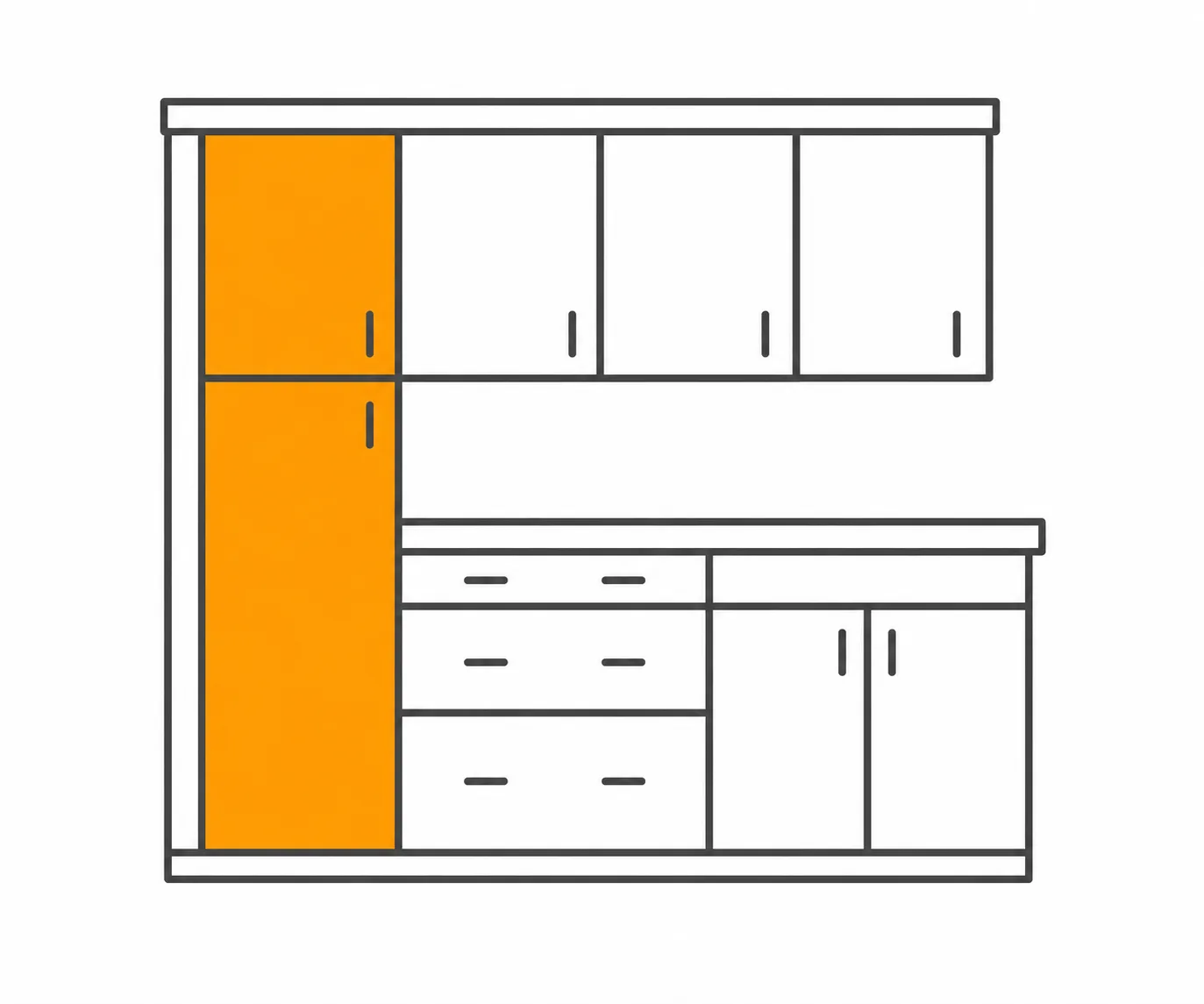
The build on this page: a single opening with a door above it and a door or drawer beneath. It is the most cabinet of the three and, at $1,758.25 to $1,920.75, the most expensive — you are paying for the woodwork around the appliance rather than for a larger hole. Right for one oven plus a separate microwave somewhere else, and right for anyone who wants the tower to also be storage.
Two ovens, stacked
GN OC3384D through OC3396D, $1,599.00 to $1,748.50. One tall opening, almost no cabinetry, and a set of questions of its own about weight and about how high the top oven can sit. That page covers them.
An oven with a microwave above it
GN OC3384C through OC3396C, $1,677.00 to $1,836.25. Two openings for two appliances of different heights, which makes it the box most often ordered wrong — both appliances have to be specified at the same moment. There is an order checklist on that page.
Where paint meets stainless
The sides of an oven tower do more work than the sides of a pantry, because there is an appliance in the middle of them and appliances are unforgiving neighbours. Three parts usually appear on the quote next to the box itself.
A tall filler, where the tower meets a wall or an adjacent cabinet whose width does not cooperate: GN TF396 at $84.50 for three inches by ninety-six, GN TF696 at $152.75 for six, both on the filler page. An end skin if a side is exposed: GN SK TALL, $169.00. And, where the tower is part of a run rather than a stand-alone, a tall pilaster such as GN PP-TP96 at $464.75 to divide it from the pantry beside it.
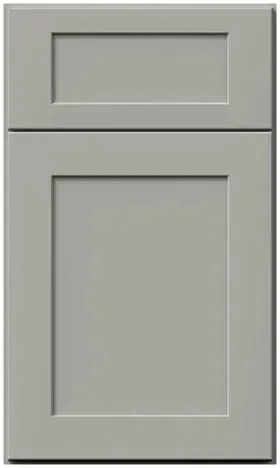
Order all of them factory-finished, and this is the one place the colour genuinely changes a decision. A filler is the only painted piece that touches the appliance, so it sits two inches from a bright stainless edge under direct light — the least forgiving position in the kitchen for a paint match. A site-painted grey next to a factory one is a difference you will notice from across the room, and a mid-tone shows the seam more readily than a white would. Buy the strip in the finish. It costs less than the argument.
Then the ordinary checks: ceiling measured, route walked, appliance on site or at least confirmed, and the wall sent for a free 3D design so the tower, the base run and the hood are drawn to the same dimensions. Trade buyers order through Captivating Pro, and everything in the finish is on the collection page.
Common questions
- What size cabinet do I need for a single wall oven?
- A nominal 30-inch wall oven takes a 33-inch-wide tower in this line, because the cabinet has to carry the cutout plus the face frame and the appliance trim overlap. Always check the cutout dimensions on the installation sheet against the published opening for the exact SKU before ordering.
- Do I have to buy the oven before the cabinet?
- Effectively yes. The opening is cut at the factory and cutouts vary by manufacturer, by series and by model year. Decide the exact model, take the installation sheet, and confirm it against the cabinet opening before the order goes in.
- How much is an oven cabinet?
- The single-oven tower runs $1,758.25 at 84 inches to $1,920.75 at 96. Double-oven boxes are $1,599.00 to $1,748.50 and oven-and-microwave combos $1,677.00 to $1,836.25.
- Does a wall oven need its own circuit?
- In most installations yes, and the amperage and connection type are stated on the appliance installation sheet. What matters for the cabinet is where the rough-in lands and how far it protrudes — a surface box behind a full-depth tower can hold the cabinet off the wall.
- Why does the single-oven cabinet cost more than the double?
- Because it is more cabinet. A double-oven box is mostly opening; a single-oven box has to be a finished cabinet above the appliance and storage below it, with the doors, drawer, hinges and runners that implies.
- Are oven cabinets available in different depths?
- No. Unlike the pantries, which come 12 and 24 inches deep, the oven towers are built full depth only — the appliance and its cutout require it.
Keep reading
The guides behind the numbers on this page.
- Fabuwood Cabinet Sizes and Specs
The published opening tables to check an appliance cutout against.
- Kitchen Cabinet Terminology: Glossary of Terms, Parts and Abbreviations
Opening, overlay, reveal and rough-in, defined the way both documents use them.
- Important Kitchen Dimensions Before Buying Cabinets
The counter an oven tower needs beside it, and how far it can be from the sink.
- How to Read Cabinet SKU Codes
Why the last letter of OC3396S is the most important character in the order.
- Cabinet End Panels, Scribe Molding and Fillers Explained
The strips that take up the difference beside a fixed-width tower.
- Free 3D Kitchen Design
Get the oven wall drawn to scale before a fixed opening is committed to.
- Kitchen Layouts Guide
Where the oven wall sits relative to the sink and the cooktop in each plan.
- Fabuwood Cabinets Review
What the box around the appliance is actually built from.


