

Wood, steel and glass: the Galaxy Horizon curved glass hood as an industrial kitchen, not a minimal one
Reviewed September 2026 · Captivating Cabinets
Prices quoted in this article were read off the grid on the review date; the live price grid on this page governs.
The curved glass shell in Galaxy Horizon is Fabuwood’s Curved Artisan hood, listed at 36″, 42″ and 48″ in the finish alone, with a Timber accent or with a Walnut accent. Over a painted shaker door, a glass canopy is usually discussed as a contemporary object, and the question is whether it fights the door. Over a stain with visible grain, the more useful way to see it is as one third of an older, well-tried palette: wood, steel and glass, the materials of an industrial kitchen. Fabuwood photographs this finish with industrial accents and stainless steel, and this page takes that direction seriously.
What Fabuwood photographs with this stain, and why it points here
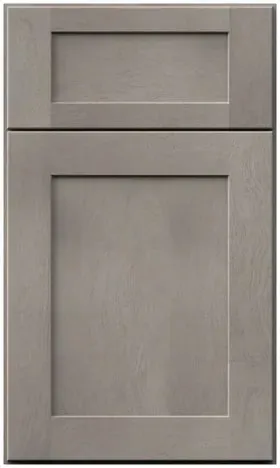
Fabuwood’s 2024 post of light-grey kitchen ideas includes this stain in several rooms that have nothing farmhouse about them. One is built around industrial accents. Others pair it with stainless steel, with a glass subway-tile backsplash, with subway tile laid with grey grout, with black countertops, and with a black marble backsplash. Taken together, that is a harder-edged room than the French country card Fabuwood also publishes for this finish, and it is the room a glass-and-steel canopy belongs in.
The reason it works on a stain in particular is the grain. Steel and glass are cool, smooth and hard. A flat grey paint beside them adds a third cool, smooth surface, and the wall can feel clinical. A stain that lets the wood show through adds the one thing the other two lack, a natural texture, and its warm taupe side softens the steel. That is our reading of it, not a Fabuwood claim, but it is why we draw this hood into more rooms in this finish than we would in a painted grey.
Under a glass canopy: glass tile, subway tile and grout
Of the backsplashes Fabuwood shows with this finish, two sit naturally under this hood: glass subway tile and ceramic subway tile with grey grout. Both are industrial in spirit, and each changes what the hood does.
Glass subway tile: two reflective surfaces
A glass tile under a glass canopy makes the range wall shiny from the counter to the top of the hood. In a room with good daylight that is lively; under strong downlights it can become a wall of reflections, with the insert’s lamps doubled in the canopy and again in the tile. If you like the pairing, choose a glass tile with some texture or a matte face, and keep the hood’s own lamps warm enough that the reflections flatter the grain around them.
Subway tile with grey grout: the calmer option
A plain ceramic subway tile with a grey grout, which Fabuwood also shows with this finish, gives the glass something matte to sit against. The grout is the detail that ties it in: a mid grey echoes the cabinets and hides cooking splash far better than white. Our advice is to pick the grout with a door sample in hand, since a grout that looks neutral on the chart can lean blue next to a warm stain.
Steel, black and the grain between them

An industrial range wall usually has two metals, and the question is which two. The hood’s liner is stainless, and the range almost always adds more. Fabuwood shows this finish with stainless appliances, so that half of the decision is made.
The second metal is the hardware on the flanking cabinets. Matte black is the classic industrial choice, and it links to a black countertop if you follow Fabuwood’s black-counter pairing. That is our advice rather than something Fabuwood photographs with this hood, and it has a trade-off on a light-to-mid stain: black pulls read as crisp dots across the run, which suits a loft-style room and can look busy in a small one. Brushed stainless or satin nickel hardware is the quieter answer, one metal throughout. Whichever you choose, keep warm metals such as brass away from this wall if the room is meant to read industrial; they pull it back toward the farmhouse look covered on the designer hood page.
Nine listings, and what the 48″ costs over a plain box
The curved glass shell is listed at three widths in three versions, and the Timber and Walnut versions cost the same as the plain one at each width. It is the only decorative shape in this finish that goes to 48″, the width for a 48″ range or for a 36″ range where you want generous overhang.
| Width | SKU (plain) | Shell | With the 400 CFM insert | With the 600 CFM insert |
|---|---|---|---|---|
| 36″ | GHZ RHCA36 | $3,532.75 | $4,436.25 | $5,320.25 |
| 42″ | GHZ RHCA42 | $3,789.50 | $4,693.00 | $5,577.00 |
| 48″ | GHZ RHCA48 | $4,062.50 | $4,966.00 | $5,850.00 |
For comparison, the plain wall-mount box at 48″ is $2,596.75, so the glass canopy costs $1,465.75 more at that width. Both take the same inserts. The 250 CFM insert is not offered for the 48″ plain box, but it is not excluded here; on a 48″ canopy over a large range, though, the 600 is the realistic choice, and the range-hood CFM guide explains the makeup-air rule that comes with it.
Plain, Timber or Walnut in a room of steel and glass
In an industrial room the plain version has the strongest logic. Wood, steel and glass is already a complete palette, and the stain is the wood. A Timber or Walnut accent adds a second wood tone to an object that already carries two other materials, and on a finish whose own colour moves with the light, the eye has more to reconcile. Our listings do not show which part of the shell carries the accent, so if you are drawn to one, ask for the drawing or a photo of that exact listing.
Where an accent does earn its place is a room that is only half industrial: a wood floor in a similar tone, a butcher-block island top, open shelving on reclaimed-look boards. There the accent picks up something already in the room. Hold a door sample of this finish against the floor and the accent photo together before deciding.
When this is the wrong hood for the room
The same reasoning that makes the glass canopy work in an industrial room makes it a poor choice in two others. The first is a kitchen that has already gone French country or farmhouse, the rooms Fabuwood also pictures with this stain. Brass hardware, an apron sink, veined marble and a glass-and-steel canopy send two different messages from one wall, and the canopy usually loses. In that room, the farmhouse shape does the job this one cannot.
The second is a kitchen where the range wall faces strong daylight. A glass canopy reflects what is opposite it, and in a room with a big window across from the range it can mirror the sky, the garden and the window frame back at you, which competes with the grain rather than framing it. Neither case is a rule, and both are easy to test: stand where the hood will hang, at canopy height, and look at what it would be facing. If it is a window, or a room full of warm, traditional detail, look at the plain wall-mount box or the slim hood instead.
Cleaning the glass without harming the stain beside it
A glass canopy needs regular cleaning, and the product most people reach for is a glass spray. That is where a stained hood needs a little care. Fabuwood’s warranty lists colour change from certain household cleaners among the things it does not treat as defects, and its cabinet-care guidance says never to spray cleaner directly onto the wood. Our own cabinet care guide goes further and keeps ammonia-based sprays away from cabinet finishes altogether.
On a hood where glass and stained wood meet, that adds up to one habit: spray the cloth, not the glass. A cloth dampened with glass cleaner, used on the canopy and kept off the wood frame, does the job without overspray drifting onto the stain. The wood parts of the hood get the same treatment as the rest of the cabinets — a little dish soap in warm water, a wrung-out soft cloth, wiped with the grain, then dried — and grease on the glass comes off more easily if the hood runs every time you cook.
Common questions
- Does a glass range hood go with wood cabinets?
- Yes, especially with a stain that shows its grain. Wood, steel and glass is the classic industrial palette, and the grain adds the texture that steel and glass lack. Over a flat painted door, a glass hood reads more contemporary.
- What backsplash goes under a glass range hood?
- Fabuwood shows this stain with glass subway tile and with subway tile and grey grout. Glass tile under a glass canopy is very reflective; a textured or matte tile, or a plain subway with mid-grey grout, is calmer.
- What hardware suits an industrial grey kitchen?
- Matte black or brushed stainless. Black links to a black countertop and reads crisp; stainless keeps one metal throughout. Brass pulls the room toward farmhouse instead.
- How much is a 48 inch curved glass range hood?
- In this finish the 48″ shell, GHZ RHCA48, is $4,062.50 before a blower, and $5,850.00 with the 600 CFM insert. The Timber and Walnut versions are the same price.
- How do I clean a glass range hood without damaging the cabinets?
- Spray the cloth, not the glass, so no cleaner drifts onto the wood. Fabuwood advises against spraying cleaner directly on its finishes, and some household cleaners can change a finish’s colour.
Keep reading
The guides behind the numbers on this page.
- Gray Kitchen Cabinets: Finding the Right Shade
Where a warm, grained grey sits against steel and cool stone.
- How to Clean and Care for Your Kitchen Cabinets
Which cleaners stay off a stained finish, and why.
- Range Hood CFM: How Much Ventilation Your Kitchen Needs
Sizing the blower under a 48″ canopy, and the 400 CFM line.
- Kitchen Cabinet Samples: How to Order & Evaluate
Testing a stain sample against tile, grout and metal finishes.


