

French country, modern farmhouse: the Galaxy Horizon designer hood in the rooms Fabuwood itself pictures
Reviewed September 2026 · Captivating Cabinets
Prices quoted in this article were read off the grid on the review date; the live price grid on this page governs.
The designer shell in Galaxy Horizon is Fabuwood’s Farmhouse hood, listed at 30″, 36″ and 42″, in the finish alone or with a Timber accent. It is the most decorative shape on the hood list and the most expensive. Most finishes leave you to work out which room a hood like this belongs in. This one comes with a brief: Fabuwood markets the stain for French country and modern farmhouse kitchens, and the pairings it photographs are specific enough to build a room from. This page starts from those rooms, separates what Fabuwood shows from what is our own advice, and ends with the one decision that is peculiar to a stain: whether to put a second stain on the same hood.
What Fabuwood says this stain is for
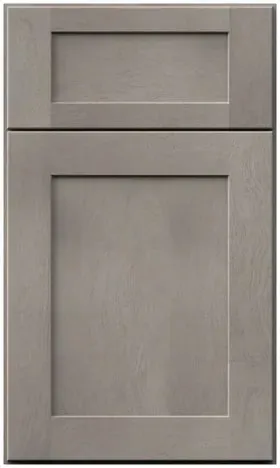
Fabuwood’s own descriptions are worth quoting, because they are more varied than most. The door-style page calls it an “adaptable gray stain, accented with soft pink undertones.” A style card on the same page, titled “Refined French Charm,” says its “soft taupe tones and delicate woodgrain bring a timeless elegance to French country style.” And Fabuwood’s 2024 blog of light-grey kitchen ideas shows it in a modern farmhouse room with open shelving, a farmhouse sink, shiplap and wood accents.
Two things follow from that for this page. First, of all the shapes listed, the farmhouse profile is the one that speaks the same language as those rooms: a broad canopy, a visible taper and the kind of mass that reads as a piece of furniture rather than an appliance. Second, the reason the stain suits those styles is the woodgrain. French country and farmhouse kitchens are built on materials that look like what they are, and a grey-taupe you can see wood through fits that far better than an opaque grey paint does. A big decorative hood is where that grain is most visible, so this shape and this finish work in each other’s favour.
The pairings Fabuwood shows, and the ones that are our advice

Fabuwood’s light-grey kitchen post pictures this stain with each of the following. We list them as it does, because each one is a pairing the manufacturer chose to photograph rather than a guess.
- A marble backsplash, and in a separate room a black marble one.
- Black countertops.
- Gold hardware, captioned against “the cool grey” — a reminder that even Fabuwood describes this stain as warm in one place and cool in another.
- Copper accents.
- A modern farmhouse room with open shelving, a farmhouse sink, shiplap and wood accents.
- Two-tone kitchens with Galaxy Frost (the white) and with Galaxy Cobblestone (the dark grey-brown stain).
The rest is our advice, not Fabuwood’s. For a French country room we would draw a veined marble or a warm white stone behind the hood, aged brass or copper on the flanking cabinets, and a plaster-white wall above the crown. For modern farmhouse, a matte black or oil-rubbed faucet, a white apron sink and open oak-toned shelves on the wall next to the hood. In both cases, keep the hood the same stain as the cabinets around it. A farmhouse hood is already the loudest thing on the wall; it does not also need to be a different colour.
Three widths, two looks, and the price of the silhouette
The designer shell is listed at three widths, in the finish alone or with a Timber accent. The accent costs nothing extra; the silhouette does. At 36″, this shape is $1,254.50 more than the chimney shell and $1,625.00 more than the plain box, and every one of those dollars is appearance. It takes the same blower inserts, moves the same air and uses the same duct as the cheaper shapes.
| Width | SKU | Shell | With the 400 CFM insert | With the 600 CFM insert |
|---|---|---|---|---|
| 30″ | GHZ RHF30 | $3,812.25 | $4,715.75 | $5,599.75 |
| 36″ | GHZ RHF36 | $4,043.00 | $4,946.50 | $5,830.50 |
| 42″ | GHZ RHF42 | $4,277.00 | $5,180.50 | $6,064.50 |
There is no 48″ in this family. The two shapes that reach 48″ in this finish are the plain wall-mount box and the curved glass hood. For a 30″ range, the 36″ shell gives better capture than the 30″ and costs $230.75 more; for a 36″ range, the 42″ does the same job.
Plain or Timber: two stains on one object
On a painted finish, a Timber accent is a simple contrast: wood against paint, textured against flat. On this finish the contrast is subtler and harder to judge, because both halves are stains. Timber is itself one of Fabuwood’s stains, and it appears on the short list of related finishes Fabuwood shows on this stain’s own page. A Timber hood in this finish therefore puts two wood tones, with two grains, on a single object, and our listings do not show exactly which parts of the shell carry the accent. Ask for the drawing, or a photo of the accent version, before choosing it.
Our view is that it works when the Timber has somewhere else to land in the room — open shelving, a butcher-block run, a wood floor in a similar tone — so the accent on the hood reads as part of a pattern rather than a one-off. It works less well when the hood is the only warm wood in sight, because then the eye reads two nearly-related browns and greys side by side and wonders if one of them is a mismatch. That is a sharper risk on a stain than on a paint, since the grey-taupe itself shifts with the light. If you are unsure, the plain version is the safer choice; the farmhouse profile carries the room on its own.
Whichever you choose, get a door sample of this finish and hold it against whatever wood the room already has. Our brown and stained cabinets guide covers how warm wood tones sit together, which is the question the Timber accent raises.
What the rest of the wall should do
A farmhouse hood is wide, deep and visually heavy, so the wall around it has to be calmer than it would be under a plain box. Three things keep it in proportion.
Let the backsplash run quiet
Fabuwood’s marble pairing is a good model: one material, with movement in it, rather than a pattern. A busy tile under a decorative hood competes with it. If the room has open shelving, keep the backsplash going behind the shelves so the wall reads as one surface.
Let the flanking uppers be plain
The five-piece shaker door is already the right partner for this hood. Resist glass fronts or decorative mouldings on the two cabinets either side of it; they make three focal points on one wall. If you want glass in the room, put it on a different run.
Keep one metal near it
Gold and copper both appear in Fabuwood’s photographs, and a stainless range sits below. On the few feet around the hood, choose one warm metal for the hardware and let the range be the steel. A third metal on the same wall is one too many.
More detail, more to keep clean
The farmhouse shape has more edges and profiles than the plain box, and all of them sit in the rising cooking plume. Grease settles on those ledges first. On a stain, the answer is the same routine as the rest of the cabinets, done a little more often on the hood: warm water with a little dish soap, a wrung-out soft cloth, wiped with the grain, then dried. Our cabinet care guide covers when to escalate and what never to use. The easiest way to reduce the cleaning is to run the hood every time you cook, which is also the best argument for choosing a blower you will actually switch on; the internal blower page covers that.
Common questions
- Does a farmhouse range hood go with grey cabinets?
- With a warm, grained grey like this one, very well. Fabuwood markets this stain for French country and modern farmhouse kitchens, and the farmhouse hood is the shape that suits those rooms. A cool, flat grey paint is a harder match.
- What countertops and backsplash go with a grey stained kitchen?
- Fabuwood photographs this stain with black countertops, a marble backsplash and a black marble backsplash, among others. Behind a decorative hood, one material with movement in it usually works better than a patterned tile.
- Is gold or copper hardware better with grey stained cabinets?
- Fabuwood shows both with this stain. Pick one warm metal for the hardware near the hood and let a stainless range be the steel on that wall.
- How much is the designer range hood?
- In this finish, $3,812.25 for 30″, $4,043.00 for 36″ and $4,277.00 for 42″, before a blower. With the 400 CFM insert the 36″ is $4,946.50. The Timber version is the same price.
- Does a more expensive hood ventilate better?
- No. The designer shell takes the same blower inserts and duct as the cheaper shapes. The extra cost buys the farmhouse profile, not airflow.
- Should I choose the Timber accent on a grey stained hood?
- Only if Timber-toned wood appears elsewhere in the room, such as shelves, a butcher block or the floor. On its own, a second stain on the hood can read like a mismatch. Ask for a drawing showing which parts carry the accent first.
Keep reading
The guides behind the numbers on this page.
- Gray Kitchen Cabinets: Finding the Right Shade
Why this grey reads warm, and how it differs from the painted greys.
- Brown Kitchen Cabinets: Stains, Shades & Pairings
How two wood tones sit together, the question a Timber accent raises.
- How to Clean and Care for Your Kitchen Cabinets
Keeping grease off a detailed stained hood without harming it.
- Range Hood CFM: How Much Ventilation Your Kitchen Needs
The blower and duct that do the work inside this shape.
- Kitchen Cabinet Samples: How to Order & Evaluate
Holding a stain sample against the other woods in the room.


