

Light on the range wall: how the Galaxy Horizon slim hood reads beside the uppers, morning to night
Reviewed September 2026 · Captivating Cabinets
Prices quoted in this article were read off the grid on the review date; the live price grid on this page governs.
The slim shell in Galaxy Horizon is Fabuwood’s Signature hood, listed at 30″, 36″ and 42″ in three versions: the finish alone, with a Timber accent, or with a Walnut accent. Its point is restraint. It keeps a low profile and sits close to the line of the wall cabinets, so the range wall reads as one continuous run rather than two cabinets with an object between them. That makes the slim hood the shape that is always seen in the same breath as the doors beside it, lit by the same windows and the same bulbs. On a stain that moves with the light, the lighting of that wall is the decision worth getting right.
A grey that changes with the light, in the words of people who own it

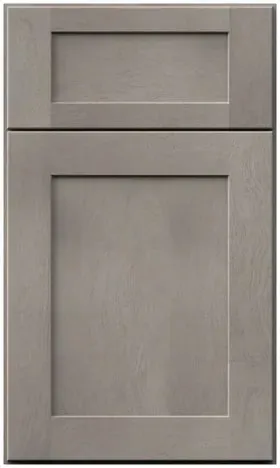
Fabuwood’s own copy for this finish pulls in two directions. One page describes an adaptable grey stain with soft pink undertones; a style card talks about soft taupe tones; the finish page itself speaks of misty greys and silvery undertones. Fabuwood’s colour value for it is a warm grey-taupe. Its copy for the same stain on another door style says it shifts with light, and that is the most useful description of the lot.
Owners say the same thing more bluntly. In a long Houzz discussion of this stain, a homeowner who installed it in 2022 reported that on a cloudy day the cabinets can look cold or dull, and on a sunny day they look warm, and that how much natural light the kitchen gets makes the difference. A kitchen designer whose showroom sells Fabuwood added that it can read warm or cool depending on the other furnishings. You may also read, on some older pages, that it is a blue-grey. Fabuwood never describes it that way, and its colour value is warm; a cool photo or a grey day is the likely source of that impression.
None of that is a fault. It is what people like about the finish. But it means the range wall, where the hood and the uppers stand together under the most deliberate lighting in the kitchen, is where you decide which version of this grey you will live with.
Why the slim shape makes this a lighting question
A chimney or farmhouse hood stands proud of the uppers. It catches light differently from the flat doors either side, and the eye accepts that it is a separate object. The slim shell does not stand apart in the same way. It stays low and close to the line of the run, with the same stain, so it reads as one more piece of the upper cabinetry, and any difference between it and its neighbours reads as a difference in the run.
Two sources of light act on that wall. There is under-cabinet lighting along the flanking uppers, which lights the backsplash and the lower edge of the doors; and there are the lamps inside the hood, which light the cooktop and the underside of the canopy. If those are different colours of white, the hood and the uppers can look like two different stains even when they are the same one. That is the practical problem this page solves.
Choosing warm or cool light for a grey-taupe

Light for kitchens is sold by colour temperature, in kelvin: around 2700K is warm and yellowish, 3000K is a soft neutral-warm, and 4000K is a clean, cooler white. This is our general advice, not a Fabuwood specification, but on a stain that already moves between warm and cool it has a predictable effect.
| Light | Likely effect on this finish | When we would choose it |
|---|---|---|
| 2700K, warm | Pulls toward the taupe and pink; reads cosy, a little browner | North-facing kitchens, and rooms with warm wood floors and brass |
| 3000K, soft neutral | Keeps the grey and the warmth in balance; closest to what most people pictured | Our default for the range wall in most kitchens |
| 4000K, cool | Pulls toward the silvery side; the grain reads crisper | Bright south-facing rooms with white stone and stainless, where you want it cooler |
Whatever you choose, the rule that matters is to match the two sources. Pick the under-cabinet strip and then check the colour temperature of the hood insert’s own lamps in its specification sheet before ordering; our listings do not publish it. If they differ, the hood will read as a different stain from the uppers at night, which is exactly when the under-cabinet lights are on.
Test the sample on the range wall, at three times of day
A door sample in this finish is $35.00, and on this page it is worth more than any photograph, including ours. The door sample is the same stain on the same five-piece door, and the test is simple.
- Tape it to the wall where the hood will hang, at the height of the canopy, not flat on the counter.
- Look at it in the morning, in the middle of the day and after dark with the lights you plan to use switched on. A phone photo in each light, taken from the same spot, makes the comparison honest.
- Hold a white sheet of paper beside it in each light. If the paper looks yellow, so will the stain’s warmth; if it looks blue, the stain will lean silvery.
- Check it with a cloudy day in the mix if you can. The owner reports above are specific that overcast light is when it looks coolest.
Our samples guide covers the rest of the method, and the grey cabinets guide shows where this stain sits among the painted greys if you are still comparing it with one of them.
Plain, Timber or Walnut, judged in the same light
All nine slim listings are the same price at each width, so the choice between the plain finish and the two accent woods is purely visual. On this wall it is also a lighting choice, because every accent is another colour that the light will move.
| Width | SKU (plain) | Shell | With the 250 CFM insert | With the 400 CFM insert |
|---|---|---|---|---|
| 30″ | GHZ RHS30 | $2,785.25 | $3,204.50 | $3,688.75 |
| 36″ | GHZ RHS36 | $2,944.50 | $3,363.75 | $3,848.00 |
| 42″ | GHZ RHS42 | $3,159.00 | $3,578.25 | $4,062.50 |
The plain version is the one that best serves this shape’s purpose, since it keeps the run continuous. Of the two accents, judge them by how far each sits from a light-to-mid grey-taupe: the further the accent is in depth and warmth, the more it will read as a separate object, and the more the light will move the two apart, since warm light tends to draw warm tones together and cool light separates them. Look at both on the product pages in daylight rather than choosing by name. Our listings do not show which parts of the shell carry the accent, so ask for a picture or the drawing before choosing it; and if you are going to add an accent to a shape whose job is to blend in, make sure the same wood tone appears somewhere else in the room, so the hood reads as part of a scheme.
A range under or beside a window
Slim hoods often end up on walls with a window close by, because the low profile leaves room for one. Two practical cautions for a stain. Direct sun on one side of the hood and not the other can make the two halves look different at certain times of day, which is the light, not the finish. And Fabuwood’s warranty treats colour change from sunlight and UV as outside its cover, so a hood that takes hard afternoon sun is worth protecting with a shade or UV film on the window, as our cabinet care guide recommends for any run that faces the glass.
For everything else on that wall — the flanking uppers, the fillers and the crown — the principle from the plain wall-mount hood page applies: order every stained piece you will see in the same glance on one order, so the only variable left is the light.
Common questions
- Why do my grey cabinets look different in different light?
- Because a warm grey like this stain sits between warm and cool, and the light decides which way it leans. Owners report it looks cooler and duller on cloudy days and warmer in sun. Test a sample on the wall at several times of day.
- Is this grey stain blue-grey?
- No. Fabuwood describes it with soft pink or taupe undertones, and its published colour value is warm. Some older descriptions call it blue-grey; cool light or a cool photo is the likely reason.
- What colour temperature under-cabinet lighting suits grey cabinets?
- For a warm grey stain we usually draw 3000K, which keeps the grey and the warmth balanced. 2700K pushes it browner, 4000K pushes it silvery. Match the hood insert’s lamps to the under-cabinet strip.
- How much is the slim range hood?
- In this finish, $2,785.25 for 30″, $2,944.50 for 36″ and $3,159.00 for 42″, before a blower. The Timber and Walnut versions cost the same.
- Walnut or Timber accent with grey cabinets?
- Compare both on the product photos in daylight, and hold a sample of this finish beside them. On a hood meant to blend in, the plain finish is usually best; choose an accent only if that wood tone appears elsewhere in the room.
- Will sunlight fade a stained range hood?
- Colour can change with sun and UV exposure over time, and Fabuwood does not treat that as a defect. A shade or UV-filtering film on a nearby window protects the hood and the cabinets around it.
Keep reading
The guides behind the numbers on this page.
- Gray Kitchen Cabinets: Finding the Right Shade
Warm and cool greys side by side, and where this stain belongs.
- Kitchen Cabinet Samples: How to Order & Evaluate
The full method for judging a sample on your own wall.
- How to Clean and Care for Your Kitchen Cabinets
Protecting a sunny run of stained cabinets from uneven fading.
- Range Hood CFM: How Much Ventilation Your Kitchen Needs
Why a shallow hood should still overhang the cooktop.


