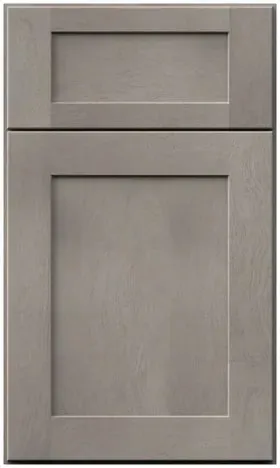


One order, one look: buying the Galaxy Horizon wall-mount hood so it matches the doors beside it
Reviewed September 2026 · Captivating Cabinets
Prices quoted in this article were read off the grid on the review date; the live price grid on this page governs.
The plain wall-mount shell in Galaxy Horizon is Fabuwood’s Arched hood: a flush-sided box at 36″, 42″ or 48″, and the least expensive of the five shapes on the hood list. On a painted finish, a box like this is simply a colour. On a stain it is something else: the biggest single flat face of stained wood in the kitchen, hung at eye level between two runs of doors that it will be compared with for as long as the kitchen stands. That comparison is what this page is about: why the hood needs to be on the same order as the cabinets, what to look at when it arrives, and what counts as normal.
Why a stained hood is a matching question, not just a size question
A stain is a translucent colour laid over wood, and the wood shows through it. That is the whole appeal of this finish: the grain on the stiles and rails, and the figure in the veneered centre panel, are visible under the grey-taupe instead of being buried beneath an opaque coat of paint. It is also why no two stained parts are ever quite identical. Fabuwood says so directly in its Allure specification book, where stained finishes carry a note that because of the nature of wood and the complex finishing processes involved, there may be variations in colour, and those variations are considered normal.
Most of the time that variation is invisible, because the eye averages it across a run of doors of similar size. A hood is not averaged. It is one large object, usually the widest single piece on the wall, and it sits in the middle of the upper run where it is compared directly with the doors either side. If it came from a different finishing run from those doors, the difference has nowhere to hide. The same book is candid about the other half of the problem: under the warranty terms, replacement cabinets may not match display samples or existing cabinets. A part ordered later is, in effect, a replacement part.
None of this is a defect and none of it is unique to Fabuwood. It is what buying a real stain involves. But it turns one piece of ordering advice from a nicety into a rule, and the rest of this page follows from that.
Put the hood on the first order, even if the range is not chosen yet
The most common way a stained hood ends up visibly different from the cabinets around it is timing. The kitchen is ordered, the range is still undecided, and the hood gets left off “until we know the size.” Weeks later it is ordered on its own, finished in a different batch, and arrives a shade warmer or cooler than the doors it will hang between.
The fix is to decide the hood width from the wall rather than from the appliance. For a 30″ range, the 36″ box is the better hood anyway, because a hood that overhangs the cooking surface by about three inches each side captures more of the rising plume; the range-hood CFM guide walks through why. For a 36″ range, the 42″ box does the same job. For a 48″ range, the 48″ box is the widest this family goes. Once the width is fixed, the hood can go on the same order as everything else, and the range can be chosen at leisure as long as it fits the base opening you drew.
The blower is different. It is a Broan-NuTone insert that sits inside the hood’s stainless liner, it has no finish, and nothing about it varies from batch to batch. If the airflow question is still open, it is the one part of the hood order that can safely wait. The internal blower page covers how to decide it, and which choices are hard to reverse later.
Three widths, and what each costs with a blower in it
The Arched box is listed at three widths, all with a full stainless liner and none with a blower. There is no 30″ version in this family; a 30″ range takes the 36″ box, or one of the other shapes on the list if the wall cannot spare the width. There is also no accent-wood version of this shape: the chimney and designer shells list a Timber accent, and the slim and curved glass shells list Timber or Walnut, but the Arched box comes in the finish only. In a room where the hood must match the doors, that is not a loss.
| Width | SKU | Shell | With the 400 CFM insert | With the 600 CFM insert |
|---|---|---|---|---|
| 36″ | GHZ RHA363021 | $2,418.00 | $3,321.50 | $4,205.50 |
| 42″ | GHZ RHA423021 | $2,502.50 | $3,406.00 | $4,290.00 |
| 48″ | GHZ RHA483021 | $2,596.75 | $3,500.25 | $4,384.25 |
Two notes on that table. The 250 CFM insert ($419.25) fits every Allure wood hood except one, and the exception is the 48″ box on the bottom row, GHZ RHA483021; pair that width with the 400 or 600. And the spread between the narrowest and widest box is under $180, so width should be chosen for capture and for the wall, never to save money. Ductwork, the exterior cap and damper, the circuit and the installation are not in any of these numbers.
On delivery day: how to inspect a stained hood before it goes up

Every problem is cheaper to raise before the hood is fixed to the wall than after, and a stain gives you one extra reason to look closely. Unpack it where you can see it in daylight, next to at least two of the doors it will hang between, and go through it in this order.
- Stand it beside the doors, not on its own. Lean the hood against the wall with a flanking wall cabinet door either side, at roughly the height they will hang if you can manage it. Judge it from where you will normally stand, about the width of the kitchen away, not with your nose to it.
- Look for tone, then for grain. A slight shift in warmth, or a panel whose figure is busier than its neighbour, is the variation Fabuwood describes as normal. A distinctly different colour across the whole piece, or blotching that looks like finish rather than wood, is worth photographing and raising before installation.
- Check the flush sides. This box is built with finished ends because a wood hood projects well past a 12″-deep upper and its sides are on show. Run a hand and an eye along both of them and along the bottom edge, which is where knocks happen in transit.
- Look inside. The stainless liner should be seated, undented and free of anything rattling loose. It is removable for cleaning, and it is what the blower bolts into, so a bent liner is an installation problem as well as a cosmetic one.
- Photograph everything before the installer starts, in the same light, with a door beside the hood in each shot. If there is a question later, photos taken before the first screw are the ones that settle it.
If something needs raising, call us on 609-900-3358 with the photos in hand. A scuff on an edge is a touch-up; a panel that reads as a different colour is a conversation to have before the box is on the wall, because after that it is a replacement part with its own batch.
The top of the box, the crown line and the plane above
The Arched box has a lift-up top panel rather than a chimney, and Fabuwood’s note for this family is that crown molding is applied above the cabinet, not fixed to the hood’s face frame. On a stain that detail has a second consequence. Crown is a run of stained molding, and any length of it that crosses above the hood is compared with the hood in the same glance, so it belongs on the same order as the box for the same reason the flanking cabinets do. The molding types guide covers the profiles; the elevation drawing decides how far the run goes.
Above the box there are three usual outcomes: a short wall cabinet, a stained panel, or open wall. Each is a different amount of stained surface meeting the hood. A panel above the hood is the hardest to get right later, because it is a large, plain, grain-forward face sitting directly on top of another one. If the drawing shows one, finish it in the same run as the hood or leave the wall open until you can. The fillers and panels guide explains how those pieces are cut and scribed on site.
Depth, finished sides and the one custom question worth asking
A wood hood is deeper than the wall cabinets beside it, because it has to reach the front burners that sit 18″ to 20″ out from the wall. That depth is why the sides of this box are finished and why they are on show from across the room. The standard depth is set by the drawing in Fabuwood’s specification book; our listings publish width and price, not depth, so check the drawing against anything that sits beside the range before ordering.
Of the five shapes, this is the one Fabuwood allows to be made shallower or deeper by custom quote. That option has a catch on a stain that it does not have on a paint. A custom-quoted part is priced and scheduled on its own track, separate from the stock cabinets, and anything finished on its own track is exactly the later-batch problem described at the top of this page. If you need it, ask for the hood and the cabinets either side of it to be released for finishing together, and get that in writing on the quote.
Where the other shapes fit, briefly
If a plain box is not the look you want, four other shapes are listed in this finish, each with its own page: the chimney hood for a tapered stack to the ceiling, the designer hood for a farmhouse profile, the slim hood for a canopy that stays in line with the uppers, and the curved glass hood for a glass canopy. The matching rule on this page applies to every one of them; the plain box is simply where it matters most, because nothing on its face distracts from the stain itself.
Common questions
- Does a stained wood range hood match the cabinets exactly?
- Closely, not exactly. Fabuwood says colour variation in stained finishes is normal because wood varies, and its warranty notes that replacement parts may not match existing cabinets. Ordering the hood with the cabinets keeps the difference as small as it can be.
- Can I order the range hood after the cabinets?
- You can, but on a stain we advise against it: a hood ordered later is finished in a different run and may read slightly warmer or cooler than the doors beside it. Decide the width from the wall now, and leave only the blower, which has no finish, for later.
- What size wall-mount hood goes over a 30 inch range?
- The 36″ box, GHZ RHA363021 at $2,418.00. This family has no 30″ size, and a hood about three inches wider than the cooking surface on each side captures more smoke than one the same width.
- Does the 48 inch wall-mount hood take the 250 CFM blower?
- It does not. That 48″ box, GHZ RHA483021, is the single exception to the rule that every insert fits every Allure shell. Choose the 400 at $903.50 or the 600 at $1,787.50 for it.
- What should I check when my range hood is delivered?
- Unpack it in daylight beside two of the doors it will hang between. Check overall tone, both finished sides and the bottom edge, and the stainless liner inside. Photograph everything before installation starts.
- Is there a Timber or Walnut version of the plain hood?
- Not on this shape. If a second wood tone on the hood appeals, four other shapes carry one: Timber on the chimney and designer, Timber or Walnut on the slim and curved glass, each priced the same as its plain listing.
Keep reading
The guides behind the numbers on this page.
- Range Hood CFM: How Much Ventilation Your Kitchen Needs
Why a hood wider than the range captures more, and what sits inside the shell.
- Gray Kitchen Cabinets: Finding the Right Shade
Where this warm grey stain sits among the greys, and why it reads warmer in sun.
- Kitchen Cabinet Molding Types and Where Each One Belongs
The crown that runs above this box rather than onto its face.
- Cabinet End Panels, Scribe Molding & Fillers Explained
The stained pieces that meet the hood and belong on the same order.
- Kitchen Cabinet Samples: How to Order & Evaluate
How to judge a stain sample, and why the light you look at it in matters.


