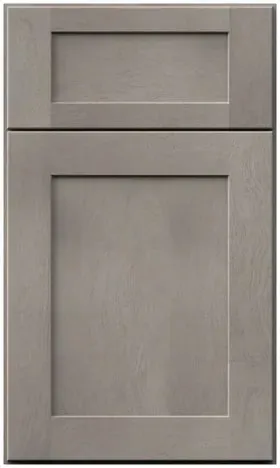


The front that travels: Galaxy Horizon pull-out organizers, grouped by the face that moves
Reviewed September 2026 · Captivating Cabinets
Prices quoted in this article were read off the grid on the review date; the live price grid on this page governs.
The Galaxy Horizon pull-out organizers are twenty-eight parts under one heading, and the most useful way to sort them is not by price or width. It is by what moves when you pull. On some of them the stained face itself slides out of the run, with the shelves hanging behind it. On others a hinged door opens first and a unit behind it slides. That single difference decides which pull goes on the part, what the edges go through over ten years, how exact the alignment has to be, and whether a face ordered on its own has to sit convincingly between doors made on a different day. This page sorts the list that way and deals with each consequence in turn.
Three families, sorted by what moves

Filler pull-outs. These turn the strip of filler that would otherwise be a dead face into a narrow sliding rack. The face is the part you grip, so the stained front is the moving part. The base versions are GHZ SPO-BF3 at $334.75, GHZ TBPO-BF3 at $432.25, GHZ SPO-BF3 BLUM at $585.00, GHZ SPO-BF6 at $380.25, GHZ SPO-BF6 BLUM at $695.50, and the slim GHZ SSPO-BF1-1/2 at $1,313.00. The wall versions come three and six inches wide at 30, 36, 39 and 42 inches high, from GHZ SPO-WF330 at $380.25 up to GHZ SPO-WF642 at $497.25.
Base pull-out kits, 9 to 24 inches. These go into a base cabinet of the matching width: GHZ TDPO-B9 BLUM at $672.75 through GHZ UKBPO-B15 BLUM at $1,433.25, then the 18- and 24-inch units (GHZ MLU-B18 at $1,088.75, GHZ CWO-B18 BLUM at $1,075.75 and GHZ CWO-B24 BLUM at $1,241.50). Whether each kit mounts to the cabinet door so that the door rides out with it, or sits behind a door that still swings, is not stated on the listings. It changes everything below, so ask for each code you are considering.
Blind-corner pull-outs. GHZ BPO-BLB42/45 L or R at $1,277.25 and GHZ BPO-BLB48/51 L or R at $1,394.25 sit inside a blind corner base, and the corner base door opens first on its hinges. Here the face does not travel; the unit behind it does.
What changes when the stained face is the thing you pull
A hinged door is gripped, swung and let go. A sliding face is gripped at one point and dragged straight out against the weight of everything behind it, then pushed back. Three things follow from that, and each one is worth planning.
The pull takes the whole load. On a three-inch face there is no room for anything but a short vertical bar or a single knob, and whatever you fit is carrying a loaded rack every time. Our general advice is a bar rather than a knob, fixed with two screws, because a single-screw knob on a heavily used sliding face works loose and twists. Hold the pull in your hand before you order it and check your knuckles clear the neighbouring doors.
The edges pass close to their neighbours. A sliding face runs out parallel to the doors on each side with a small reveal between them. If it drops a fraction at the front under load, or twists, the edge brushes the door beside it. On paint that shows as a rubbed line; on a stain it wears the finish off the edge. The remedy is alignment, and the check is in the next section.
The face gets handled at one spot for years. Hand oil collects round the pull on a sliding face faster than on any door, because it is gripped harder. Fabuwood’s care guidance applies: mild cleaners, never sprayed straight onto the wood, and blot anything wet rather than wiping it across the grain.
Alignment: the check to do loaded, not empty
Every pull-out is aligned when it is installed, and almost every one is aligned empty. That is the mistake. A narrow rack full of oils, vinegars and spice jars is heavy, and what looked square empty can sit a fraction low at the front once it is loaded. Load it with what it will really hold, close it, and look along the run from the side.
- The reveal each side of the face should match the reveal between the doors next to it. A tapering gap means the face is twisted.
- The top of the face should line up with the top of the neighbouring drawer fronts or doors. A face that sits lower at the front is sagging under the load.
- Pull it out slowly and watch the edges. They should not touch anything on the way out or on the way back.
- Close it firmly. It should stop flush with the doors, not proud of them and not behind them.
How much adjustment each mechanism allows, and where, is not published on the listings. The installer should set it with the unit loaded. If something drifts after a few months, which is normal as the load settles, send us the code and a photo from the side and we will tell you what can be adjusted.
A three-inch face is a stile, and on a stain it shows like one
A painted face has no grain, so a narrow painted filler reads as a flat strip. A stain is different. The Galaxy door is a solid wood frame with a veneered centre panel under the stain, and the grain is visible through the finish. At three inches wide there is no room for a frame and panel, so a filler face reads as one strip of wood, exactly as a door stile does. Set between two doors, it should look like a third stile: grain running vertically, the same way as the frames either side.
That is how the parts are made, and it is also why a narrow face is where variation between stained parts is easiest to see. Fabuwood says plainly that colour variation between stained parts is normal and that parts may not match display samples or existing cabinets. Next to a wide door a slight shift in tone reads as the character of wood. Beside a narrow strip that is meant to vanish between two frames, the same shift can make the strip stand out.
The answer is timing. Order the filler pull-outs on the same order as the doors, so they come through as one batch and arrive together. If you are adding one to a kitchen that is already standing, buy a door sample first and hold it against your installed doors in daylight; on a stain that has had a year or two of light, that comparison tells you what to expect.
The list by face width, from the slim filler to the blind corner
Here is the whole list grouped by the width of the face or box it belongs to, so you can see where each price step is.
| Width | Codes | Price range | What moves |
|---|---|---|---|
| Slim filler | GHZ SSPO-BF1-1/2 | $1,313.00 | The face |
| 3″ base filler | GHZ SPO-BF3 · TBPO-BF3 · SPO-BF3 BLUM | $334.75–$585.00 | The face |
| 6″ base filler | GHZ SPO-BF6 · SPO-BF6 BLUM | $380.25–$695.50 | The face |
| 3″ wall filler | GHZ SPO-WF330 to WF342 | $380.25–$432.25 | The face |
| 6″ wall filler | GHZ SPO-WF630 to WF642 | $438.75–$497.25 | The face |
| 9″ base | GHZ TDPO-B9 · SPO-B9 · UPO-B9 (all BLUM) | $672.75–$880.75 | Ask per code |
| 12″ base | GHZ SPO-B12 · UPO-B12 · UKBPO-B12 (all BLUM) | $919.75–$1,205.75 | Ask per code |
| 15″ base | GHZ UKBPO-B15 BLUM | $1,433.25 | Ask per code |
| 18″ base | GHZ MLU-B18 · CWO-B18 BLUM | $1,075.75–$1,088.75 | Ask per code |
| 24″ base | GHZ CWO-B24 BLUM | $1,241.50 | Ask per code |
| 42–45″ blind corner | GHZ BPO-BLB42/45 L or R | $1,277.25 | The unit, behind a door |
| 48–51″ blind corner | GHZ BPO-BLB48/51 L or R | $1,394.25 | The unit, behind a door |
Two readings worth taking from it. The filler faces are the cheapest way into a pull-out on this finish, and they are also the parts whose stained face has to sit between doors. The dearest items on the list are the ones where the face question barely arises: a blind-corner unit is hidden behind a door that came with the cabinet. Price is buying mechanism, not face.
The slim filler pull-out is the outlier: $1,313.00 for the narrowest face on the list, more than the 12-inch base kits. What it contains is not described. If the gap it would fill is genuinely too narrow for anything else, ask what it holds before you decide it is worth that. All twenty-eight codes are on the pull-out organizer list.
Where a moving face is a good idea, and where it is not
A sliding stained face belongs where the hand goes often and the contents are light: oils and spices beside the hob, cleaning sprays beside the sink, trays and boards in a 3-inch gap between a base and a wall. It is a poor idea at the very end of a run where the face will be kicked or knocked by passing traffic, and beside a dishwasher where the open machine door sits against it.
Near the hob, think about grease. A face gripped with cooking hands collects it at the pull; wipe it with a mild soapy cloth and dry it. Fabuwood’s warranty names certain household cleaners, alongside sunlight and smoke, among the causes of colour change it does not cover, so skip strong degreasers that are not meant for finished wood.
Whatever the position, the stain rewards one habit more than paint does: fix small marks early. The Touch Up Kit at $62.40 is a stick, marker and scraper; Fabuwood makes no spray can for stains. A scuff on a narrow face is a minute’s job with a marker and a small job for a long time after that.
Common questions
- Will a filler pull-out match my cabinet doors?
- It is stained in the same finish, but Fabuwood treats colour variation between stained parts as normal, and a narrow face is where a difference shows most. Order it on the same order as the doors. If you are adding one later, hold a door sample against your installed doors first.
- What kind of handle is best for a narrow pull-out?
- A short vertical bar fixed with two screws, in our experience. The pull carries the whole loaded rack every time it moves, and a single-screw knob tends to work loose. Check your knuckles clear the doors on either side.
- Why is my pull-out cabinet front out of alignment?
- Usually because it was set empty and has settled under load. Load it, close it, and look for an uneven reveal or a face that sits low at the front. How much each mechanism adjusts is not on the listings; send the code and a side photo and we will tell you.
- Does the door move with a blind corner pull-out?
- No. GHZ BPO-BLB42/45 and BPO-BLB48/51 sit inside a blind corner base; the cabinet door opens first and the unit slides out behind it. They are handed: left or right is decided by which side the blind part of the cabinet is on.
- How much is a pull-out organizer?
- From $334.75 for a 3-inch base filler pull-out (GHZ SPO-BF3) to $1,433.25 for the 15-inch base kit (GHZ UKBPO-B15 BLUM). Wall filler pull-outs run $380.25 to $497.25 and blind-corner units $1,277.25 to $1,394.25.
- Which way should the grain run on a cabinet filler?
- Vertically, the same way as the door stiles either side, so the filler reads as another stile. On a stained finish the grain is visible, which is why a narrow filler face is noticed more than it is on paint.
Keep reading
The guides behind the numbers on this page.
- Cabinet End Panels, Scribe Molding & Fillers Explained
Where fillers come from in a run, and why some become pull-outs.
- Beam-Mounted Pull-Out Accessories: What They Are and What to Buy Instead
How a pull-out carries its load, and what that means for alignment.
- Brown Kitchen Cabinets: Stains, Shades & Pairings
Why stained faces vary piece to piece, and how they touch up.
- Kitchen Cabinet Samples: How to Order & Evaluate
Holding a sample against installed doors before a late order.
- Space-Saving Cabinet Solutions
Which narrow gaps are worth a pull-out and which are not.
- Free 3D Kitchen Design
A designer replies within one business day; the full drawing and quote follow in 24–48 hours.


