

Daylight first: planning Galaxy Horizon cabinet lighting around a stain that changes with the weather
Reviewed September 2026 · Captivating Cabinets
Prices quoted in this article were read off the grid on the review date; the live price grid on this page governs.
Most lighting advice starts with the fixtures. For this finish it should start with the window. The Galaxy Horizon cabinet lighting list has pucks, bars, strips and the parts that power them, but the reason to light this stain carefully is that its colour moves with the daylight: people who live with it describe it looking cool and flat on an overcast day and warm on a sunny one. Undercabinet light is the one light in the kitchen you control, so its job here is to be the constant. This page reads the room first, then chooses fixtures run by run, then deals with colour and the wood housings.
Why this stain looks different on a grey day

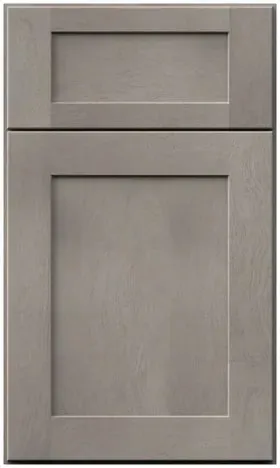
Fabuwood gives this finish a warm grey-taupe value (#989089) and describes it in more than one way: a grey stain with soft pink undertones on the door page, soft taupe tones on another, and misty greys and silvery undertones on the finish page. Those descriptions are not contradictory so much as a record of how it behaves. Fabuwood’s own copy for the finish on another door says it shifts with the light.
People who own it say the same thing more plainly. One homeowner with this stain on her kitchen wrote that on a cloudy day the cabinets can look cold or dull and on a sunny day they look warm, and that it depends on how much natural light the kitchen gets. A kitchen designer who sells the line said it can read warm or cool depending on the furnishings around it.
For lighting, that is useful information. The daylight in your kitchen sets where the stain sits most of the time. The fixtures decide where it sits for the hours when daylight is gone or weak, which in winter is most of the hours the kitchen is used. That is why the plan below starts with the window, not the fixture list.
Read the room before choosing a single fixture
Answer four questions about the kitchen, on paper, before looking at prices.
- Which way do the main windows face? As general guidance, north light is cool and even all day, south light is strong and warm, east is bright in the morning and west in the evening.
- How much of the cabinetry sees that window directly? In an L or a U, one run often faces the window and another sits with its back to it.
- What is the weather like for most of the year where you live? A kitchen under grey skies half the year will see the cool, flatter version of this stain far more often.
- When is the kitchen actually used? A household that cooks after dark in winter lives with the artificial light more than the daylight.
The answers sort each run of wall cabinets into one of two kinds. A run in good daylight needs light for the evening and for task work, and not much more. A run in poor daylight, facing away from the window, in a north-facing room or under grey skies, needs light that does more: it is the only warm source that run ever gets.
Puck lights or light bars? Decide it run by run
The list gives you two ways to light the underside of a wall cabinet. Puck sets are matched to cabinet width, from GHZ LED W09 at $74.75 for a nine-inch box to GHZ LED W39 at $152.75, with a single GHZ LED 2-1/4" PUCK at $71.50. Light bars are continuous and sold by length, from GHZ LED FLS24 at $487.50 to GHZ LED FLS60 at $1,027.00 in the Standard housing. Bars give an even wash; pucks give pools of light with softer gaps between.
Spend where the daylight is weakest. On the run that gets good window light, puck sets are usually enough for evenings. On the run that never sees the sun, a bar is worth the money, because that run depends on it for the look of the stain as well as for task light.
| Run | Daylight | Fixtures | Cost |
|---|---|---|---|
| Window run: a 30″ and a 36″ wall cabinet | Good | GHZ LED W30 $130.00 · GHZ LED W36 $146.25 | $276.25 |
| Back run: a 30″ and a 36″ wall cabinet | Poor | GHZ LED FLS30 $539.50 · GHZ LED FLS36 $617.50 | $1,157.00 |
| Whole kitchen in bars | — | Two FLS30 and two FLS36 | $2,314.00 |
| Whole kitchen in pucks | — | Two W30 and two W36 sets | $552.50 |
The mixed plan in the first two rows comes to $1,433.25 in fixtures, $880.75 less than bars everywhere and with the money spent on the run that needs it. The driver ($204.75), wireless switch ($221.00) and, where runs are joined, mesh connector ($201.50) are separate lines on every route. Whether pucks and bars can share one driver and switch is not stated, so ask before mixing them on one circuit.
Warm or cool light for a grey-taupe stain
There is no single right colour temperature for this finish, because it has two faces and you are choosing between them. Our advice, which is general lighting practice and not a Fabuwood specification, is to decide which of its two reads you bought it for.
If you chose it for the warm, taupe side, the soft pink undertone Fabuwood describes, a warm-white source around 2700K to 3000K will lean it that way after dark and in a room with cool daylight. If you chose it for the silvery, misty side, a neutral source around 3500K to 4000K keeps it there. What we would avoid is a very cool, bluish source in a room that already has cool daylight: the stain then has nothing warm in it at any hour.
If the household cannot agree, or if the room swings between strong summer sun and grey winters, GHZ LED STRIP TUNABLE WHITE 10MM at $286.00 is the one fixture on the list whose colour can be changed after it is fitted. And whichever you choose, check it the way the finish demands: take a door sample and look at it on a grey afternoon by the window, then after dark under a bulb of the temperature you are considering.
Wood housings beside a grained door

The bars come in three housings: Standard, Timber and Walnut. Standard and Timber are priced the same at every length; Walnut costs more, from GHZ LED FLS24 WALNUT at $585.00 to FLS60 WALNUT at $1,098.50.
On a painted kitchen a wood housing is simply a wood accent. On this finish it is a third wood-look surface beside a door whose grain already shows through the stain, and wood next to wood invites comparison. Our advice is one of two things. Either hide the housing completely behind a light rail molding (GH LRM, $149.50, on the light rail page), so the only thing anyone sees is the light; or choose the housing to echo a wood that is already in the room, such as the floor or a butcher-block top, so it reads as part of a scheme rather than a near-miss. The Timber and Walnut names are finish names, so look at the housings before choosing rather than going by the word.
The Standard housing is the safe choice if the fixture will be visible and there is no other wood nearby. It is also the cheapest of the three, alongside Timber.
Who fits it, and when
Undercabinet lighting is low-voltage at the fixture, but the driver is wired to the mains, and that part is a job for an electrician. The simplest time to do it is between the wall cabinets going up and the backsplash going on, when the driver can be placed where it will stay reachable and any cables can be run before the tile hides them. The wireless switch on the list ($221.00) means no switch cable needs to be chased into a finished wall.
Tell us in the design request which runs face the window and which do not, and the drawing will come back with fixtures matched to each run rather than one fixture everywhere. If an electrician or contractor is buying the lighting with the cabinets, our trade program, Captivating Pro, gives trade pricing; there is one program, with no tiers or logins.
Lighting inside an open or glass box
The interior of every box in this line is a natural wood veneer, noticeably paler and warmer than the grey-taupe outside. In a glass-front or open-shelf box, GHZ LED CAB INT 48" STRIP at $221.00 lights that interior, and on a grey afternoon it gives the run a warm spot that does not depend on the weather. It is the smallest spend on the list that addresses the daylight problem directly, and on a run that faces away from the window it is worth considering for that reason alone.
Common questions
- Why do my grey cabinets look different on cloudy days?
- Because a muted grey stain takes on the colour of the light falling on it. Homeowners with this finish report it looking cold or dull on overcast days and warm in sun. Undercabinet light is the one source you control, so it can steady the look after dark and on grey days.
- What colour under-cabinet light suits greige or taupe cabinets?
- Decide which side of the finish you want to bring out. As general guidance, around 2700K to 3000K leans a grey-taupe warmer, and around 3500K to 4000K keeps it silvery. The tunable strip (GHZ LED STRIP TUNABLE WHITE 10MM, $286.00) can change after installation.
- Should I use puck lights or light bars?
- Decide by run. A run in good daylight usually needs only puck sets ($74.75 to $152.75 each); a run that never gets sun is worth a bar ($487.50 to $1,027.00 in the Standard housing). In our L-shaped example the mixed plan costs about 62 per cent of bars everywhere in fixtures.
- How do I light a kitchen with little natural light?
- Put the budget into the runs that face away from the window: continuous bars under those wall cabinets, and an interior strip in any glass or open box. Choose a warm-to-neutral colour so a grey stain is not left cool at every hour.
- Should an under-cabinet light housing be wood?
- Only if it echoes a wood already in the room, such as the floor or a butcher-block top. Otherwise hide the housing behind a light rail molding (GH LRM, $149.50). Standard and Timber housings cost the same; Walnut costs more.
Keep reading
The guides behind the numbers on this page.
- Gray Kitchen Cabinets: Finding the Right Shade
How warm and cool greys move under different light.
- How to Match Kitchen Cabinets With Countertops, Backsplash and Flooring
Counters that throw light back onto the doors, and ones that absorb it.
- Kitchen Cabinet Samples: How to Order & Evaluate
Looking at a sample by the window and after dark before deciding.
- Glass Cabinet Doors: Buying Guide, Styles & Installation Tips
Where an interior strip earns its place.
- Parts of a Kitchen Cabinet: Every Component Named, From Toe Kick to Crown
Where the light rail sits, and what it hides.
- Free 3D Kitchen Design
A designer replies within one business day; the full drawing and quote follow in 24–48 hours.


