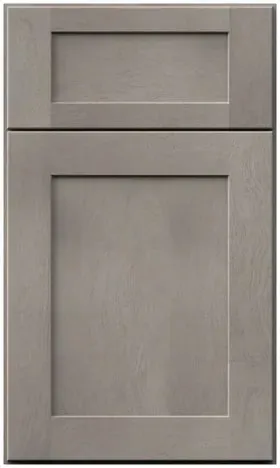


The corner as it is seen: Galaxy Horizon lazy susan inserts, the angled door and the order to buy in
Reviewed September 2026 · Captivating Cabinets
Prices quoted in this article were read off the grid on the review date; the live price grid on this page governs.
The Galaxy Horizon lazy susan inserts are hidden parts, but the corner they turn in is the most visible cabinet on the wall. It is the one door that faces the room at an angle, or the one door pair that folds, and on a stain whose tone moves with the light, that matters more than it would on paint. This page is about the corner as people see it: what a face turned 45 degrees does next to flat doors, how a pie-cut door has to come to rest, what the whole corner costs with its insert, and why, on this finish, the box has to be bought with the kitchen while the mechanism can wait.
Six inserts, two corner shapes, and the boxes they belong to
The mechanisms come in two shapes. A pie-cut insert is a round tray with a quarter missing; a wedge insert is a part-circle for a corner with one angled door. Both are listed by cabinet width and height, and those heights (30 inches, or a 36-to-42-inch band) are wall-cabinet heights. Read against the corner wall cabinets in this finish, they line up with the pie-cut GH WPC boxes and the diagonal GH WDC boxes. That pairing is our reading of widths and heights, not a statement on either listing, so confirm the two codes together before ordering.
Four of the six appear on this page under a lazy susan title. The two 30-inch-high versions for a 24-inch box are filed under other titles, as a Wood Version (GHZ LSW24 30, $429.00) and a Plastic Version (GHZ LSP24 30, $227.50), on the wider accessory list. Ask for them by code if you cannot find them.
| Insert | Price | Matching box (our reading) | Corner complete |
|---|---|---|---|
| GHZ LSP24 30 (pie-cut) | $227.50 | GH WPC2430 · $542.75 | $770.25 |
| GHZ LSP24 36/42 (pie-cut) | $341.25 | GH WPC2436 · $633.75 | $975.00 |
| GHZ LSW24 30 (wedge) | $429.00 | GH WDC2430 · $455.00 | $884.00 |
| GHZ LSW24 36/42 (wedge) | $663.00 | GH WDC2436 · $510.25 | $1,173.25 |
| GHZ LSW27 30 (wedge) | $546.00 | GH WDC2730 · $539.50 | $1,085.50 |
| GHZ LSW27 36/42 (wedge) | $848.25 | GH WDC2742 · $682.50 | $1,530.75 |
The complete column is the useful one, because the corner is bought as a pair. The cheapest turning corner on the finish is the 30-inch pie-cut at $770.25; the dearest is the tallest 27-inch diagonal at $1,530.75, about twice as much. At 36 inches high the pie-cut corner complete is $198.25 less than the 24-inch wedge corner. If the shape of the corner is still open, that is a real saving, and the next two sections are about how each shape looks once it is up.
Why a door turned 45 degrees can read as a different shade

A diagonal corner cabinet has one door on the 45, facing into the room between two runs. Every other door on the wall is square to the wall. That means the angled door meets the window light at a different angle from all its neighbours, and at some times of day it will catch more light and at others less.
On a flat, opaque paint that makes little visible difference. On this stain it can. Fabuwood describes the finish as a grey that shifts with the light, and homeowners report it reading cool and flat on an overcast day and warm in sun. A stained face also shows grain, and grain reads differently depending on the angle the light arrives at. Put the two together and the angled door can look a touch warmer or cooler than the doors either side of it for part of the day, then match them again later. It is the same finish; it is simply turned.
This is worth knowing, not worth worrying about. Most people who notice it like it: the corner reads as a little lantern of wood tone in the run. If you would rather it did not, the check is simple. Take a door sample to the corner, hold it square to the wall and then at 45 degrees, morning and evening. What you see is what the door will do.
Pie-cut doors have to come to rest square
A pie-cut corner wall cabinet has a two-part door that meets at the inside of the corner. In some corner designs those door panels are fixed to the turntable and rotate with it; in others the door is hinged in the usual way and the turntable turns behind it. Which arrangement you get with a given insert and box is not described on either listing, and it changes how the corner behaves, so ask before ordering.
If the door panels ride on the turntable, the one thing to check on installation is where it stops. The turntable has to come to rest with both panels square to their runs and flush with the doors beside them. A few degrees off and one panel sits proud, the reveal between it and the next door tapers, and its edge catches the light as a bright line. On a stain that line is more obvious than on paint, because the edge of a stained panel shows the grain end-on. Turn it by hand to the closed position several times after it is fitted and check it lands in the same place.
If the door is hinged, the check is the usual one: the turntable must clear the door and the hinge as it turns, and nothing on the tray should brush the back of the door. Load it and turn it once around slowly with the door wide open, then again with the door at the angle you actually open it.
Either way, the edges of a corner door get knocked more than the doors of a straight run, because the corner is where two people pass. If an edge gets marked, the Touch Up Kit at $62.40 is the repair; Fabuwood makes no spray cans for stained finishes.
The box goes on the original order; the insert can wait
On a paint, you could argue for buying the corner cabinet late and still expect it to match. On this stain, the corner box is a stained door face that will sit at the junction of two runs, and Fabuwood is plain that colour variation between stained parts is normal and that replacement or later parts may not match existing cabinets. The corner box belongs on the same order as its neighbours.
The insert is the opposite. It lives inside the box, where the interior is a natural wood veneer, and it is never seen against a door. That makes it one of the safest parts on this finish to buy later. Build the corner with fixed shelves, live with it for a season, and add the turntable if you find yourself emptying the front of the shelf to reach the back. The insert list will still be there, and at 24 inches wide and 30 high the wood wedge at $429.00 costs almost as much as the $455.00 box, so waiting until you know you want it is a reasonable saving.
One thing to check before choosing that route: ask whether the box you are ordering takes the insert later without a change at the factory. For most corners it should, but it is a one-line question and the answer belongs on your quote.
When the corner arrives: look at it in daylight before it goes up
Every stained part on an order is a little different from the next, and Fabuwood treats that as normal. Most of the time the differences are what make the run look like wood. Occasionally a single door is further from its neighbours than you would like, and the corner door, because it will be the most visible door on the wall, is the one to check.
Before the installer hangs anything, stand the corner cabinet next to the wall cabinets that will flank it, in daylight, doors facing the window as they will on the wall. Look from across the room rather than up close. If the corner reads as part of the same family, hang it. If it stands out clearly, talk to us before it goes up, not after; a question raised with the cabinet still on the floor is a much simpler conversation.
While it is on the floor, fit the insert and turn it by hand a few times. It is far easier to see how the turntable sits, and whether anything catches, at waist height than overhead.
Using an overhead turntable day to day
A corner wall turntable is at chest to eye height, and it works best loaded evenly. Put heavier things near the centre and spread them round the tray; a turntable loaded on one side tips slightly and turns unevenly. Keep tall bottles off the edge where they will catch the door or the frame as it turns.
Spills are rarer overhead than in a base corner, but they happen, and a turning tray carries the spill round with it. Wipe the tray with a damp cloth and dry it; do not flood it. The care guide covers the rest of the cabinet, including the stained door.
If the corner is at the end of a run by a window, remember that sun moves a stain. Fabuwood’s warranty lists colour change from sunlight and UV as outside its cover, and says finishes may darken or lighten over time. A corner door that gets direct afternoon sun will age a little differently from one in shade; a blind or a film on the glass is the cheap protection.
Common questions
- Why does my diagonal corner cabinet door look a different colour?
- It faces the window at a different angle from the flat doors around it, so it catches the light differently. On a stain that shifts with the light and shows grain, that can make an angled door read slightly warmer or cooler at some times of day. It is the same finish, turned.
- Can you add a lazy susan to an upper corner cabinet later?
- Usually yes, because the insert lives inside the box and is never seen against a door. Confirm the box takes the insert without a factory change when you order it. Buy the corner box itself with the rest of the kitchen, since on a stain later parts can vary in colour.
- Why won’t my pie-cut corner cabinet doors close straight?
- If the doors ride on the turntable, it is stopping a few degrees off square, so one panel sits proud. Turn it to the closed position by hand several times and check where it lands; send us the code and a photo if it will not settle.
- How much is a corner wall cabinet with a lazy susan?
- From $770.25 for a 24-inch, 30-inch-high pie-cut corner with its plastic insert, to $1,530.75 for a 27-inch, 42-inch-high diagonal corner with its wedge insert. The pairings are our reading of widths and heights; confirm the two codes together.
- Should I check stained cabinets before they are installed?
- Yes, especially the corner. Stand it beside the cabinets that will flank it, in daylight, and look from across the room. Colour variation between stained parts is normal, but if one door stands out clearly, raise it before it is hung.
- Which is cheaper, a pie-cut or a diagonal corner wall with a turntable?
- At 24 inches wide and 36 high, the pie-cut: GH WPC2436 with GHZ LSP24 36/42 is $975.00, against $1,173.25 for GH WDC2436 with GHZ LSW24 36/42. At 30 inches high the pie-cut is also cheaper, $770.25 against $884.00.
Keep reading
The guides behind the numbers on this page.
- Gray Kitchen Cabinets: Finding the Right Shade
Why the same grey reads differently in different light.
- Wall & Tall Kitchen Cabinets: Sizes & Buying Guide
Corner wall heights and how they line up with the insert bands.
- Kitchen Cabinet Samples: How to Order & Evaluate
Checking a sample at an angle and in different light before you order.
- Fabuwood Cabinet Accessories: Lazy Susans, Trash Pull-Outs, Drawer Inserts and Blind Corners
Photographs of corner turntables in base and wall cabinets.
- Free 3D Kitchen Design
A designer replies within one business day; the full drawing and quote follow in 24–48 hours.


