

The most expensive box in the bathroom: three layouts that earn a Galaxy Nickel vanity drawer base
Reviewed September 2026 · Captivating Cabinets
A vanity drawer base is the correct answer to bathroom storage and it is priced like it knows. At every width it runs somewhere between $237 and $290 more than the drawer-over-door box of the same size, which is roughly double the money for the same cubic feet of cabinet. That premium is not a markup on the idea of drawers; it is four drawer boxes and four pairs of runners instead of one of each. The question is not whether drawers are better — in a bathroom they plainly are — but whether this particular box, in this particular position, is where that money does the most work. There are three layouts where it is, and a lot of bathrooms where it is not.
It is always the second column, never the first

Start with the constraint that decides everything on this page. A drawer base has no plumbing accommodation in it at all — no notch, no cut-out, nothing. It cannot go under a basin, because a full-extension drawer would travel straight through a trap. So it is never the cabinet the sink sits on. It is always the cabinet beside the one the sink sits on, which means this box does not exist unless your bathroom is wide enough for two cabinets.
That explains why so many people shortlist a drawer base and then find it does not fit their room. Work out where the bowl goes first, then see what is left. If what is left is under twelve inches, there is no drawer base in your future and the argument moves to the sink-and-drawer combo, which does both jobs in one carcass.
The other half of the position argument is who uses it. A drawer stack beside a bowl is opened by somebody standing sideways to it, usually holding something, usually in a hurry. That is a good position for drawers and a bad one for a cupboard door, which has to be swung clear before anything can be reached. It is the strongest practical case for this box and it has nothing to do with capacity.
Three layouts where the premium is the right money
We would specify this box in three situations and talk people out of it in most others.
- Two adults, one bathroom, one morning. A 60-inch or wider run with a bowl at one end and a drawer stack at the other gives each person a defined place to keep things, which is the single most effective thing you can do to a shared bathroom. This is the layout where a drawer base pays for itself in domestic peace rather than in storage.
- The narrow leftover beside the basin. Twelve to eighteen inches of wall next to a sink base is the classic filler situation, and GN VDB12-34 at $601.25 or GN VDB15-34 at $627.25 turns it into the best cabinet in the room — four tiers of small things, all visible, in a space that would otherwise hold a strip of wood. Expensive per inch, and the only way to get drawers into a room that has no other space for them.
- A bathroom where nothing bulky lives under the counter. If the cleaning kit is elsewhere, the bin is free-standing and nobody stores a laundry basket in the vanity, then the cupboard half of a conventional box is being wasted and the drawer stack is simply the better use of the same volume.
And the situations where we would not. A guest bath or a powder room, where the cabinet holds a spare roll and a hand towel and $601.25 of drawer boxes is money spent in the wrong room. Any bathroom where a mop bucket, a caddy or a nappy bin has to go under the counter — drawers cannot take those, and the full height door box can, for less. And a single-cabinet bathroom, where there is no second column and the answer was always the combo.
What the money buys, mechanically
It is worth being concrete about what the premium is made of, because "drawers cost more" is not an argument anyone can check. Each tier is a ⅝-inch solid-wood drawer box with dovetailed corners, running on Tandem plus Blumotion concealed full-extension runners — the drawer comes all the way out, the runners are underneath rather than at the sides so nothing eats into the width, and the last two inches close themselves. That is four of those instead of one, in the same carcass, and the runners are the expensive half.
What that buys in use is visibility. A drawer presents its entire contents from above when it is open; a shelf presents its front row. In a room where every object is a small bottle, that difference is the whole argument, and it is why we say plainly that drawers beat doors for everything in a bathroom except bulk. Why dovetails and full-extension runners are the thing to look at when comparing cabinets is set out in the dovetail drawer piece and the soft-close comparison.
One spec we do not publish per width is the drawer count, so we will not print one. Assume the stack is divided into a shallow top tier and deeper tiers below — that is the normal arrangement — and ask us to confirm the split for the width you are ordering before it goes on the acknowledgement. The construction guide covers what is inside these boxes in general.
Before it goes on the order
Three things, in the order they cause trouble. First, position relative to the bowl, which is a drawing question rather than a preference — the stack should open into clear floor, never into the swing of the room door or the side of the toilet. Second, the wall it stands against: if the end of the stack faces the room or a bath, it needs a finished side, and that is a quoted line rather than something on a shelf. The end panel guide explains what is what.
Third, and most often forgotten: what the drawers will be divided with. Four undivided tiers in a bathroom become four shallow ponds of small objects within a month. Budget for dividers or inserts at the same time as the cabinet, not a year later — the vanity accessories page has the bath-specific parts, and the space-saving guide covers the general principle.
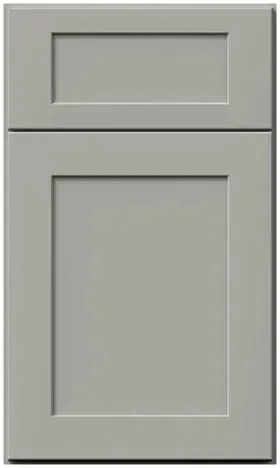
A last word on the finish, because it changes something here. A drawer stack is four horizontal fronts with three shadow lines between them, read from two feet away. On a mid-tone neutral those reveals are more legible than on a white door, so the stack reads as furniture rather than a flat panel — either what you wanted or one line too many. A door sample at $25.00 in the actual bathroom settles it, and the design service will draw the run around the plumbing before you commit.
Common questions
- Can a vanity drawer base go under the sink?
- No. It has no plumbing accommodation at all, and a full-extension drawer would travel straight through the trap and the tailpiece. It stands beside the bowl, never under it, which means it only exists in a bathroom wide enough for two cabinets.
- How much more does an all-drawer vanity cost?
- Between $237.25 and $289.25 more than the drawer-over-door box of the same width, on our displayed figures at review — roughly double. The premium peaks at 21 inches and falls away at both ends, because the narrow drawer boxes are cheap and the wide comparison box already has two doors in it.
- Is there a 30-inch vanity drawer base?
- Not in this finish. The widths go 12, 15, 18, 21, 24, 27 and then jump to 33. If the drawing wants exactly 30 inches of drawers, use the 27-inch stack with a 3-inch filler or take the 33 and find three inches elsewhere in the run.
- When is a drawer base worth the money?
- Three layouts: a shared bathroom where two people need their own defined space, a 12 to 18-inch leftover beside the basin that would otherwise be a filler, and a bathroom where nothing bulky has to live under the counter. In a guest bath or a powder room it is money in the wrong room.
- What is inside the drawers?
- ⅝″ solid-wood dovetailed boxes on Tandem plus Blumotion concealed full-extension runners — they come all the way out, the runners are underneath rather than at the sides, and the last two inches close themselves. The runners are the expensive half of the premium. The tier split per width is worth confirming on the order.
- What is the widest vanity drawer base?
- 33 inches, GN VDB33-34 at $877.50, which is the dearest single non-combo cabinet in the bath range. Beyond that width the answer is a sink-and-drawer combo, which puts a bowl and a drawer stack in one carcass.
Keep reading
The guides behind the numbers on this page.
- Dovetail Drawers and Cabinet Quality
What you are paying for four times over in this box.
- Soft-Close vs Self-Closing Cabinet Drawers
The runner mechanism that makes up most of the premium.
- Fabuwood Bathroom Vanities: Sizes, Styles and Buying Guide
The whole bath range, so the second column has something to stand beside.
- Space-Saving Cabinet Solutions
Dividing four tiers before they become four ponds of small objects.
- Cabinet End Panels, Scribe Molding and Fillers Explained
Fillers at 30 inches, and finishing an exposed end of the stack.
- Kitchen Cabinet Materials and Construction
What the carcass under those runners is made of.
- How Much Do Fabuwood Cabinets Cost
Where drawer hardware sits in the cost of a cabinet.


