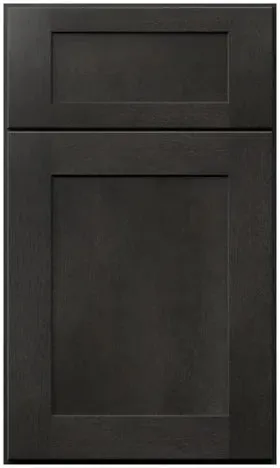
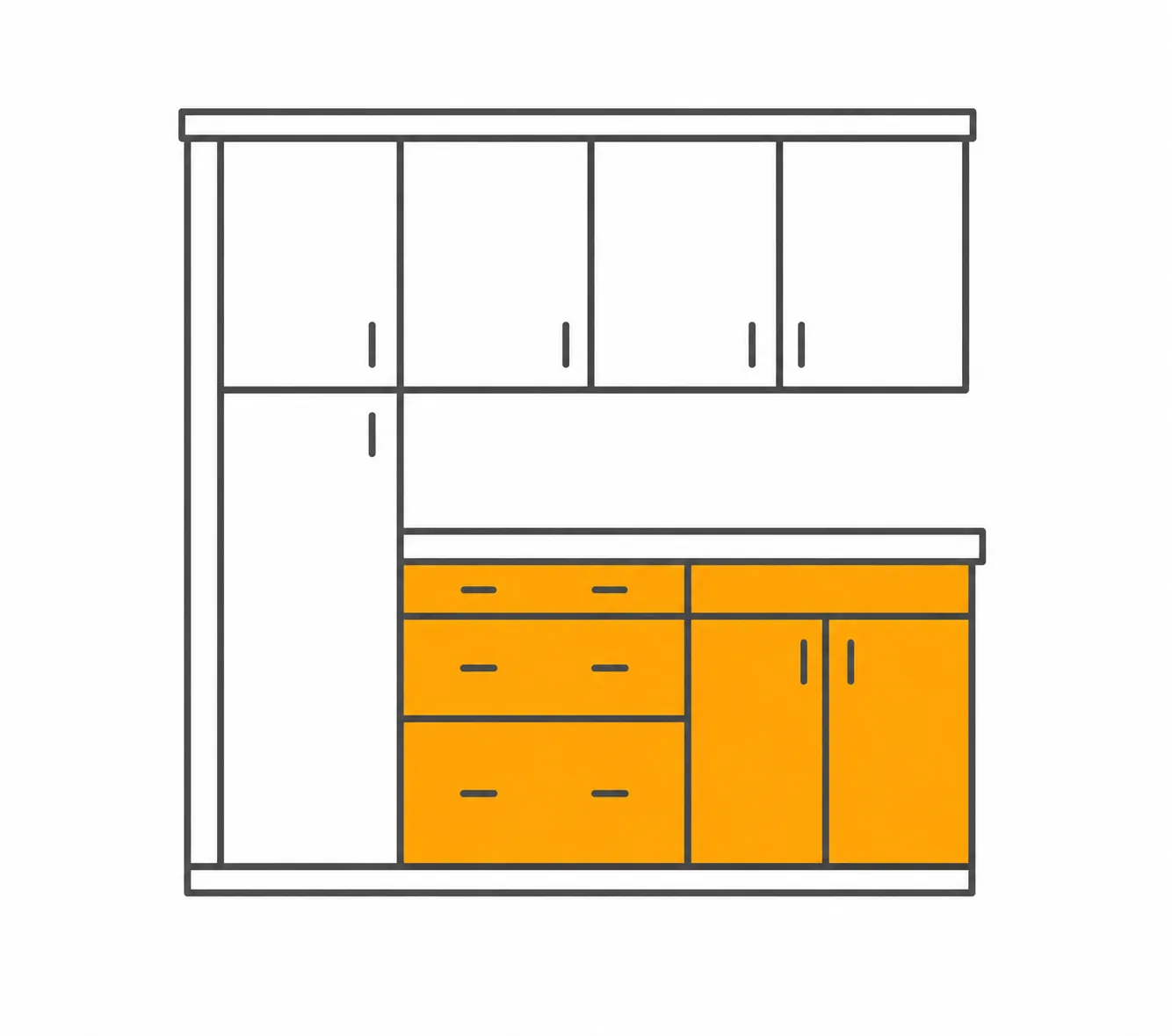


Knee height, both hands full: how a Galaxy Cobblestone 2 drawer base cabinet wears
Reviewed September 2026 · Captivating Cabinets
The pot drawer gets opened with a knee, a hip, a wet hand and a floury one, more often than any other front in a base run, and it lives at the height where splashes land. That makes the Galaxy Cobblestone 2 drawer base cabinet the best place to understand what a dark stained finish shows over time and what it hides. It comes in 24″, 30″ and 36″; this page is about keeping it looking the way it did on delivery day.
Three widths, three neighbours, three kinds of mess
Fabuwood builds this configuration as GC DB24-2 at $724.75, GC DB30-2 at $835.25 and GC DB36-2 at $1,017.25: two deep dovetailed drawers on Blum Tandem plus Blumotion full-extension runners, in a 34½″ by 24″ pre-assembled box. The width usually follows the appliance above it, and the appliance decides what the front will be exposed to.
- Under a cooktop (the 30″ or 36″): steam and a fine film of cooking grease settle on the top rail. On a dark front a grease film shows as a dull patch in the sheen rather than as a stain, visible only when light rakes across it.
- Beside the dishwasher or sink (usually the 24″): the drips. Water running off the counter edge dries as pale mineral spots on the top rail, and on this finish they are the most visible mark of all.
- At the baking end: flour and sugar. Both drift down onto the ledge formed by the top of each drawer front and sit there, white on near-black, until wiped.
None of that is a reason to avoid the finish. It is a reason to know which neighbour this cabinet gets before choosing a pull, and to keep a dry cloth nearer the 24″ than the 36″.
Do dark cabinets show dust and fingerprints? A mark-by-mark answer

The honest answer is: some marks, not others, and they swap places compared with a white or mid-gray door. The table is from our own kitchens and callbacks, not a lab. Where a mark is worse here than on the light Galaxy finishes, it says so.
| Mark | Where it lands on this cabinet | On Cobblestone | Against a light Galaxy finish |
|---|---|---|---|
| Dust and lint | Top edge of each front, the toe kick | Shows as a gray film within a week or two | Worse; white dust barely registers on white |
| Flour, sugar, powdered detergent | The ledge on top of each front | Obvious from across the room | Worse |
| Dried water spots | Top rail under the counter edge | Pale rings, the most visible mark | Worse |
| Hand grime around the pull | Rail and panel within two inches of the pull | Mostly disappears into the colour | Better; this is the classic white-door complaint |
| Skin oil and fingerprints | Flat rails where hands push drawers shut | Visible as shine when light rakes across | Different; shows as sheen rather than smudge |
| Fine scratches | Anywhere keys, buttons or a ring touch | Broken up by the visible grain | Better than a flat paint of any colour |
| Shoe scuffs | Bottom rail of the lower drawer, toe kick | Rubber leaves light gray streaks | Worse; black scuffs show on white instead |
The pattern: anything pale that lands on the front shows, and anything dark that comes off hands does not. A household that cooks with flour weekly will wipe this cabinet more than a white one. A household with small children and sticky fingers will wipe it less.
Why the grain matters more than the colour
Cobblestone is a stain, not an opaque paint: the dark gray-brown sits in the wood and the grain reads through it. That changes two things on a drawer front that gets knocked daily.
First, small scratches hide. On a flat painted door, a fine scratch is a straight line across a uniform field and the eye finds it at once. Here the same scratch crosses dozens of grain lines running the same way and mostly vanishes into them. A deeper ding that goes through the topcoat is another matter, and the next section covers it.
Second, no two fronts are identical. Grain figure and how much stain each piece takes vary from board to board, so the upper and lower drawer on the same cabinet can read a touch different, and a 36″ front shows more figure than a 24″. That is what stained wood does, not a defect. The door sample at $25.00 is one piece of wood; treat it as a guide to the colour, not a promise of the exact figure on every drawer.
The pull decides where hands land, and feet land anyway
On a front roughly 15″ tall, a knob or short pull leaves fingertips resting on the rail, and over months skin oil builds a faint shine exactly there. A long bar mounted on the top rail keeps the hand wrapped around metal instead of wood, and on the lower drawer it doubles as something to hook with a free finger when both hands hold a pan.
The lower drawer gets closed with a foot. Rubber soles leave light gray streaks on the bottom rail that show clearly on this colour, and they come off with a damp cloth, not a scrub. If the drawer is beside the dishwasher, expect this weekly. We would rather plan for it than pretend it will not happen: it is a wipe, not damage.
Cleaning a dark stained front without making it worse
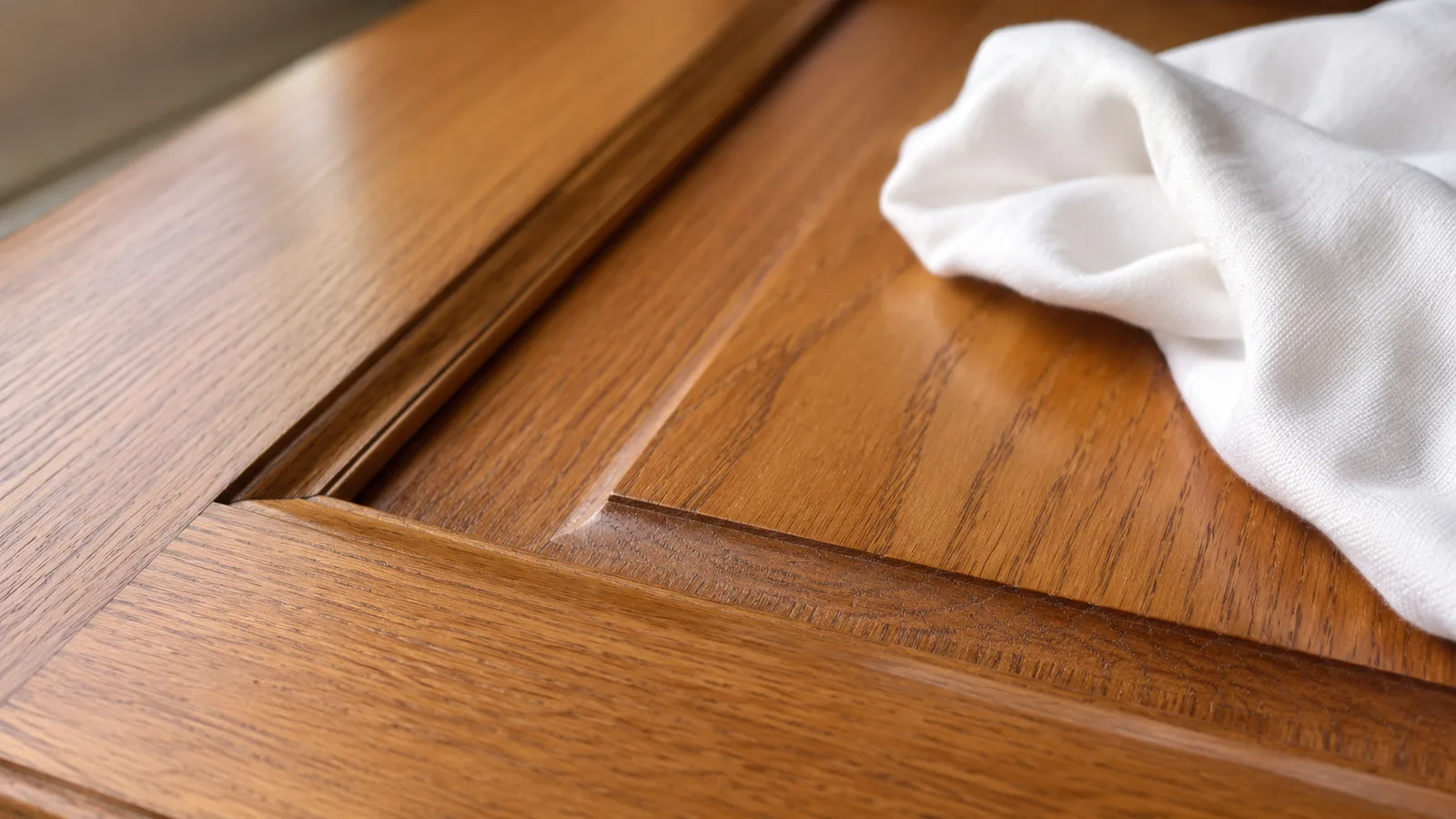
Most of the damage we see on dark cabinets comes from cleaning, not cooking. Aggressive products leave the finish looking hazy, and on a dark colour haze is conspicuous. General practice for a factory-finished stained door, which Fabuwood’s own care guidance overrides if it says otherwise:
- A soft microfibre cloth, barely damp with water and a drop of mild dish soap. Wipe along the grain, never in circles.
- Dry immediately with a second cloth. On this finish the water you leave behind is what turns into a visible spot, not the dirt you removed.
- Dust the top edges of both fronts with a dry cloth weekly; it takes seconds and stops the gray film from building.
- Skip abrasive pads, magic erasers, ammonia glass cleaner and silicone furniture polish. The first two dull the sheen in patches; polish builds a streaky layer that shows on a dark front.
- Grease near the cooktop: a slightly stronger soap solution, a clean damp cloth to rinse, then dry. Repeat rather than scrub.
For a ding through the topcoat, Fabuwood makes a colour-matched Cobblestone touch-up kit (GCB TOUCH-UP-KIT, $62.40). A ding in stained wood shows as lighter wood at the bottom of the dent; the kit darkens it back so it reads as grain instead of a pale spot. Our cabinet care guide covers the rest of the kitchen.
Inside: light wood in a dark box
Open the drawer and the colour stops. The drawer boxes are ⅝″ dovetailed solid wood and the cabinet interior is natural wood veneer, so pots and lids show against a pale background, which helps in a dark kitchen at night. The published spec does not give interior drawer heights; by our measurement each front hides close to ten inches of usable height, enough for a Dutch oven with its lid on. Confirm on a sample if one particular pot is the reason you are buying.
Inserts in this finish sized for these widths: GC CD-21/24 ($273.00) for the 24″, GC CD-27/30 ($399.75) for the 30″ and GC CD-33/36 ($526.50) for the 36″. Fabuwood also lists GC DTD-DB30 BLUM ($884.00) and GC DTD-DB36 BLUM ($932.75), hardware-mounted inserts named for the 30″ and 36″ drawer bases; which drawer configuration they are built for is one to confirm with your designer. The rest are on the accessories page.
What to add to the order
Three small things, all cheap next to the cabinet: the touch-up kit, so it is in the drawer before the first ding rather than three weeks after it; a door sample, if you have not judged the colour under your own bulbs yet; and the pulls, chosen before installation day so the installer drills once. Galaxy ships assembled in 7 days to 3 weeks.
The base cabinet lineup has the sink base and door boxes that go either side, the full Cobblestone collection has everything else, and the design service returns a drawn layout in 3–5 business days if you would rather hand over the measurements.
Common questions
- Do dark kitchen cabinets show dust?
- Yes, more than light ones. Dust, lint, flour and dried water spots are pale, so they show on a dark front, mostly on the top edge of each drawer and on the toe kick. Hand grime around the pulls shows less. A weekly dry wipe of the top edges is usually enough.
- Is Galaxy Cobblestone painted or stained?
- Stained. It is a dark gray-brown stain with the wood grain visible through it, which Fabuwood describes as a cross between traditional brown and transitional dark gray. It is darker than Nickel and is not black; Galaxy Pitch Black is the black finish.
- How do you clean dark stained cabinets?
- A barely damp microfibre cloth with a drop of mild dish soap, wiped along the grain, then dried straight away with a second cloth. Avoid abrasive pads, magic erasers, ammonia cleaners and silicone polish, which leave haze or streaks that show on a dark finish.
- Do stained cabinets hide scratches better than painted ones?
- Fine scratches, yes: the visible grain breaks them up where a flat paint would show a clean line. A ding deep enough to go through the finish shows lighter wood underneath; the Cobblestone touch-up kit at $62.40 is made for that.
- How much is a two-drawer base in Cobblestone?
- $724.75 for GC DB24-2, $835.25 for GC DB30-2 and $1,017.25 for GC DB36-2, each pre-assembled with dovetailed solid wood drawers on Blum soft-close runners. Prices move; the product grid above is current.
- Which pull is best on a dark pot drawer?
- A long bar on the top rail. It keeps fingers on metal rather than on the wood, where skin oil builds a visible shine on a dark front, and it can be hooked with one finger when both hands are full. Knobs work, but they put fingertips on the rail.
Keep reading
The guides behind the numbers on this page.
- How to Clean and Care for Your Kitchen Cabinets
The full cleaning routine, including what not to spray on a finished door.
- Brown Kitchen Cabinets: Stains, Shades & Pairings
Where a gray-brown stain sits among the browns, and why grain changes how it wears.
- Black Kitchen Cabinets: Styles, Pairings & Care
The care problems of a true black, most of which apply here at lower strength.
- What Dovetail Drawers Tell You About Cabinet Quality
The joint holding the heaviest drawer in the kitchen together.
- Soft Close vs Self Closing Cabinet Drawers Explained
Why a drawer closed with a foot still lands gently.
- Kitchen Cabinet Samples: How to Order & Evaluate
Reading grain and colour on one sample door before a whole kitchen of them.


