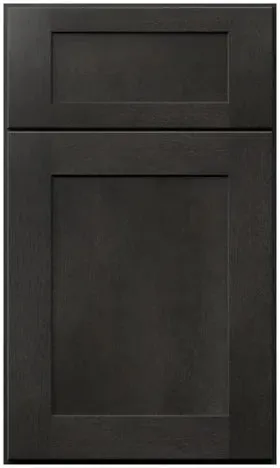


Where the saw meets the stain: a Galaxy Cobblestone corner base cabinet and the cuts around it
Reviewed September 2026 · Captivating Cabinets
A Galaxy Cobblestone corner base cabinet arrives finished on every face the room will see. The trouble starts on site. Closing an inside corner means sawing a filler to width, mitering a toe kick and trimming scribe, and every one of those cuts opens raw, pale wood inside a near-black gray-brown stain. The four blind boxes — GC BLB36/39, BLB39/42, BLB42/45 and BLB48/51, $614.25 to $767.00 — are easy to choose. Where the cut edges end up is the part worth planning.
Every cut an inside corner needs, and where its raw edge ends up

On a white door a sliver of bare wood nearly disappears. This finish is dark enough that the same sliver reads as a chalk mark from across the room. None of the cuts are optional; what you control is which way each one faces. Go through them with the installer before the saw comes out:
| Part | What gets cut | Where the sawn face ends up | Visible from the room? |
|---|---|---|---|
| GC BF3 base filler, $26.00 | Ripped lengthways to the gap, 0″ to 3″ | Against the side of the blind box, if it is ripped from one edge only | No, when the factory edge faces out. Yes, if both edges are trimmed |
| GC TK8 toe kick, $55.90 per 8 ft | Cut to length and mitered where the recess turns the corner | Into the miter joint, plus the square end where a run stops | A tight miter hides it; an open one shows a pale V at floor level |
| GC SM8-S scribe molding, $39.00 per 8 ft | Planed or cut to follow a wall that is not straight | Against the wall, with the end grain at top and bottom | The ends, if the scribe stops short of the counter or the floor |
| The blind box itself | Nothing, unless a plumbing or outlet hole is needed in its back | Inside the cabinet | Only when you open the door, against a light veneer interior |
The pattern is the same on every row. A cut made by the factory has been stained and sealed. A cut made on site has not, and it has to be finished before the job is called done. The scribe and toe kick are cheap enough to buy with spare length. The filler is the one to plan precisely, because the width of that strip comes from the blind box you choose.
Choose the blind size that shrinks the filler
Each label carries two numbers. The first is the box set tight against the corner; the second is the widest it may be installed once it is drawn out and the gap closed with filler. That 3″ of travel is a tolerance, and on a dark stain it pays to use as little of it as possible. A box that lands at its first number needs almost no filler. A box pulled the full 3″ needs a full-width strip, which means more sawing and a wider face to match.
So measure the long leg of the L before choosing. If a 42/45 would need the full 3″ pull and a 48/51 fits with half an inch to spare, take the larger box. The two are the same $767.00, and the bigger one means a narrower strip. The 36/39 at $614.25 and the 39/42 at $685.75 follow the same rule. All four are 34½″ high and 24″ deep, with one door and a drawer above it. The SKU guide explains the slash notation if it is new.
The site also lists each blind box as a carcass-only loose part under cabinet accessories, from GCB-BLB36-39-BO at $396.50 up to GCB-BLB48-51-BO at $494.00. That is the bare box without a finished front. For an ordinary corner, order the complete cabinet. Ask your designer what the carcass-only part ships with before using it for anything else.
Opening a dark blind corner: a pale interior and a long reach
The door and face frame carry the stain, but the inside of the box is a natural wood veneer. Open a Cobblestone blind box and you look into a light cabinet, which helps in a corner that gets little daylight. The covered end is still a long reach, though. It suits the things that come out a few times a year: the roasting pan, a stack of platters, the slow cooker.
To reach that covered end without kneeling, the site lists a blind base pull-out, handed left and right, for the two largest boxes only. GC BPO-BLB42/45 is $1,277.25 and GC BPO-BLB48/51 is $1,394.25. Nothing mechanical is listed for the 36/39 or 39/42. Once a pull-out is added, the corner costs more than the lazy Susan box ($1,030.25 or $1,095.25), which gives up a square corner on each wall instead. The pull-out makes sense when the plan cannot spare that wall and the corner has to hold everyday things.
Put the touch-up kit on the same order
The corner box is set first and everything else is slid in against it, so the knocks of an install collect there: a toe kick tapped into place, a drill chuck against a frame, a clamp that slipped. The grain in this stain hides a fine scratch better than a flat paint would. What it cannot hide is a chip through the finish down to bare wood, which shows as a pale fleck.
Fabuwood lists a Cobblestone touch-up kit, GCB-TOUCH-UP-KIT, at $62.40 under loose parts. Order it with the cabinets rather than after the first chip. It is the same finish, it is in the house on install day, and the installer can seal every sawn filler face and mitered toe kick before packing up. Ask your designer what the kit contains and how Fabuwood says to apply it.
When a blind box is the wrong answer in this finish
- Both legs can spare 33″ or 36″ from the inside corner: the easy reach box ($838.50 or $848.25) shows every shelf through one diagonal door and needs no filler at all at the corner.
- The corner will hold pans used every day: rotating trays in the lazy Susan box bring them to you, and no part of the box hides behind a neighbour.
- The corner is for rarely used bulk, and the plan is tight: this is the box. Choose the size that needs the thinnest filler and finish every cut edge the day it is made.
If you cannot tell which case your corner is, send the room through a free design request. The drawing comes back in 3–5 business days with the filler widths already worked out.
Common questions
- Why do cut edges show more on dark cabinets?
- The factory has stained and sealed every edge it cut. A filler ripped or a toe kick mitered on site opens bare wood, which is far paler than a near-black gray-brown stain. Face each sawn edge toward the cabinet or the wall where you can, and seal the rest with the matching touch-up kit.
- What sizes does the blind corner base cabinet come in?
- Four: BLB36/39, BLB39/42, BLB42/45 and BLB48/51, each 34½″ high and 24″ deep with one door and a drawer. The first number is the box set tight to the corner; the second is the box pulled up to 3″ out with a filler closing the gap. Prices run from $614.25 to $767.00.
- How wide should the filler be at a blind corner?
- As narrow as the wall allows, anywhere from almost nothing up to 3″. Choose the blind size that lands closest to its first number on your wall, so the GC BF3 strip ($26.00) needs little ripping.
- Is there a touch-up kit for Galaxy Cobblestone?
- Yes. GCB-TOUCH-UP-KIT is listed at $62.40. Order it with the cabinets so the installer can seal sawn edges on install day. Ask your designer what it contains and how Fabuwood says to apply it.
- Can I add a pull-out to a blind corner cabinet?
- Only to the two largest. The site lists handed pull-outs for the 42/45 at $1,277.25 and the 48/51 at $1,394.25. None is listed for the 36/39 or 39/42.
- Does a scratch show on a dark stained cabinet?
- A fine surface scratch usually hides in the grain better than it would on a flat paint. A chip that goes through to bare wood does show, as a pale fleck, and that is what the touch-up kit is for.
Keep reading
The guides behind the numbers on this page.
- Cabinet End Panels, Scribe Molding and Fillers Explained
What each site-cut strip at the corner actually does.
- How to Read Cabinet SKU Codes
The two numbers in BLB42/45, and why the second is a limit.
- Brown Kitchen Cabinets: Stains, Shades and Pairings
How a stain differs from paint once it is on the wall.
- How to Clean and Care for Kitchen Cabinets
Keeping a sealed edge sealed after install day.
- Beam-Mounted and Pull-Out Cabinet Accessories
How the blind-base pull-out mounts in the 42/45 and 48/51.
- Kitchen Layouts Guide
How many inside corners each plan shape gives you to finish.


