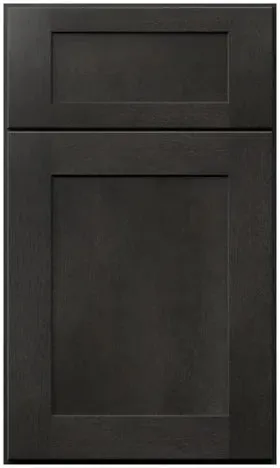
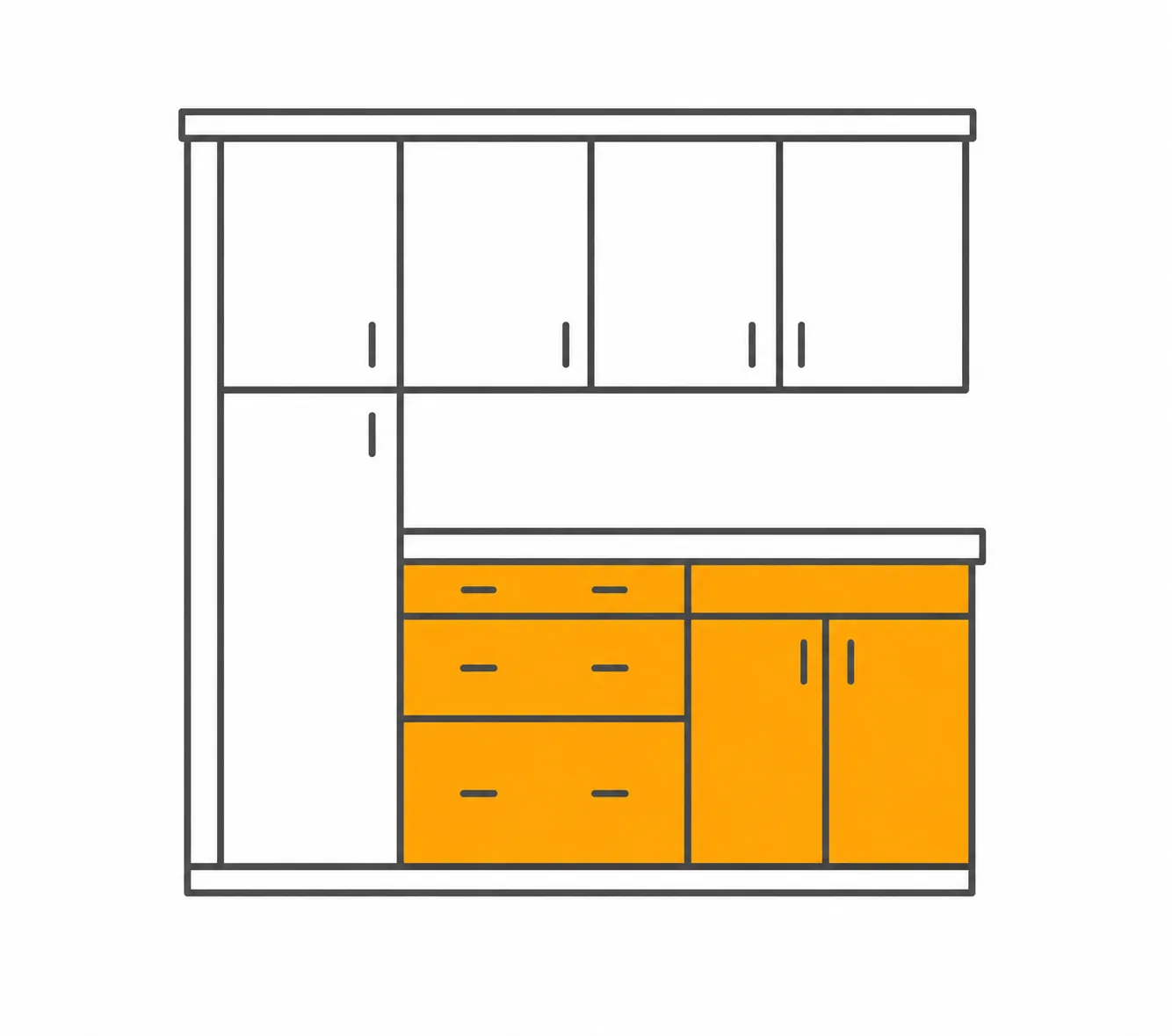


Dark lowers, light uppers: the wide base as the anchor of a two-tone kitchen
Reviewed September 2026 · Captivating Cabinets
Most kitchens that use this finish use it low. Galaxy Cobblestone double door base cabinets — two doors under a drawer tier, 27″ to 48″ wide — make up most of the dark band in a two-tone plan, where a near-black gray-brown base run sits under paler wall cabinets. This page is about getting that split right, because the wide boxes are where it is won or lost.
Why a dark finish usually goes on the bottom half

A room reads as balanced when the heavy colour is closest to the floor. Put a dark stain on the lower run and paler doors above it, and the kitchen feels grounded without closing in; reverse the two and the ceiling seems to drop. That is the practical reason two-tone kitchens almost always put the darker finish underneath, and it is why this finish sells more base cabinets than wall cabinets.
It has a housekeeping logic too. Base doors are the ones that take shoes, mop heads and shopping bags, and a dark gray-brown hides that traffic in a way a white base run never does. The wall cabinets above are touched only by hands at eye level, where a pale finish stays clean. Each half ends up with the colour that suits its job.
The wide two-door box matters here more than any other base. A 36″ or 42″ door pair is a large, unbroken dark rectangle, and three or four of them define the band. Narrow boxes and drawer banks break the run into small pieces; the wide ones give it a continuous line.
What colour upper cabinets go with dark gray-brown lowers?
Cobblestone has a brown undertone under the gray, and that decides the pairing more than the depth does. A cool, blue-leaning white above it can look slightly chilly against the warmth; a warmer white or a pale wood picks the undertone up. Every option below is a Galaxy finish on the same shaker door, so the profiles, overlay and hardware stay identical top and bottom and only the colour changes.
| Upper finish | How the pair reads | Good with |
|---|---|---|
| Frost | Highest contrast: crisp and graphic, the dark band very obvious | White quartz, polished nickel or brass, a bright room |
| Dove | Softer contrast, and the warm white meets the brown undertone halfway | Warm veined quartz, brass, oak floors |
| Linen | Low contrast and very warm; the kitchen reads as one earthy palette | Cream counters, bronze, warm tile |
| Open wood shelving | No upper doors at all; the dark run carries the whole cabinet look | A plain tiled wall, a long window |
Mixing Cobblestone with Nickel, the Galaxy mid gray, is the one pairing we steer people away from on the same wall. The two are close enough in family and far enough apart in depth to look like a near-miss. Used in separate zones, such as a Cobblestone island and a Nickel perimeter, they can work; the Cobblestone versus Nickel comparison goes through that case.
The countertop is the stripe that holds the two halves apart
In a two-tone kitchen the counter is not just a surface; it is the line that separates the dark half from the light one. Whatever sits on a wide dark box is seen edge-on from across the room as a band, and it needs enough contrast with the doors below to register as a stripe.
A pale quartz with visible veining is the combination we quote most often over this finish. It makes a bright horizontal edge above the drawer tier and gives the veining something dark to read against. Butcher block works in a warmer kitchen because its colour meets the brown in the stain. A dark granite or a black quartz is the choice to think twice about: on a run of dark gray-brown doors, a dark top merges with the cabinets into one heavy block, and the two-tone split disappears at counter height.
Backsplash follows the same logic. A pale tile carried up to the wall cabinets keeps the upper half light and makes the counter line the only dark-to-light break. Our countertop and backsplash matching guide has the undertone test to run with the slab sample and a door side by side.
Are dark lower cabinets a good idea in a small kitchen?
Usually, yes, and more often than dark uppers. A dark base run in a small room is below the sightline, so it does not crowd the space the way a wall of dark upper doors would. What it does do is soak up light, and in a small kitchen the base doors spend most of the day in the shadow of the counter overhang.
Two things keep that under control. The first is keeping the uppers and the counter pale, so there is plenty of bright surface to bounce light around. The second is light aimed where it will be seen: under-cabinet strips in the wall cabinets throw light onto the counter and down the drawer fronts, which is exactly the zone a dark base needs lifted. In a north-facing room with one window, look at the door sample ($25.00) in the evening under your own bulbs before committing; this finish can read close to black at night.
Every two-door width, read as part of the dark band
Each box below is a pair of doors under a drawer tier, 34½″ high and 24″ deep, pre-assembled with a ½″ veneered plywood box and Blum soft-close hinges and glides. The right-hand column is where each width tends to fall in a two-tone plan.
| Width | SKU | Our price | Where it tends to go in a two-tone run |
|---|---|---|---|
| 24″ | GC B24 | $471.25 | The first two-door width; short returns and peninsula ends |
| 27″ | GC B27 | $516.75 | Between a dishwasher and a corner |
| 30″ | GC B30 | $555.75 | Under a 30″ cooktop, or beside the range |
| 33″ | GC B33 / GC B33SDF | $633.75 | Between the refrigerator and the range |
| 36″ | GC B36 / GC B36SDF | $676.00 | The long stretch under a window, or under a 36″ cooktop |
| 39″ | GC B39 | $718.25 | A wide gap on a wall that does not break neatly |
| 42″ | GC B42 | $757.25 | Long unbroken walls; drawer tier only, no drawerless version |
| 48″ | GC B48 | $815.75 | The single largest dark rectangle in the line |
The SDF versions at 33″ and 36″ carry one continuous drawer front instead of two, at the same price. On a dark stain the seam between two fronts is a thin line of shadow inside an already dark face, so it matters less than on a white door; take the SDF where you want the drawer tier to read as one clean band under the counter.
Cobblestone also builds drawer bases at 27″ and 33″ (GC DB27, $773.50; GC DB33, $955.50) as well as the usual 24″, 30″ and 36″, so the working positions on either side of the range can stay drawers even when the wall does not divide into round numbers. They are on the drawer base page. For the same widths with no drawer tier, see the full-height two-door page; below 24″, the single door page; and the rest of the finish is on the collection page. If the split between dark and light is still undecided, our design service draws both versions, usually within 3–5 business days.
Common questions
- Should dark cabinets go on the top or the bottom?
- The bottom, in most kitchens. A dark base run with pale wall cabinets feels grounded; dark uppers make a room feel lower and smaller. Base doors also take more scuffs, which a dark finish hides.
- What color upper cabinets go with Cobblestone lower cabinets?
- A warm white such as Galaxy Dove, a crisp white like Galaxy Frost for more contrast, or Galaxy Linen for a low-contrast warm palette. Avoid Galaxy Nickel on the same wall: it is close enough to look like a near-miss.
- What countertop goes with dark brown shaker cabinets?
- A pale quartz with veining is the most common choice because it makes a bright band above the dark drawer tier. Butcher block suits a warm kitchen. A black or very dark top tends to merge with the doors into one heavy block.
- Are dark lower cabinets too dark for a small kitchen?
- Usually not, because they sit below eye level. Keep the uppers, counter and backsplash pale, add under-cabinet lighting, and check the door sample at night in your own light before ordering.
- How much is a 36 inch Cobblestone double door base?
- GC B36 shows at $676.00, and GC B36SDF, the same box with one continuous drawer front, is the same price. Without the drawer tier, GC B36FD is $490.75.
- Is there a 33 inch drawer base in Galaxy Cobblestone?
- Yes. GC DB33 is a 33″ drawer base at $955.50, and there is a 27″ one too, GC DB27 at $773.50.
Keep reading
The guides behind the numbers on this page.
- How to Match Kitchen Cabinets With Countertops, Backsplash and Flooring
The undertone test for the slab that makes the two-tone stripe.
- Gray Kitchen Cabinets: Finding the Right Shade
Where a deep gray-brown sits against the cooler charcoals.
- Black Kitchen Cabinets: Styles, Pairings & Care
Two-tone ideas from the next step darker, most of which carry over.
- White Kitchen Cabinets: Finding Your Perfect Shade
Choosing the white that goes above a warm dark base run.
- Small Kitchen Design and Layout Ideas
Keeping a compact room bright when the lower half is dark.
- How to Read Cabinet SKU Codes From B12 to WBC3042
B, SDF and DB decoded before the box list goes to the designer.


