

Building a dark island from drawerless boxes: lengths, light and the seating side
Reviewed September 2026 · Captivating Cabinets
Prices quoted in this article were read off the grid on the review date; the live price grid on this page governs.
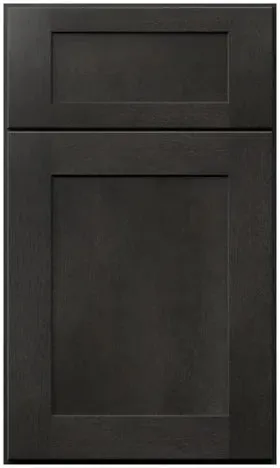
If the perimeter stays light and only one piece of the kitchen goes dark, it is usually the island. Galaxy Cobblestone full height double door base cabinets — two doors, no drawer tier, six widths from 24″ to 39″ — are the simplest way to build one: large dark door faces, few seams, and a pale interior behind them. This page covers assembling the island, lighting it, and living with it.
How many base cabinets make an island, and what it costs
An island is a length, not a cabinet, so start with the length the room allows after clearances and fill it with boxes. The table builds five common lengths from these drawerless boxes and adds two base end panels (GC BEP at $149.50 each) for the exposed ends. The back and seating overhang are separate and are covered below.
| Island length | Boxes | Boxes total | With two end panels |
|---|---|---|---|
| 60″ | GC B24FD + GC B36FD | $893.75 | $1,192.75 |
| 66″ | GC B30FD + GC B36FD | $952.25 | $1,251.25 |
| 72″ | GC B33FD + GC B39FD | $994.50 | $1,293.50 |
| 84″ | GC B24FD + GC B30FD + GC B30FD | $1,326.00 | $1,625.00 |
| 96″ | GC B30FD + GC B33FD + GC B33FD | $1,397.50 | $1,696.50 |
Each box is 34½″ high and 24″ deep, pre-assembled. Other combinations are possible — a 72″ island could equally be two 36″ boxes — and it is worth mixing widths so the door pairs do not all line up identically. If the island needs drawers at the working end, swap one box for a drawer base; Cobblestone has them at 24″, 27″, 30″, 33″ and 36″ on the drawer base page. End panels and other finished parts are on the side panel page and the decorative accessories page.
How a dark island reads in a light room

A dark island becomes the centre of gravity of the room. Against a white or warm-white perimeter it reads as a piece of furniture rather than part of the cabinet run, which is the look most people are after. It also becomes the largest dark surface in the kitchen, so three things around it decide whether it looks rich or heavy.
The floor comes first. Cobblestone’s brown undertone sits naturally on white oak and mid-tone wood floors; the contrast keeps the base of the island defined. On a very dark wood or charcoal tile floor the island merges into the floor and loses its outline, especially in the evening. A pale floor is the easiest partner.
Then the top. A pale counter caps the dark block and gives it a clear edge; a waterfall end in the same stone makes the island feel lighter still, because it turns the dark ends into a frame rather than a solid mass. Finally the lights. Pendants over an island light the counter surface, not the doors, so the sides spend the evening in shadow. That is fine for a dark finish — it looks deeper in low light — but if you want the doors themselves to read, warm pendants at 2700–3000K keep the brown in the stain from turning flat gray.
The seating side takes the scuffs
Every island with stools has a side that gets kicked. Shoes rest against the cabinet back, stool legs knock it, and on a dark finish those marks show as pale scuffs rather than dark ones. They mostly wipe off with a damp cloth; the ones that cut into the surface are what the touch-up kit ($62.40) is for.
Two decisions reduce the problem at the design stage. A counter overhang of around 15″ on the seating side moves knees and feet away from the cabinet back; the island clearance guide covers overhang and stool spacing. And the back itself should be a finished panel in the same stain, so it cleans exactly like the doors. Ask your designer which finished panel suits the island back, since the right part depends on the length and on whether it also has doors on that side.
A dark outside and a pale inside
The worry with a dark cabinet is that it is a dark cave inside. These are not: the stain is on the doors and exposed faces, and the cabinet interior is natural wood veneer, so opening a pair of 36″ doors shows a pale, light-reflecting box. On a drawerless cabinet that interior is what you see every time, and it makes the contents easy to find.
Fit the interior for how the island is used. A roll-out tray on the floor of the box turns deep storage into something you can reach: the standard-height trays run from $214.50 at 24″ to $240.50 at 36″, and there is a higher-sided version for roughly $45 to $50 more, on the roll-out drawer page. A spare adjustable shelf is listed by width (AS-B36 at $110.50, for example); the number included with each box is not published, so confirm it with your designer. Note that there is no roll-out listed for the 39″ box.
Before the island goes on the order
A short list for an island built from these boxes. Width first: the drawerless two-door box stops at 39″, so a longer island is always two or three boxes. Then the exposed faces: two ends and a back, each needing a finished part. Then the seating overhang and its support, which the countertop fabricator specifies. Then any outlet the island needs, which goes on the electrical drawing before the floor is finished. Then hardware, bought separately and in hand for install day. And finally, if the island is the only dark element, a look at the door sample ($35.00) against the perimeter door and the floor, in the evening.
Everything here ships pre-assembled with Blum soft-close hinges, typically two weeks from order. The same widths come 12″ deep (GC B24FD-12D at $396.50 through GC B36FD-12D at $477.75) for a shallow island row or a dining-room sideboard. For a drawer tier on top, see the double door bases; under 24″ without a drawer, the single full-height page; and for the sink, if the island has one, the sink base page. Our design service will draw the island with its panels and overhang, usually within 24–48 hours, and the whole finish is on the Galaxy Cobblestone collection page.
Common questions
- How many base cabinets do I need for a kitchen island?
- Two for islands up to about 78″, three for longer ones, since the widest drawerless two-door box is 39″. A 72″ island can be GC B33FD plus GC B39FD at $994.50, or two 36″ boxes.
- What does a 96 inch Cobblestone island cost in cabinets?
- About $1,397.50 for three drawerless boxes (one 30″ and two 33″), or $1,696.50 with two base end panels. The finished back, countertop and overhang support are extra.
- Does a dark island go with oak floors?
- Yes. Cobblestone’s brown undertone pairs well with white oak and mid-tone wood, and the contrast keeps the island’s base defined. A very dark floor tends to swallow a dark island.
- Will stools scuff a dark island?
- They will leave pale scuffs on the seating side, most of which wipe off. A 15″ overhang, stools with footrests and a finished back panel all help. Keep the touch-up kit for deeper marks.
- Are dark cabinets dark inside?
- No. The interior of these boxes is natural wood veneer, so it stays light and easy to see into even though the doors are a dark stain.
- Is there a 36 inch base cabinet without a drawer in Cobblestone?
- Yes, GC B36FD at $490.75, two full-height doors with no drawer tier. GC B36, with the drawer tier, is $676.00.
Keep reading
The guides behind the numbers on this page.
- How Much Kitchen Island Clearance Do You Really Need
Aisles, overhang and stool spacing around the island you are building.
- Cabinet Skin Panels and Gables: What They Are and Where You Need Them
The finished ends and back that turn boxes into an island.
- Black Kitchen Cabinets: Styles, Pairings & Care
Dark-island ideas from the next shade down.
- Brown Kitchen Cabinets: Stains, Shades & Pairings
Floors and counters that suit a brown-leaning dark stain.
- Space-Saving Cabinet Solutions That Actually Work
Roll-outs and inserts for the deep interior of an island box.
- How Free 3D Kitchen Design Works
Seeing the dark island in the room before any box is ordered.


