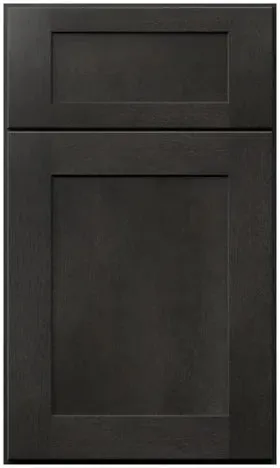


Galaxy Cobblestone return angle base cabinets and the floor they stand on
Reviewed September 2026 · Captivating Cabinets
Galaxy Cobblestone return angle base cabinets finish a run where the room can see it: GC BRA24 at $588.25, and GC BTL12 and GC BTR12 at $419.25 each. Usually that is the end of a peninsula, facing the dining table or the hall. At that end the thing that decides how it looks is the floor under it. A near-black gray-brown end sets a hard line wherever it stands on something lighter. On something just as dark, it can disappear into the floor.
BRA24, BTL12 or BTR12: which piece ends which run
- GC BRA24, 24″ × 24″ × 34½″: an angled base return with a door and one shelf. It turns the end of a run through 45° where a square end would stick out into a walkway, and it still stores something.
- GC BTL12 and GC BTR12, 12″ wide, 24″ deep, 34½″ high: handed transitions that step a 24″-deep base run down to a 12″-deep run or a finished end, angled to the left or to the right. They fix a change in depth and are not bought for storage.
- The hand is cut at the factory and cannot be flipped on site. Read it from the room looking at the run, and if the drawing leaves any doubt, send it in with a design request before ordering.
The shelf in the BRA24 is a wedge, deep against the wall and narrow at the angled door. It suits bottles, a pitcher, serving boards stood on edge. A spare is listed as GCB-AS-BRA24 at $64.35. The transitions are also listed carcass-only, GCB-BTL12-BO and GCB-BTR12-BO at $269.75, for a site-built face; ask your designer what ships with them.
Dark cabinets with light wood floors, dark floors and everything between

Cobblestone is a gray-brown, not a neutral charcoal, and the brown in it reacts to what is under it. A wood floor picks up that brown; a gray floor makes it stand out. Here is how the angled end reads on the floors we see most:
| Floor | At the toe kick | Overall effect |
|---|---|---|
| Pale or white oak | A crisp dark line; the angle reads clearly from across the room | The strongest pairing. The pale floor gives back the light the cabinet absorbs |
| Honey or mid-tone oak | Clear contrast, and the warm floor brings out the brown in the stain | A warm, traditional look; the cabinet reads more brown than gray |
| Dark walnut or espresso | Little contrast; the base of the cabinet merges into the floor | Heavy. The angled end reads as a dark mass without an edge |
| Cool gray plank or tile | Visible, but the cool floor pulls the brown undertone forward | Works, if the rest of the room is warm; put the door sample on the floor first |
| White or light stone-look tile | The sharpest line of all | Graphic and clean, but pale dust along the kick shows most here |
The row to avoid is the third one. A dark end on a dark floor was a common look in stained kitchens for years, and it is why many of them feel heavy. If the floor is already dark, give the peninsula end a lighter counter overhang or a light rug in front of it to break the mass. Our guide to matching cabinets with floors and counters walks through the undertone test.
Shoes, chair legs and a stain at shin height
A peninsula end sits at the edge of a walkway, so it takes more contact low down than any other cabinet: shoes, the vacuum, chair legs pushed back from the table, a dog’s claws. A grained stain handles fine scuffs better than a flat paint, because the grain breaks up a thin line that paint would show. A deeper gouge to bare wood still shows pale, and dust gathers along the recessed toe kick and looks lighter against the dark finish.
Order toe kick with spare length, because the 45° face needs two miters where a square end needs one. The site lists the standard GC TK8 at $55.90 and a ¾″ version, GC TK8-3/4, at $58.50 per 8-foot length. Ask your installer which one suits the floor. Put the touch-up kit, $62.40, on the same order for the chips a walkway end will eventually get.
Finishing the side that faces the room
The cabinet side is built as an interior surface, and at a peninsula end it faces the room. It needs a finished end in the same stain. The product pages offer a finished-side option at checkout; confirm the charge there. The alternatives are a GC BEP base end panel at $149.50 or a GC SK BASE end skin at $62.40. Order it with the cabinet. Grain differs from piece to piece in any stain, which is normal, but a panel from a separate order can also differ in tone. At the most visible end of the kitchen, that difference shows.
Tell the countertop fabricator at template stage that the end is angled, since a mitered return in stone is a different cut and sometimes a seam. If the angled end sits on a walkway, the island clearance guide gives the widths that decide whether the angle is needed at all.
The other odd base boxes in this finish
Corners have three pages: the blind corner bases, the easy reach bases with a 45° door and fixed shelves, and the lazy Susan bases with rotating trays. Banquettes are built from the drawer bench seats, and the microwave bays and desk parts are on the specialty bases page.
Common questions
- What is a base return angle cabinet?
- A 24″ × 24″ × 34½″ base with its face turned through 45°, used to end a peninsula or wrap a run where a square end would stick out into a walkway. It has a door and a wedge-shaped shelf. In this finish it is GC BRA24 at $588.25.
- Do dark cabinets look good with light wood floors?
- Usually, yes. A pale or white oak floor gives a dark gray-brown cabinet a crisp line at the toe kick and reflects back some of the light it absorbs. A mid-tone oak brings out the brown in the stain.
- Should dark cabinets go on a dark floor?
- It is the pairing to be careful with. With little contrast, the base of the cabinet merges into the floor and the end reads as a heavy block. Break it up with a lighter counter overhang, a rug, or a lighter floor.
- Do scuffs show on dark stained cabinets?
- Fine scuffs tend to hide in the grain better than on a flat paint. Gouges through to bare wood show pale, and dust along the toe kick shows. The Cobblestone touch-up kit is listed at $62.40.
- How do I finish the exposed side of a peninsula?
- Choose the finished-side option on the product page, or order a GC BEP base end panel ($149.50) or a GC SK BASE end skin ($62.40) with the cabinet, so it comes from the same order as the doors.
- What are the BTL12 and BTR12 for?
- 12″-wide handed transitions that step a 24″-deep base run down to a 12″-deep run or a finished end, angled left or right. They are $419.25 each and are not storage pieces.
Keep reading
The guides behind the numbers on this page.
- How to Match Kitchen Cabinets, Countertops, Backsplash and Flooring
The undertone test, done where the cabinet meets the floor.
- Brown Kitchen Cabinets: Stains, Shades and Pairings
Brown undertones against oak, walnut and gray floors.
- Cabinet End Panels, Scribe Molding and Fillers Explained
End panel or end skin on the side a guest sees.
- Kitchen Island Clearance Guide
The walkway widths that decide whether to angle the end at all.
- Kitchen Layouts Guide
Peninsula and G-shaped plans, where these pieces are used.
- Fabuwood Cabinet Colors
Where this gray-brown sits among Fabuwood’s other dark finishes.


