

Grain behind grain: styling and pricing Galaxy Horizon open shelf units
Reviewed September 2026 · Captivating Cabinets
Prices quoted in this article were read off the grid on the review date; the live price grid on this page governs.
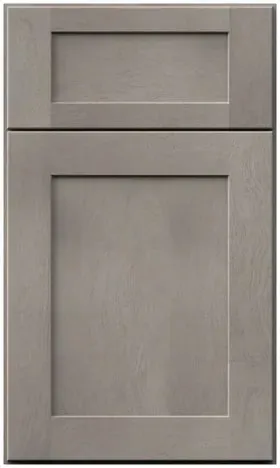
Open shelves in a kitchen fill up with wood. Cutting boards stood on edge, a salad bowl, a stack of trivets, a basket, a pepper mill. On a white or painted shelf all of that reads as warm accents against a plain ground. On Galaxy Horizon it does not, because the shelf is wood too: a stain with its own grain showing through a warm grey-taupe. The eight open shelf units, 18 or 30 inches wide at $399.75 to $757.25, are worth planning with that in mind.
Eight units, two widths

The listing describes these as open shelving wall cabinets from the Matching Interior series, "exposed shelves with the same Galaxy Horizon finish". They are 12 inches deep, in the four heights of the run:
| Height | 18″ wide | 30″ wide |
|---|---|---|
| 30″ | GH WOS1830 · $399.75 | GH WOS3030 · $565.50 |
| 36″ | GH WOS1836 · $448.50 | GH WOS3036 · $672.75 |
| 39″ | GH WOS1839 · $464.75 | GH WOS3039 · $698.75 |
| 42″ | GH WOS1842 · $500.50 | GH WOS3042 · $757.25 |
There is no 24 or 36-inch unit. For those widths the no-door wall box is the open alternative. What the stained interior looks like against the frame is not shown on the listing either; ask us for a photograph of a real unit if the shelf is the feature of the wall.
Wooden things on a stained shelf
Put a wooden object against a grained background and two sets of grain are competing. Whether that looks rich or muddled comes down almost entirely to tone. This is our general styling advice, not a Fabuwood rule, but it holds for any stain:
- Go clearly lighter. Pale boards, light bowls and raw or whitewashed pieces stand forward from a mid-light grey-taupe and read as objects.
- Or go clearly darker. A dark wood bowl or a black-stained board sits in front of the shelf like a silhouette.
- Avoid the near-match. A greyish or mid-brown piece whose tone is close to the shelf looks like a failed attempt to match it, and its grain fights the shelf's.
- Break up wood with something that is not wood. White or cream ceramics, glass and one metal between every two wooden things stop the shelf reading as a lumber rack.
Fabuwood's own Horizon photographs point the same way. Among the looks its light-grey ideas post shows are a modern farmhouse kitchen with open shelving, a farmhouse sink, shiplap and wood accents, and rooms finished with gold hardware or copper accents. Taking the hint, a brass or copper piece on the shelf itself, a small pot or a lamp base, does the same work as the ceramics.
Three wooden things that end up there anyway
Cutting boards
Boards stood on edge at the back of a shelf are the commonest wood on an open unit. Pale boards and end-grain blocks sit well against a grey-taupe stain; a board close to the shelf in tone reads as part of the cabinet. Stand them on the bottom shelf, where their weight and their width are easiest to manage, and never put one back wet.
Bowls and baskets
Woven baskets are usually warmer and more yellow than this stain, and that difference is useful: the basket reads as an object. A turned wooden bowl works if it is clearly darker than the shelf, and less well in the middle tones. Group them, one or two per shelf, rather than lining them up.
A wooden counter underneath
If the counter below the unit is wood, the shelf and the counter face each other across the backsplash. Here the same tone rule applies at a larger scale: a clearly lighter or clearly darker counter works, a near-match looks like a mismatch. Our general advice, not a Fabuwood pairing, is to let the backsplash separate them with a plain light tile.
One thirty, or a pair of eighteens
The commonest placement question is whether to put one open unit in the middle of a wall, or two either side of something, a window, a hood or a range. The flanking pair is the more classical look; it is also the more expensive one:
| Height | Two 18″ (36″ of shelf) | One 30″ | The pair costs |
|---|---|---|---|
| 30″ | $799.50 | $565.50 | +$234.00 |
| 36″ | $897.00 | $672.75 | +$224.25 |
| 39″ | $929.50 | $698.75 | +$230.75 |
| 42″ | $1,001.00 | $757.25 | +$243.75 |
The pair gives six more inches of shelf in total, but it is two boxes, four sides and twice the corners. Per inch of width the 30-inch unit is the cheaper buy at every height; at 36 inches high it works out at about $22.43 an inch against $24.92 for an 18. Pay for the pair when the wall is symmetrical and the thing between them deserves framing. If the wall is not symmetrical, one 30 placed at the end of a run usually looks more deliberate than a pair forced into it.
With a pair on a stain there is one more thing to plan: order both units together. Two open boxes facing each other across a window are compared by everyone who stands at the sink, and Fabuwood treats colour variation between stained parts as normal. One order for both is the surest route to a close pair.
Cleaning a shelf you can see
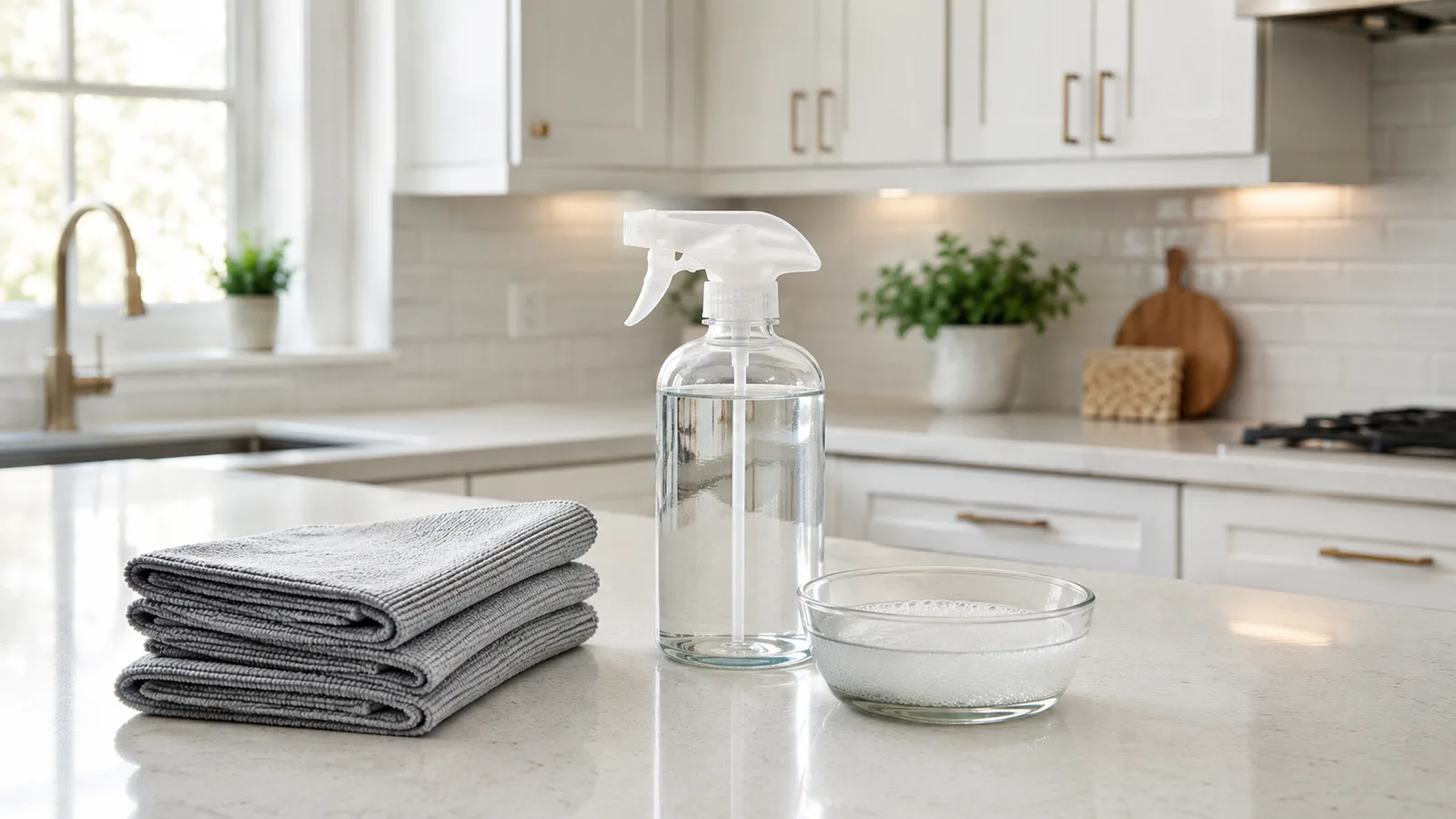
A closed shelf gets cleaned when it is emptied. An open one gets dusted weekly and wiped whenever something spills near it, and it is wiped around objects that stay put. That is more contact with the finish than any door in the run gets, so the rules matter.
Fabuwood's guidance fits in a line. Soak up wet marks by pressing, not rubbing; keep to gentle cleaners; and never aim a spray bottle at the wood. On an open shelf that means dampening the cloth, not the shelf, and lifting objects rather than wiping around their feet, which is where a ring of grime settles. A dry microfibre cloth does most of the weekly work on its own.
A worn shelf edge is fixed with Fabuwood's marker-and-fill-stick kit, $62.40 as TOUCH UP KIT on the loose parts page, since stains get no aerosol.
Before you order
- Decide one 30 or a flanking pair, and if a pair, order both at once.
- Ask for a photograph of a real Horizon open unit if the shelf will be the focal point.
- Plan what goes on it, and check each wooden piece against the door sample for tone.
- Add finished skins for any exposed side, and a touch-up kit, to the same order.
A free 3D design shows the unit, or the pair, in place with the run around it, with a designer in touch by the next business day and a costed plan inside 48 hours. Assembled boxes typically ship in two weeks. Skins for exposed ends are on the decorative accessories page, the $35.00 door sample on the samples page, and every other part of this finish on the collection page.
Common questions
- How do you style open shelves on stained cabinets?
- Use contrast of tone. Wooden pieces clearly lighter or clearly darker than the shelf read well; pieces close in tone look like a mismatch. Break up wood with white ceramics, glass and a little brass or copper.
- What widths do open shelf wall cabinets come in?
- Two, 18 and 30 inches, each in 30, 36, 39 and 42-inch heights and 12 inches deep. Displayed prices run from $399.75 for GH WOS1830 to $757.25 for GH WOS3042 on the review date.
- Is a pair of open shelves cheaper than one wide one?
- No. Two 18-inch units cost $224.25 to $243.75 more than one 30-inch unit of the same height, for six more inches of shelf. The pair is worth it when it frames something symmetrical, such as a window or a hood.
- How do I clean open wood cabinet shelves?
- Dust with a dry microfibre cloth; for anything more, spray a mild cleaner onto the cloth, never straight onto the wood, and blot spills rather than wiping. Those are Fabuwood's own care rules.
- Should a pair of open shelf units be ordered together?
- Yes. Two open units either side of a window or hood are compared by everyone who looks at them, and Fabuwood treats colour variation between stained parts as normal. Ordering both at once, with the rest of the run, gives the closest pair.
- Are the shelves the same colour as the cabinet?
- The listing says the shelves carry the same finish. Because it is a stain on a plywood box rather than a paint, ask us for a photograph of a real unit if an exact match with the frame matters to you.
Keep reading
The guides behind the numbers on this page.
- How to Clean and Care for Your Kitchen Cabinets
A weekly dusting routine and the cleaners that are safe on a finished wood shelf.
- Brown Kitchen Cabinets: Stains, Shades & Pairings
Wood tones against wood tones: the pairing advice from the brown side of the stains.
- Gray Kitchen Cabinets: Finding the Right Shade
Where this warm grey-taupe stain sits among the greys, and what that means for the objects on its shelves.
- Kitchen Cabinet Samples: How to Order & Evaluate
Taking the door sample to the shelf wall, with the boards and bowls you own beside it.
- Wall & Tall Kitchen Cabinets: Sizes & Buying Guide
Where the four open-shelf heights sit against the rest of an upper run.


