

Pucks, bars or strip: the whole bill of materials for one lit Galaxy Nickel run
Reviewed September 2026 · Captivating Cabinets
Lighting is the only thing on the accessory list that is not a part — it is a system, and that is why it is the line most often under-budgeted. A fixture on its own does nothing: it needs a supply, it needs a way to be switched, and on a long run it needs the pieces that join one length to the next. Price only the fixtures and you will be roughly half right. This page prices the whole thing, three ways, for the same stretch of cabinets, and then makes the argument about colour temperature that matters more on this finish than it does on a white one.
Three fixture types doing three different jobs

Puck lights are small round fixtures that screw to the underside of a wall cabinet. They are sold here as sets matched to a cabinet width — GNK LED W09 at $74.75 for a nine-inch box through to GNK LED W39 at $152.75 for a thirty-nine-inch one — with a single 2-1/4″ puck available on its own at $71.50. They throw pools of light with darker gaps between them, which is a look rather than a fault; it suits a kitchen where the worktop is a backdrop.
Light bars are continuous linear fixtures in a housing, sold by length from 24 to 60 inches. They give an even wash along the whole worktop with no scallops, which is what you want if you actually chop, read and work down there. They are also several times the money.
Strip is the third thing and it does a different job: GNK LED CAB INT 48" STRIP at $221.00 is for lighting the inside of a box rather than the counter below one — glass-fronted cabinets, open shelving, a display run. And GNK LED STRIP TUNABLE WHITE 10MM at $286.00 is the strip whose colour temperature you can change after it is installed, which is relevant to the argument at the bottom of this page.
The same 90 inches of worktop, priced three ways
Take a common run — a 30-inch cabinet, a 36 and a 24, ninety inches of worktop — and cost it properly. The supporting parts are the same whichever fixture you choose: GNK LED DRIVER at $204.75 to power the run, GNK LED WLS SWITCH at $221.00 to operate it, and GNK LED MESH CONNECTOR at $201.50 where separate runs have to be linked.
| Route | Fixtures | Fixture subtotal | Plus driver and switch | Total |
|---|---|---|---|---|
| Puck sets | GNK LED W30 $130.00 · W36 $146.25 · W24 $113.75 | $390.00 | $425.75 | $815.75 |
| Light bars, standard | GNK LED FLS30 $539.50 · FLS36 $617.50 · FLS24 $487.50 | $1,644.50 | $425.75 | $2,070.25 |
| Light bars, walnut | FLS30 WALNUT $646.75 · FLS36 WALNUT $715.00 · FLS24 WALNUT $585.00 | $1,946.75 | $425.75 | $2,372.50 |
| Interior strip (different job) | GNK LED CAB INT 48" STRIP $221.00 ×2 | $442.00 | $425.75 | $867.75 |
Two headlines. On fixtures alone the bars cost more than four times what the pucks cost for the same stretch, and all-in the bar route is about two and a half times the puck route. And the supporting parts add the same $425.75 to every route — which is 52 per cent of the all-in cost on the puck route and 21 per cent on the bars. That $425.75 is the line that gets left off quotes, and it is proportionally most damaging on exactly the route people choose when money is tight.
One honesty note on the puck row: whether each puck set arrives with its own supply or needs to be taken back to the driver is not stated on the listings, so we have costed the supporting parts into every route rather than assuming one of them escapes. Ask us to confirm against the specific codes on your order, and if the puck sets do carry their own supply you will get that money back rather than being surprised the other way.
The driver is a box that has to live somewhere reachable
A driver converts mains to the low voltage the fixtures run on, and it is a physical object roughly the size of a paperback that has to be mounted where it can be got at. It is not a wire in a wall. Deciding where it goes is a five-minute conversation at planning stage and a genuine nuisance afterwards.
The usual homes: the top of a wall cabinet above the crown line, inside the top of a pantry, in the toe kick behind an access panel, or at the back of a base cabinet clear of the shelves. What it should never be is buried behind a fixed panel or above a ceiling, because the driver is the component in an LED installation most likely to need replacing, and the fixtures will outlast it.
The switch is the other half of that thought, and GNK LED WLS SWITCH at $221.00 being wireless is doing more work than the price suggests. A wired switch means a cable chased through a wall, which is a first-fix decision; a wireless one sticks where your hand naturally goes and moves later when it turns out your hand goes somewhere else. It is also what makes the whole installation possible in a kitchen whose walls are already closed.
Why this finish wants a cooler light than a white kitchen does
Here is the part that is specific to this colour, and it is worth arguing from the lighting side rather than the paint side, because that is where the mechanism is.
An under-cabinet fixture is a grazing source. Almost none of its light reaches a door face directly — it goes down, hits the backsplash and the worktop, and what lands on the doors above and below is second-hand light that has already taken on the colour of whatever it bounced off. That is the whole reason under-cabinet lighting changes how cabinetry looks at all, and it is why the counter you choose matters as much as the bulb.
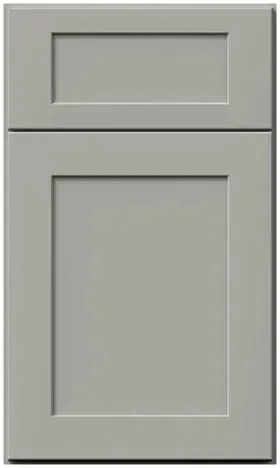
Now run two temperatures through that. A 2700K source is heavily weighted to the red and yellow end. Bounce it off a warm-toned worktop and the reflected light is warmer still, and it arrives at a door that has no warmth of its own to meet it — this line’s mid-tone grey is a true neutral rather than a greige, so it does not absorb a yellow cast gracefully the way a cream or a beige does. It just gets muddier, and the effect is strongest exactly where the light is strongest, which is the bottom edge of the wall cabinets and the top of the base doors. People describe the result as the grey "going brown at night", and they usually blame the paint.
A 3000K to 4000K source has more energy in the middle and blue end of the spectrum, so the bounce carries less of a cast and the doors read at night roughly as they read at noon. That is the whole objective with a neutral: the same colour at 9am and 9pm.
This is the inverse of the advice a white kitchen gets, and the inversion is not a contradiction — it follows from the same principle. A bright white needs the warmth to stop it reading clinical, so 2700K is doing useful work there. A neutral grey has nothing to rescue and everything to lose, so the warmth is doing harm. If you have read a lighting guide written for a white kitchen, this is the line in it to ignore.
Where the fixture sits under the cabinet
Set a bar or a puck toward the front edge of the cabinet underside rather than at the back against the wall. Two reasons, and both are visible immediately. A fixture at the back throws most of its light up the backsplash, which is pretty and does not help you chop. A fixture at the front puts the light on the working half of the worktop where your hands are — and, critically, puts the source itself behind the cabinet’s front rail, so a seated person at an island or a table opposite does not look straight into it.
A glare check worth doing before anything is screwed down: sit where people will actually sit, at the height they will sit, and look at the run. If you can see the fixture, move it forward or add a light rail moulding to shield it — the trim list carries the rail, and hiding the source is most of what it is for. Inside a box is a separate decision with a separate part: add the 48-inch interior strip from the lighting list for any box with glass in it, and none for the boxes without.
Common questions
- Do under-cabinet LED lights need a driver?
- The bars do, and the list carries GNK LED DRIVER at $204.75 as its own line, plus a wireless switch at $221.00 and a mesh connector at $201.50 for joining runs. Budget $425.75 for the supporting parts on any route — it is the most commonly omitted figure on a lighting quote.
- What colour temperature is best for grey kitchen cabinets?
- 3000K to 4000K. Under-cabinet light reaches the doors as bounce off the worktop, and a 2700K source arrives carrying a yellow cast that a true neutral grey has nothing to absorb — it reads muddy or brownish after dark. Cooler light keeps the doors reading the same at night as at noon.
- How much does under-cabinet lighting cost?
- For 90 inches of run: about $815.75 all-in on puck sets, or $2,070.25 on standard light bars, both including $425.75 of driver and switch. Bars are the even wash and the better working light; pucks are pools with gaps between them, at roughly 40 per cent of the price.
- Puck lights or light bars for a kitchen?
- Bars where the worktop is worked on — an even wash with no scallops, and no shadow where you chop. Pucks where the counter is a backdrop, or where the budget has to stretch: $390.00 of fixtures against $1,644.50 for the same 90 inches.
- Can under-cabinet lighting be added to an existing kitchen?
- Yes, and the wireless switch is the reason. It removes the one job that needs an open wall, so the fixtures screw up, the driver sits somewhere reachable inside a cabinet, and the switch sticks where your hand goes. Put the driver somewhere you can get at it later — it is the part most likely to need replacing.
- Is there a tunable white option?
- GNK LED STRIP TUNABLE WHITE 10MM at $286.00 lets you change the colour temperature after installation. On this finish it is worth considering specifically because it turns the warm-versus-cool decision into something you settle in the room over a few evenings rather than on a spec sheet.
Keep reading
The guides behind the numbers on this page.
- Gray Kitchen Cabinets: Finding the Right Shade
How the greys in this family behave as the light changes.
- Kitchen Cabinet Samples: How to Order and Evaluate
Judging a door under your own bulbs, after dark, on the worktop.
- How to Match Cabinets, Countertops, Backsplash and Flooring
The worktop is what the light bounces off before it reaches the doors.
- Glass Cabinet Doors Buying Guide
Why a glass box needs an interior strip and a plain box does not.
- Kitchen Cabinet Molding Types
The light rail that hides a fixture from a seated sightline.
- Important Kitchen Dimensions Before Buying Cabinets
The worktop-to-cabinet gap the wash has to cross.
- How Much Do Fabuwood Cabinets Cost
Where a four-figure lighting line sits against the whole quote.
- Free 3D Kitchen Design
Send the plan and the parts come back listed against the boxes they fit.


