

Glasses hung upside down: sizing a stemware rack, and the two places to refuse
Reviewed September 2026 · Captivating Cabinets
A stemware rack is a set of parallel channels that screws to the underside of a wall cabinet; the foot of a wine glass slides into a channel and the glass hangs by its base. It is the most decorative thing on the accessory list and the one most likely to be bought for the photograph rather than for the kitchen — which is a shame, because in the right position it is genuinely good, and in the two wrong positions it is a permanent annoyance screwed to the ceiling of your worktop. Two widths are stocked, and neither listing tells you how many glasses it holds. That number is worked out at home, with one glass and a ruler.
Two widths, and a rack that can outprice the cabinet above it

GNK STMW30 is $403.00 and GNK STMW36 is $425.75, sized for a 30-inch and a 36-inch cabinet respectively. Both fix to the underside of the box with screws, so this is a retrofit at any point in a kitchen’s life — nothing has to be planned for at the factory.
Put those numbers beside the cabinets they hang under and something worth knowing appears. A 30-inch upper at the common heights costs $234.00 at 12 inches high, $253.50 at 18 and $383.50 at 30; the 36-inch equivalents are $253.50, $273.00 and $422.50. So on the shallow boxes the rack costs substantially more than the cabinet it is screwed to. That is not a reason not to buy one — fittings often outprice carcasses — but it does reframe the decision as a piece of furniture rather than as an accessory, and it is worth deciding at that level.
| Rack | Price | Cabinet above it | Cabinet price |
|---|---|---|---|
| GNK STMW30 | $403.00 | GN W3012 · 30″ × 12″ | $234.00 |
| GNK STMW30 | $403.00 | GN W3018 · 30″ × 18″ | $253.50 |
| GNK STMW30 | $403.00 | GN W3030 · 30″ × 30″ | $383.50 |
| GNK STMW36 | $425.75 | GN W3612 · 36″ × 12″ | $253.50 |
| GNK STMW36 | $425.75 | GN W3618 · 36″ × 18″ | $273.00 |
| GNK STMW36 | $425.75 | GN W3630 · 36″ × 30″ | $422.50 |
The 12-inch-high box in that table is the interesting one. A short upper over a bar or a sideboard, with a rack under it, is the classic position for this part: the cabinet holds the bottles and the glasses hang below, and the whole assembly reads as a piece of joinery rather than as a cupboard with a fitting on it. That pairing — GN W3012 at $234.00 plus GNK STMW30 at $403.00, $637.00 together — is the specification we write most often for this part.
Working out how many glasses it holds, since nobody publishes it
The channel count is not on the listing, and neither is the channel spacing, so any number quoted to you for capacity is a guess unless it comes with a spec sheet attached. Ask us for the current one against the code. In the meantime the arithmetic you can do yourself is more useful than a number anyway, because capacity depends as much on your glasses as on the rack.
Do it like this. Take your widest-footed glass — usually a burgundy bowl or a big red — and measure the diameter of the foot. Add a quarter-inch, because glasses that touch chime against each other every time a cabinet door shuts. Divide the usable rack length by that figure and you have the number of glasses per channel; multiply by the channel count once we have confirmed it.
Two things that come out of doing that sum honestly. First, the mixed collection is the problem: a rack loaded with one size of glass is efficient and a rack holding three different stems wastes the difference in every channel. Second, the tall glasses are the ones that decide the mounting position, not the wide ones, and that is the next section.
The drop, and the counter clearance that is left
Do the vertical sum before you buy, because it is the one that determines whether the rack is elegant or in the way. Start from the underside of the wall cabinet. Take off the thickness of the rack itself. Then take off the height of your tallest glass, measured from the rim to the top of the foot — for most wine glasses that is somewhere between seven and nine inches, and for a champagne flute it can be more.
Against a standard installation — a 36-inch worktop with cabinets hung eighteen inches above it — what is left between the rim of the hanging glass and the worktop is not much, and it is the number that decides everything about where the rack can go. Measure your own; nominal dimensions and real installations differ by more than you would like.
Which produces a simple rule: hang the rack where nothing has to pass beneath it. Over a bar counter that is used for standing and pouring, yes. Over a sideboard or a dresser run, yes. Over a stretch of worktop where a kettle boils, a mixer runs or a chopping board gets used — no, because everything on that counter now has a ceiling, and you will find it with a raised arm at least once a week.
Two positions to refuse, and the honest problem with hanging glass
Over the sink is the first. It looks right in photographs — glasses above the washing-up, everything in one place — and it is wrong for two reasons: the rack occupies exactly the air your head and shoulders need when you lean over a bowl, and everything hanging there gets a fine mist of water and detergent every time the tap runs hard. Glasses over a sink need washing before use more than glasses anywhere else in the room.
Over the hob is the second, and it is worse. Cooking throws an aerosol of fat that travels much further than people expect, and it settles on any cool surface in range. A glass hanging bowl-down above a cooking zone collects a film on the outside of the bowl and on the inside of the rim, which is the part that touches your mouth. There is no version of this that is acceptable, and it cannot be fixed by washing occasionally.
And the honest general problem, which applies even in a good position: hanging glass collects dust. Not quickly, but continuously, and it lands on the foot — which is the upward-facing surface when the glass is hung — and in a ring on the inside of the bowl near the rim. Glasses used weekly are fine. Glasses used four times a year need rinsing before they are poured into, and there is no way around that. If you are the household that keeps the good stemware for Christmas, keep it in a closed cupboard and hang the everyday glasses instead. That is the specification that actually gets used.
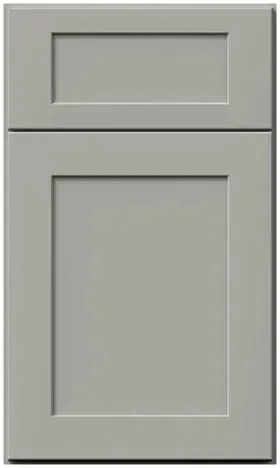
A small note on how it reads. The rack itself is a set of narrow timber ribs under a mid-tone door, and what you notice from across a room is not the rack but the shadow it casts on the underside of the cabinet and the row of glass catching light beneath it. That is a detail worth lighting deliberately rather than leaving to chance — see the cabinet lighting page for what goes under an upper and what it costs.
What the screws actually go into
A rack is only as good as its fixing, and the fixing is into the bottom panel of a wall cabinet with a row of loaded glass hanging off it. Worth thinking about for two minutes before anyone reaches for a drill.
The cabinets in this line are ½″ select solid wood boxes, which is a substrate that takes a screw properly — this is not a job being done into a thin panel. Drill pilot holes rather than driving straight in, keep the screw length short enough that nothing comes through into the cabinet interior, and fix along the rack rather than only at its ends. If the cabinet is already hung and full, empty it first; a screw driven upward into a loaded shelf is how a rack ends up slightly out of parallel, which shows immediately because every glass hangs plumb and the rack does not.
Match the rack to the cabinet width rather than to the run — GNK STMW30 for a 30-inch box, GNK STMW36 for a 36 — because the fixing has to land inside one cabinet’s bottom panel rather than bridging two boxes and a gap. If the position you want spans two cabinets, use two racks or move the position. The rack listing carries both widths; if the upper you were planning to use is neither 30 nor 36 inches, that is a reason to adjust the cabinet plan rather than to improvise the fixing.
Common questions
- How many wine glasses does a stemware rack hold?
- The channel count is not published, so work it out: measure the foot of your widest glass, add a quarter-inch so they do not chime against each other, and divide the rack length by that. Then ask us for the current channel count against GNK STMW30 or GNK STMW36 and multiply.
- How much is an under-cabinet stemware rack?
- GNK STMW30 is $403.00 for a 30-inch cabinet and GNK STMW36 is $425.75 for a 36-inch one. Worth knowing: on a shallow upper the rack costs more than the cabinet it hangs under — GN W3012 is $234.00 — so treat it as a piece of furniture rather than a fitting.
- Can you add a stemware rack to existing cabinets?
- Yes. It screws to the underside of the wall cabinet, so it is a true retrofit at any age and nothing has to be specified at the factory. Match the rack width to the cabinet width and check the drop before you fix it.
- How much clearance do you lose under a stemware rack?
- The rack thickness plus the full height of the hanging glass, which is commonly seven to nine inches from rim to foot and more for flutes. Against cabinets hung at the standard eighteen inches above a worktop there is little left, so hang it only where nothing has to pass underneath.
- Where should you not put a stemware rack?
- Over the sink, where it takes the air your shoulders need and everything gets misted every time the tap runs; and over the hob, where cooking aerosol settles on the outside of the bowl and the inside of the rim. Over a bar counter, a sideboard or a drinks run is where it belongs.
- Do hanging glasses get dusty?
- Yes, continuously — on the foot, which faces up when the glass is hung, and in a ring inside the bowl near the rim. Glasses used weekly are fine. Anything used a few times a year needs rinsing before pouring, so hang the everyday glasses and keep the good ones behind a door.
Keep reading
The guides behind the numbers on this page.
- Wall and Tall Kitchen Cabinet Sizes and Buying Guide
The cabinet heights a rack hangs under, and the gap below them.
- Important Kitchen Dimensions Before Buying Cabinets
The worktop-to-cabinet dimension the drop is subtracted from.
- Glass Cabinet Doors Buying Guide
The other way to put glassware on display, behind a door.
- 27 Kitchen Cabinet Ideas
Bar runs and drinks counters — where this part actually belongs.
- How to Clean and Care for Kitchen Cabinets
Keeping a timber fitting above a worktop presentable.
- Space-Saving Cabinet Solutions
Using the underside of a cabinet as storage rather than the inside.
- Gray Kitchen Cabinets: Finding the Right Shade
The shadow line under an upper, and how it reads on a mid-tone.
- Free 3D Kitchen Design
Send the plan and the parts come back listed against the boxes they fit.


