

These rotating inserts fit the corner overhead, not the corner underfoot
Reviewed September 2026 · Captivating Cabinets
If you have arrived here because a corner base cabinet needs a new turntable, read the next two paragraphs and then stop, because they will save you a return. The six rotating inserts stocked on this finish are all listed for a 24 or 27-inch cabinet at either 30 inches high or 36 to 42 inches high. A lazy susan base in this line is 33 or 36 inches wide and 34½ inches high. Those numbers do not overlap anywhere, in any combination. These are not spare parts for the cabinet most people think they are spare parts for — they are inserts for a corner cabinet on the wall.
The three numbers that decide it

Every insert listing names a cabinet width and a cabinet height, and those two numbers are the entire specification. Width: 24 or 27 inches. Height: 30 inches, or a 36-to-42-inch band. Nothing is listed for a 33 or 36-inch cabinet, and nothing is listed at 34½ inches, which is the height of every base cabinet in this line.
The lazy susan base cabinets — GN LSB33 at $1,030.25 and GN LSB36 at $1,095.25 — ship with their trays fitted at the factory, and what the store stocks for them afterwards is filed as a shelf rather than as a mechanism: AS-LSB33 at $146.25 and AS-LSB36 at $204.75, on the loose parts list. If your corner is on the floor, that is the page you want, and it is worth having us confirm the part against your cabinet code before it goes on an order.
A 30-inch height and a 36-to-42-inch band are wall cabinet heights. That is the whole clue, and the next section follows it.
Matched to the corner boxes they were built for
Set the insert list beside the corner wall cabinets stocked in this finish and the widths and heights line up cleanly, in both geometries. The pie-cut inserts are listed at 24 inches, which is the only width the pie-cut corner wall box comes in. The wedge inserts come at 24 and 27 inches, which are exactly the two widths of the diagonal corner wall box.
| Insert | Listed for | Price | Matching corner wall boxes on this finish |
|---|---|---|---|
| GNK LSP24 30 | 24″ cabinet, 30″ high, pie-cut, plastic | $227.50 | GN WPC2430 $542.75 |
| GNK LSP24 36/42 | 24″ cabinet, 36–42″ high, pie-cut | $341.25 | GN WPC2436 $633.75 · WPC2439 $663.00 · WPC2442 $728.00 |
| GNK LSW24 30 | 24″ cabinet, 30″ high, wedge, wood | $429.00 | GN WDC2430 $455.00 |
| GNK LSW24 36/42 | 24″ cabinet, 36–42″ high, wedge | $663.00 | GN WDC2436 $510.25 · WDC2439 $536.25 · WDC2442 $581.75 |
| GNK LSW27 30 | 27″ cabinet, 30″ high, wedge | $546.00 | GN WDC2730 $539.50 |
| GNK LSW27 36/42 | 27″ cabinet, 36–42″ high, wedge | $848.25 | GN WDC2736 $607.75 · WDC2739 $633.75 · WDC2742 $682.50 |
The pairing of geometry to box in that last column is our reading of the widths and heights rather than a statement printed on either listing, so treat it as the shortlist to confirm rather than as gospel — send us the insert code and the cabinet code together and we will check them against the current spec sheet. What is not in doubt is the arithmetic in the first three columns, and that is the part that rules the base corner out.
Now look at columns three and four side by side, because there is a second finding in them. At 24 inches and 30 inches high, the wood wedge insert at $429.00 costs within twenty-six dollars of the whole cabinet it goes into at $455.00. At 27 inches, GNK LSW27 36/42 at $848.25 costs more than every corner wall cabinet in the finish. A mechanism that outprices the box around it is not automatically the wrong purchase, but it is a purchase that should be made deliberately and not slipped onto a quote as an accessory line.
Pie-cut or wedge is chosen by the cabinet, not by preference
Overhead, the two geometries are not competing options — they belong to two different boxes, and you pick the box first. A pie-cut corner wall cabinet presents two door panels on the two faces of the 90-degree corner; the trays are full circles with a quarter taken out, and the doors travel with them. A diagonal corner wall cabinet presents one door on the 45; the trays are part-circles on a pole and the door is hung on ordinary hinges, so it opens independently of anything turning behind it.
That is why the stock list looks asymmetric. Pie-cut inserts exist only at 24 inches, because that is the only width the pie-cut box is made in. Wedge inserts exist at 24 and 27 because the diagonal box does. If your corner is 27 inches wide, the geometry question has already been answered for you and the only remaining choice is height.
One consequence for an overhead corner specifically: a turning tray in a wall box is at shoulder height, so you are reaching up and across rather than down and in. Load it with light, frequently-used things — mugs, small jars, packets — and keep anything heavy out of it. A tray at shoulder height that has to be steadied with one hand while you take something off it with the other is a tray that gets used once.
Whether a corner box needs a mechanism at all
An honest count first. A 24-inch diagonal corner wall at 30 inches high is $455.00 as it comes, with fixed shelving. Adding GNK LSW24 30 at $429.00 takes the corner to $884.00, which is very close to double. The question that deserves asking is what the mechanism is doing that the shelf is not.
What it is doing is real: a corner shelf is a triangle with an unreachable apex, and everything at the back of it is retrieved by taking out everything at the front. A tray turns that apex into frontage. But overhead, the apex is smaller than it is in a base cabinet and it is at eye level rather than below your knees, so you can at least see what is in it. That makes the case weaker up here than it is down there — which is the reverse of what most people assume.
Where we would spend the money: a corner that holds daily crockery in a kitchen where the corner is the only cupboard near the table. Where we would not: a corner above a counter nobody works at, holding the things you use at Christmas. And there is a third option worth naming, which is not to fill the corner at all — ending the run and letting the corner be wall is a legitimate design decision, and it is discussed on the corner wall page with the three ways to turn a corner priced against each other.
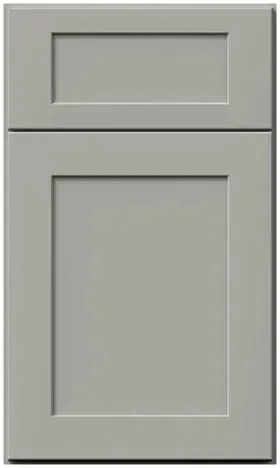
One small note on how a turning tray reads in this colour. An open corner box is a hole in a run of mid-tone doors, and the interior these cabinets ship with is a natural wood veneer, so what you see when the door is open is a warm interior against a cool-neutral frame. That is a pleasant contrast and it is also a reason to keep the tray tidy: at eye level, in a hole in a grey run, the inside of this cabinet is on display in a way a base corner never is.
If the corner already exists, measure these three things
Plenty of people reach this page holding a cabinet rather than a drawing — something has seized, cracked or been pulled off its pole, and the question is whether any of the stocked parts will go in. Three measurements answer it, and none of them needs the cabinet emptied.
- The cabinet width, taken across the front face from outside edge to outside edge. That is the 24 or 27 in the insert code, and nothing between or beyond those two numbers is stocked.
- The cabinet height, again outside to outside. A 30 puts you in the short band; anything from 36 to 42 puts you in the tall one. A base cabinet at 34½ inches falls between the two bands and is the case this whole page exists to warn about.
- The door arrangement: one door across a 45-degree face, or two doors meeting at the corner. That tells you whether you are in wedge territory or pie-cut territory, and it is the quickest of the three to check.
Send those three numbers with a photograph and the original cabinet code if you still have the quote, and we will tell you which insert — if any — is the right part. For a base corner the honest answer is usually the shelf rather than a mechanism: AS-LSB33 at $146.25 or AS-LSB36 at $204.75 on the loose parts list, confirmed against your box first. For a corner overhead, the insert list is where the six stocked parts live, and the rest of the finish is on the collection page.
Common questions
- Will these lazy susan inserts fit a lazy susan base cabinet?
- No. Every one is listed for a 24 or 27-inch cabinet at 30 inches high or 36–42 inches high. The lazy susan bases in this line are 33 or 36 inches wide and 34½ inches high, so nothing overlaps. Those cabinets ship with trays fitted, and the stocked spares are filed as shelves: AS-LSB33 at $146.25 and AS-LSB36 at $204.75.
- What cabinet does a 24-inch lazy susan insert go in?
- A 24-inch corner wall cabinet of the matching height — GN WPC2430 at $542.75 for the pie-cut route, or GN WDC2430 at $455.00 for the diagonal. Send us both codes together and we will confirm the pairing against the current spec sheet before the order goes in.
- What is the difference between a pie-cut and a wedge lazy susan?
- Pie-cut trays are full circles with a quarter removed and the doors bolt to them, so the doors turn with the mechanism. Wedge trays are part-circles on a centre pole behind an ordinary hinged door, so the door and the mechanism work independently. Overhead, which one you get is decided by which corner box you own.
- How much is a lazy susan insert?
- From $227.50 for GNK LSP24 30, the plastic pie-cut at 24 inches and 30 inches high, to $848.25 for GNK LSW27 36/42, the tall wood wedge at 27 inches. At the wide end the mechanism costs more than any corner wall cabinet in the finish.
- Is a rotating insert worth it in a wall corner cabinet?
- Less often than in a base corner, which surprises people. Adding GNK LSW24 30 at $429.00 to a $455.00 cabinet nearly doubles it, and the unreachable apex overhead is smaller and at least visible. Spend it where the corner holds daily crockery; skip it where the corner holds Christmas.
- Can I buy a replacement tray for a corner cabinet?
- For the base lazy susan cabinets, yes — AS-LSB33 at $146.25 and AS-LSB36 at $204.75 on the loose parts list, confirmed against your cabinet code first. For a corner wall box, the inserts on this page are the stocked mechanisms, matched by width and height.
Keep reading
The guides behind the numbers on this page.
- Space-Saving Cabinet Solutions
Getting a deep corner to behave, with or without a mechanism.
- Wall and Tall Kitchen Cabinet Sizes and Buying Guide
The 30-inch and 36–42-inch heights these inserts are listed against.
- Types of Kitchen Cabinets
Corner boxes overhead and underfoot, and why they differ.
- How to Read Cabinet SKU Codes
Reading LSW27 36/42 as a cabinet description rather than a part number.
- Fabuwood Cabinet Sizes and Specs
Catalogue widths and heights for every corner box in the line.
- How Long Do Kitchen Cabinets Last
Which parts of a corner cabinet wear, and which outlive the kitchen.
- Gray Kitchen Cabinets: Finding the Right Shade
Why an open corner reads as a hole in a run of this depth of colour.
- Free 3D Kitchen Design
Send the plan and the parts come back listed against the boxes they fit.


