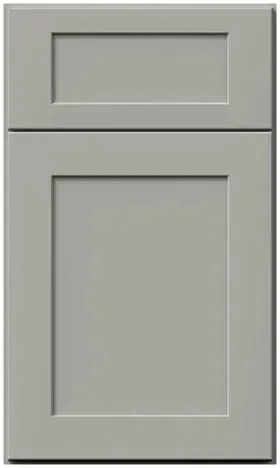


One bin or two, and the floor it has to share with the dishwasher door
Reviewed September 2026 · Captivating Cabinets
The bin cabinet is the most-used cabinet in the kitchen and the one most often placed last, after the sink, the dishwasher and the cooker have taken the good positions. That is backwards. Everything about this part is decided by geometry — how many bins fit inside it, and whether the square metre of floor in front of it is already spoken for by an open dishwasher door. Get those two right and it is the best money on the accessory page. Get them wrong and you have paid $734.50 for a cabinet you have to close before you can load the plates.
Three widths, and what the width is really buying

Three widths are stocked, each in two door styles at the same price, plus a narrower unit built for a bathroom.
| Code | Width | Door style | Price |
|---|---|---|---|
| GNK TC15 BLUM | 15″ | Door and false front above | $617.50 |
| GNK TC15FHD BLUM | 15″ | Full-height door | $617.50 |
| GNK TC18 BLUM | 18″ | Door and false front above | $734.50 |
| GNK TC18FHD BLUM | 18″ | Full-height door | $734.50 |
| GNK TC21 BLUM | 21″ | Door and false front above | $809.25 |
| GNK TC21FHD BLUM | 21″ | Full-height door | $809.25 |
| GNK TCV15 BLUM | 15″ | Vanity unit | $708.50 |
What the extra width buys is bin capacity, and here we have to be straight with you: the live listings do not state how many bins each width carries, or what volume each bin is. The convention across the trade is that the narrow unit is a single bin or two small ones stacked front to back, and that the wider units take a genuine side-by-side pair. We will confirm the current spec against the code before you order, and if a household separates recycling it is worth having that number in writing rather than inferring it from a width.
The FHD suffix is worth understanding because it is a decision about the run, not about the bin. The standard unit sits behind a door with a false drawer front above it, matching the door-and-drawer bases either side; the FHD version is one full-height door, matching a full-height door base. Same money either way, so choose it by which line of drawer fronts you want reading straight across the run — and if the cabinets beside it are drawer banks, the false front is what keeps the row unbroken.
Where it goes, decided on the floor rather than the elevation
Two rules, and they compete. The bin wants to be within one step of the sink, because scraping and rinsing is the job it exists for, and every extra pace is a pace that will eventually be skipped. The bin also wants to be somewhere you can stand with it open — which is the rule people discover after the worktop is in.
The conflict is the dishwasher. An open dishwasher door occupies roughly two feet of floor projecting from its own cabinet line, and a bin unit at full extension occupies most of the depth of a base cabinet in front of its own. Put the two immediately adjacent and facing the same way and the floor in front of them is contested: you cannot load the machine and scrape a plate in the same motion, which is precisely the motion you were trying to buy.
So place it on the opposite side of the sink from the dishwasher wherever the plan allows, with the sink between them. That gives the cook the dishwasher on one hand and the bin on the other, and the two doors never occupy the same floor. Where a plan cannot do that — a short galley, a peninsula — the next best position is round the corner of an L, on the return, where the bin opens across the walkway instead of into the dishwasher zone. The worst position, and it is common, is the cabinet directly beside the dishwasher on the same run.
Two more placement notes. Not in a walkway that people pass through while you are cooking, because an open bin drawer is a shin-height obstacle nobody sees. And not in the end cabinet of an island where the stools are, unless the stools are somewhere else.
What the mechanism costs against a bin standing on the floor
This is the comparison worth making out loud, because a lot of quotes carry a waste unit that nobody has priced against the alternative. The alternative is a perfectly ordinary base cabinet with a supermarket bin standing in it — or standing beside it.
| Route | Parts | All-in |
|---|---|---|
| Waste pull-out | GN B18FD $373.75 + GNK TC18 BLUM $734.50 | $1,108.25 |
| Plain cabinet, bin inside it | GN B18FD $373.75 + a bin from anywhere | About $400 |
| Plain cabinet, bin beside it | GN B18 $409.50, storage kept, bin on the floor | About $430 |
Call it a $700 difference. That is a real number and it deserves a real answer, so here is ours: what the $700 buys is that the bin is never visible, never has a lid you touch with a handful of peelings, opens with a knee, keeps the smell inside a closed cabinet, and does not have a ring of grime on the floor around it. In a kitchen that gets cooked in daily, that is one of the better $700 decisions on the whole quote. In a rental, a flip or a second kitchen that heats things up twice a week, it is not, and a plain cabinet is the right call.
One thing the mechanism does not buy is capacity. A bin standing on the floor of a plain 18-inch cabinet is usually larger than the bin that comes inside the pull-out carriage, because the carriage has to fit the frame and the runners. If volume is your constraint — a big household, a long gap between collections — check the litre figure before assuming the expensive route is the bigger one.
The door this cabinet is actually opened with
Nobody opens a bin cabinet with clean hands. It gets a knee, a hip, the back of a wrist and the toe of a shoe, several times an evening, usually while carrying something. It also takes drips — the short journey from the chopping board to the open drawer is where most of the mess in a kitchen lands.
That is the one place on this page where the colour changes a decision rather than decorating one. A mid-tone grey door carries that traffic better than a white one does: knuckle marks and splashes sit down into it instead of standing out, and the touch-up pen stays in the drawer. The trade is that the same door shows dried water spots and dust more readily, which on the busiest door in the kitchen is a fair swap — this one gets wiped anyway. The care routine is a damp cloth and nothing abrasive.
Two habits worth building on day one. Take the whole carriage out once a season and look at the floor of the cabinet, because a liner that has split will have been quietly wetting the deck for weeks. And if the unit is door-mounted, do not let the door be pushed shut by a foot with the bin full — the load is on the carriage, not the door, and the door is where the damage shows.
Two streams, and where the second one really goes
Most households now sort at least two ways, and the instinct is to solve that with one wider unit. Before committing to 21 inches at $809.25, work out what the two streams actually weigh and how often each is emptied — because they are almost never symmetrical. Food waste is heavy, wet and emptied every day or two. Recycling is light, dry and bulky, and it is emptied weekly or fortnightly.
That asymmetry argues for splitting them rather than pairing them. Put the daily, smelly stream in the pull-out beside the sink, where the mechanism is earning its money on every cycle. Put the weekly, bulky stream somewhere a mechanism is wasted: a plain base cabinet with a crate in it, a utility room, the garage, or a second bin in a corner nobody looks at. A pull-out carriage is an expensive way to store flattened cardboard.
Where the plan genuinely has to carry both in one box — a flat with no utility space, a galley with one spare slot — take the wider unit and ask for the bin volumes against the code before ordering, because two half-size bins in a 21-inch carriage can easily hold less in total than one bin in the 15-inch unit. That is the comparison that decides whether the extra $191.75 between GNK TC15 BLUM and GNK TC21 BLUM is buying capacity or just buying compartments.
Common questions
- How many bins are in a pull-out trash cabinet?
- The listings do not say, which is why it is worth asking before ordering. The widths are 15, 18 and 21 inches at $617.50, $734.50 and $809.25, and the wider units are the ones built for a genuine side-by-side pair. If you separate recycling, get the bin count and the litre volume in writing against the code.
- Where should the trash pull-out go in a kitchen?
- Within one step of the sink, and on the opposite side of it from the dishwasher. An open dishwasher door takes about two feet of floor, and a bin drawer at full extension takes most of a cabinet depth in front of its own — put them side by side on the same run and you cannot use both at once.
- What does the FHD on a trash pull-out mean?
- Full-height door: one door across the whole front instead of a door with a false drawer front above it. Same price either way — GNK TC18 BLUM and GNK TC18FHD BLUM are both $734.50 — so choose it by the line of drawer fronts running across the cabinets either side.
- Is a pull-out bin worth it compared to a bin on the floor?
- In an 18-inch slot the pull-out route is about $1,108.25 all-in against roughly $400 for the same cabinet with a bin standing in it. The $700 buys an invisible bin, no lid to touch, knee-opening, contained smell and a clean floor. In a kitchen cooked in daily that is good value; in a rental or a flip it is not.
- Can a trash pull-out go in a cabinet that has a shelf or drawer?
- No. The carriage uses the full height of the box, so the base has to be empty from the worktop down. That lost shelf and drawer are part of the real cost of the decision, which is an argument for putting the unit in the least valuable slot in the run.
- Is there a trash pull-out for a bathroom vanity?
- GNK TCV15 BLUM at $708.50 is the 15-inch vanity unit. It is a narrower carriage built around the shallower depth a vanity gives you, and it is a different part from the 15-inch kitchen unit at $617.50 despite the matching width.
Keep reading
The guides behind the numbers on this page.
- Important Kitchen Dimensions Before Buying Cabinets
Appliance door swings and the floor they need — the numbers behind the placement.
- Space-Saving Cabinet Solutions
Which mechanisms change daily habits and which just look good open.
- Types of Base Cabinets
The empty box a waste carriage needs, and what it costs in storage.
- How to Clean and Care for Kitchen Cabinets
The routine for the door that takes the most abuse in the room.
- Cabinets for Property Managers
Where a plain cabinet and a floor bin is the right specification.
- Gray Kitchen Cabinets: Finding the Right Shade
Why this depth of colour carries knuckle marks better than white.
- How Much Do Fabuwood Cabinets Cost
Putting a $700 mechanism in proportion to the whole quote.
- Free 3D Kitchen Design
Send the plan and the parts come back listed against the boxes they fit.


