

Normal or a defect? Checking Galaxy Horizon 3 drawer base cabinets on delivery day
Reviewed September 2026 · Captivating Cabinets
Prices quoted in this article were read off the grid on the review date; the live price grid on this page governs.
A kitchen built on drawer banks has more separate stained pieces in it than any other layout. Five Galaxy Horizon 3 drawer base cabinets are fifteen drawer fronts, each cut from its own wood and stained on its own, and they arrive together on one truck. The day they are unwrapped is the one day it is easy to tell a normal variation in a stain from a real flaw in the finish, and easy to fix the second kind. This page is a checklist for that day: what Fabuwood tells you to expect, how to look, how to arrange the banks you have, and what to send us if something is wrong.
Nine widths, three fronts on each
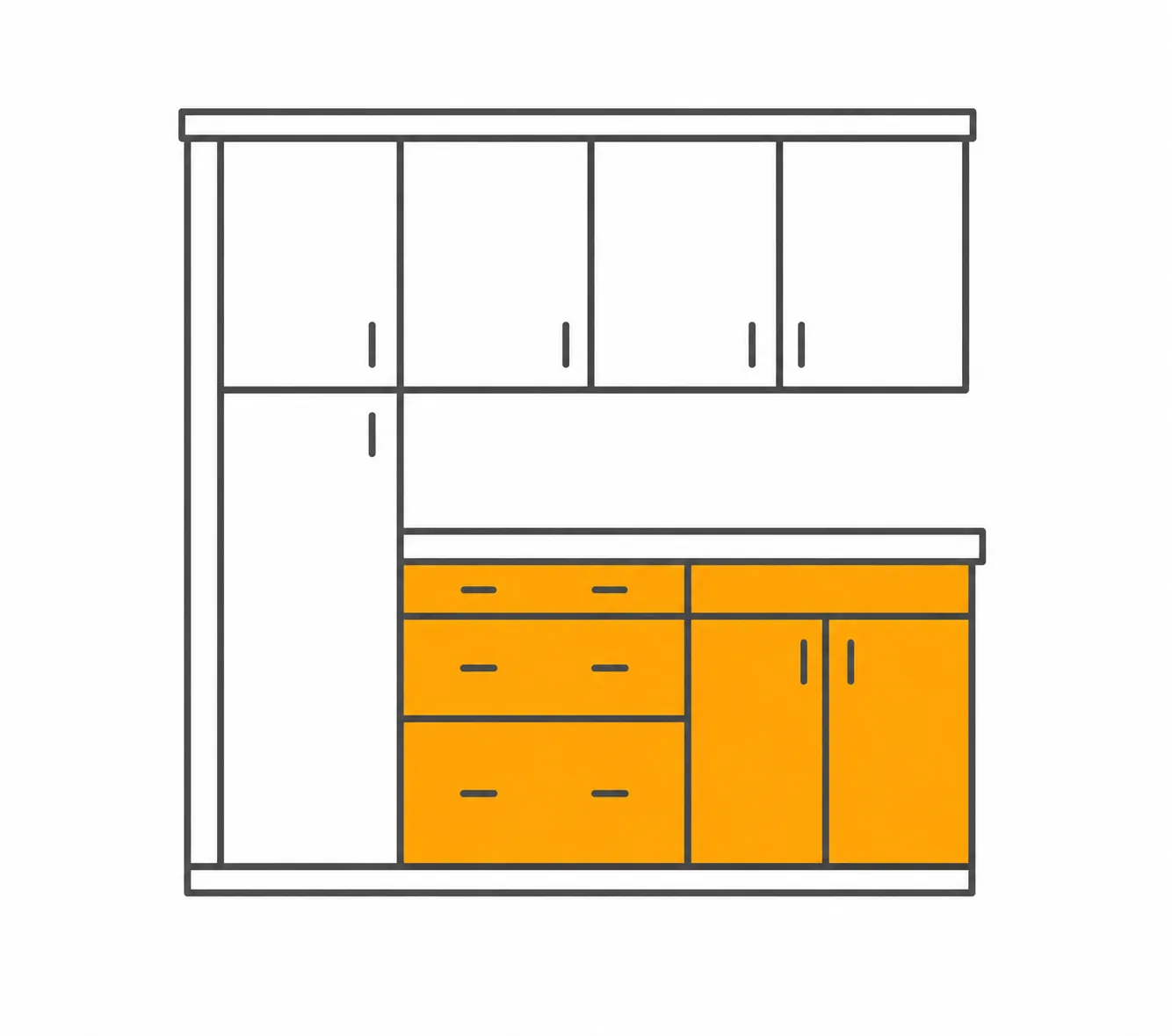
The three-drawer bank is the workhorse of the base line, and it is the configuration offered in the most widths, from 12″ to 36″ in three-inch steps. Each is 34½″ high and 24″ deep, with a shallow top drawer and two deeper ones below, on ⅝″ dovetailed boxes and Blum Tandem plus Blumotion runners.
| Width | Cabinet · price | Fronts to inspect | Carcass only |
|---|---|---|---|
| 12″ | GH DB12 · $617.50 | 3 | DB12-BO · $396.50 |
| 15″ | GH DB15 · $627.25 | 3 | DB15-BO · $403.00 |
| 18″ | GH DB18 · $646.75 | 3 | DB18-BO · $416.00 |
| 21″ | GH DB21 · $672.75 | 3 | DB21-BO · $432.25 |
| 24″ | GH DB24 · $705.25 | 3 | DB24-BO · $455.00 |
| 27″ | GH DB27 · $773.50 | 3 | DB27-BO · $497.25 |
| 30″ | GH DB30 · $845.00 | 3 | DB30-BO · $542.75 |
| 33″ | GH DB33 · $955.50 | 3 | DB33-BO · $614.25 |
| 36″ | GH DB36 · $1,030.25 | 3 | DB36-BO · $659.75 |
Prices are our displayed figures on the review date; the grid above the article is the authority if they have moved. The carcass column matters if the box is damaged but the fronts are fine, and it is covered at the end of this page.
What Fabuwood tells you to expect from this stain
Fabuwood’s spec book prints a note beside every stained finish, this one included: “Due to the nature of wood and the complex finishing processes used to generate stained finishes, there may be variations in color which are considered normal.” Its warranty adds that wood may vary in colour, texture and grain and that those variations are not defects.
That is the baseline for inspection. You are not looking for fifteen identical fronts; a stain on real wood cannot give you that, and you would not want a stain if it could. You are looking for the small number of things that are faults in the finish or the build, and separating them from the grain and tone differences that are simply what a stained front looks like.
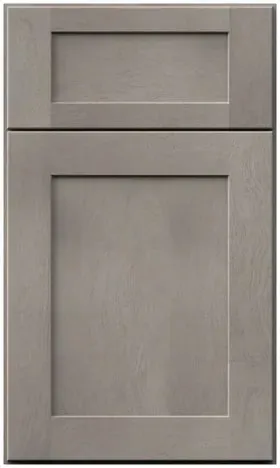
It helps to know what this stain is. It is light, a grey-taupe that Fabuwood describes with soft pink undertones, laid over a solid-wood frame and a veneered MDF panel on every front. A light stain lets more of the wood show than a dark one does, so figure and small tone differences are more visible here than on a darker stain like Cobblestone.
What you might see, and which it is

This is how we read the photos customers send us. It is a guide, not a warranty ruling; when in doubt, send the picture and let us look.
| What you see | Usually | What to do |
|---|---|---|
| Grain pattern differs from front to front | Normal | Nothing; arrange by position if it bothers you |
| One front a shade lighter or darker than its neighbour | Normal within reason | Compare in daylight at kitchen distance before deciding |
| Centre panel reads slightly different from its frame | Normal | Veneer and solid wood take a stain differently |
| A run, drip or thick edge of finish | Finish defect | Photograph in raking light and report |
| A pale spot where the stain is missing | Finish defect | Photograph and report |
| A scratch or chip through the finish | Transit or handling damage | Photograph with the carton, report before install |
| A front that rubs its neighbour or sits proud at a corner | Adjustment or a racked box | Check the box is square; report if it will not adjust |
| A colour that is clearly not this finish | Wrong item | Check the label on the carton and call us |
How to look: the right light and the right distance
Most false alarms come from looking the wrong way. Two habits make the inspection fair to the cabinets and to you.
- Use both kinds of light, for different jobs. Raking light, a window or a torch shining almost along the surface, is the best way to find finish flaws: runs, drips, dry spots and scratches all show up in it. It is also the worst way to judge colour, because it exaggerates every grain line and tone difference. Find flaws in raking light; judge colour in ordinary light.
- Judge colour from where you will stand. Line the banks up in the room, fronts facing the way they will face, and step back eight to ten feet. Tone differences that look obvious at arm’s length often disappear at kitchen distance, and the ones that remain are the ones worth discussing.
- Look in the kitchen, not the garage. This finish takes its cue from the light and colours around it. A front that looks off under a garage light can look right in the room, and the reverse.
- Open every drawer once. Pull each one out fully and let it close on the soft-close. You are checking that it runs smoothly and that the front sits evenly with its neighbours when shut.
Arranging banks you already have

Where you have more than one bank of the same width, you can choose which goes where, and it is worth doing before the installer starts. Line up the same-width banks and pick the pair whose fronts look most even for the most visible positions: the end of an island, either side of the range, the run facing the door you walk in by. Put a bank with livelier grain or a slightly different tone in a corner run or next to the refrigerator, where the eye sees it at an angle.
Different widths cannot swap, of course, but they can be arranged too. A kitchen plan often allows two positions for a 24″ or an 18″ bank; your designer will tell you which positions are fixed. Swapping individual fronts between boxes is an installer’s job and not something we recommend doing yourself.
Reporting a problem so it gets fixed quickly
If something on the table above is a defect, the fastest route to a fix is a clear report on the day. We need four things:
- A photo of the whole bank, so we can see which front and where.
- A close photo of the flaw, in raking light so it shows.
- The label from the carton, with the cabinet code on it.
- A note of whether the cabinet has been installed.
If the box is damaged but the fronts are fine, a carcass-only replacement from the table at the top of this page keeps your original fronts; ask what ships with a drawer-base carcass before ordering. The pre-assembled buying guide covers the rest of delivery day, and you can reach us on (609) 900-3358. We’re builders who sell cabinets, so we would rather see a photo on day one than a problem after the counter is down.
Other drawer configurations
For two deep drawers, the two-drawer page; for four shallow ones, the four-drawer page. Door boxes with a single drawer are on the single-door page. The finish is on the collection page, and a $35.00 door sample is the best way to know what to expect from the grain before anything arrives. Contractors ordering several kitchens can use the Captivating Pro program for trade pricing.
Common questions
- Is colour variation between stained cabinet fronts normal?
- Yes. Fabuwood notes on all its stained finishes that the nature of wood and the finishing process cause colour variations that are considered normal, and its warranty treats grain and colour variation as not defects.
- What counts as a defect on a stained drawer front?
- Runs or drips in the finish, spots where the stain is missing, scratches or chips through the finish, a front that will not sit evenly, or the wrong colour entirely. Grain differences and small tone differences are normal.
- How should I inspect new cabinets when they arrive?
- Unwrap every cabinet in the room it is going into. Look for finish flaws in raking light, judge colour in ordinary light from eight to ten feet, and open every drawer once. Photograph anything wrong with the carton label before installing.
- Why do the fronts look more different in window light?
- Light that hits a surface at a low angle exaggerates grain and small tone differences. It is the best light for finding flaws and the worst for judging colour.
- How much is a 24 inch three drawer base cabinet in this finish?
- GH DB24 shows at $705.25. The range runs from GH DB12 at $617.50 to GH DB36 at $1,030.25, each 34½″ high and 24″ deep, delivered assembled.
- Can I get just a replacement cabinet box without new drawer fronts?
- The carcass is sold on its own, from DB12-BO at $396.50 to DB36-BO at $659.75. Ask what ships with a drawer-base carcass, since the listing does not say whether drawer boxes and runners are included.
Keep reading
The guides behind the numbers on this page.
- Pre-Assembled Kitchen Cabinets: A Dealer’s Buying Guide
Unpacking and checking assembled boxes when they arrive.
- Framed Cabinets: Face Frame Construction, Overlays and Sizing
How a framed box should look when it is square.
- Kitchen Cabinet Samples: How to Order & Evaluate
Seeing the grain and variation of this stain before you order.
- Gray Kitchen Cabinets: Finding the Right Shade
Why a light stain shows more of the wood than a darker one.
- How to Clean and Care for Your Kitchen Cabinets
Looking after the fronts once they pass inspection.


