

Frame, panel and grain: reading the door on a Galaxy Horizon full height single door base
Reviewed September 2026 · Captivating Cabinets
Prices quoted in this article were read off the grid on the review date; the live price grid on this page governs.
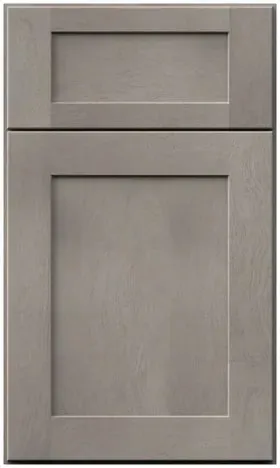
Most base cabinets break their front into a drawer and a door. This one does not. A Galaxy Horizon full height single door base cabinet is one five-piece door from the toe kick to the counter, which makes it the best place in the kitchen to see what the door is actually made of, and the place where a stain shows it most honestly. Paint hides construction under one opaque colour. A stain lets you read it: which parts are solid wood, which part is a veneered panel, which way each piece of grain runs, and where the joints are. Knowing what you are looking at explains most of the questions people ask us about stained doors, before they become complaints.
Five widths, two depths, one uninterrupted door
These are the drawerless versions of the narrow boxes, marked FD in the code. They come in the standard 24″ depth and in a 12″-deep version with -12D on the end, which sits in line with wall cabinets or makes a shallow run in a hall or behind a sofa.
| Width | 24″ deep | 12″ deep | The door |
|---|---|---|---|
| 9″ | GH B09FD · $273.00 | GH B09FD-12D · $266.50 | Almost all frame; little panel to show |
| 12″ | GH B12FD · $328.25 | GH B12FD-12D · $321.75 | A tall, narrow panel |
| 15″ | GH B15FD · $341.25 | GH B15FD-12D · $331.50 | Panel and frame in balance |
| 18″ | GH B18FD · $373.75 | GH B18FD-12D · $364.00 | The panel starts to dominate |
| 21″ | GH B21FD · $399.75 | GH B21FD-12D · $390.00 | The largest single door below 24″ |
All are 34½″ high, ½″ veneered plywood with a natural wood-veneer interior, one full-overlay door on Blum soft-close, quick-release hinges, and arrive assembled in about 2 weeks. At each width the drawerless box costs less than the one with a drawer, because there is no drawer box or runner inside. The single-door page has those versions. Prices are our displayed figures on the review date.
Five pieces and two materials

Fabuwood’s spec book describes the Galaxy door plainly. The frame is four pieces of solid wood, two upright stiles and two horizontal rails, each ¾″ thick and 2½″ wide, joined at the corners with mortise-and-tenon joints. The fifth piece is the recessed centre panel, ⅜″ thick, which the book lists as MDF/veneer: a core of medium-density fibreboard with a thin face of real wood.
That combination is deliberate, and common in good doors. Solid wood is strong and holds a joint, but a wide flat panel of solid wood moves a lot with humidity and can split or cup. An MDF core barely moves, and a veneer face gives it real grain so that it can take a stain like the frame around it. On a painted door the panel would just be painted MDF. On a stained one it has to be veneered, or it would show no wood at all.
One thing Fabuwood does not publish is the species of wood in the frame or in the veneer, so we will not name one. If it matters to your decision, the HDF door guide and the wood species comparison explain what the different cores and woods do, and a $35.00 door sample lets you look at the real grain.
Why the panel and the frame do not look identical
Stand in front of one of these doors in good light and you will notice the frame and the panel are not quite the same. That is not a finishing fault. Three things cause it, and all three are built into how a stained five-piece door is made.
- Grain direction. On the stiles the grain runs up and down; on the rails it runs across. Light hits long grain and cross grain differently, so the rails can look a shade lighter or darker than the stiles depending on where you stand and where the window is.
- Solid wood against veneer. A solid frame and a veneered panel take up a stain slightly differently, even from the same spray. In Fabuwood’s own photograph of the sample door, the panel shows a wavier, more figured grain than the straighter grain on the frame.
- Each piece is its own piece of wood. No two stiles come from the same spot in a board, so no two take the stain identically. Fabuwood notes on every stained finish that colour variation of this kind is normal.
On a drawerless door this shows more than anywhere else, because the panel is as tall as the cabinet allows and nothing interrupts it. On the 18″ and 21″ widths the panel is the biggest element on the front. If you want a door where frame and panel read as one flat colour, a painted finish is the better choice; if you want the grain to be part of the look, this is it.
What happens at the joints, stain against paint
Wood moves with the seasons, a little across its width as humidity rises and falls. On any five-piece door that movement concentrates at the four corners, where the end of a rail meets the edge of a stile. On a painted door a continuous film of paint bridges that joint, and when the wood moves the film can crack along the line into a fine hairline. It is one of the most common complaints about painted shaker doors, in any brand, and it is cosmetic.
A stain behaves differently at the same joint. It soaks into the wood and is sealed with a clear topcoat, and the joint is already visible from day one because the grain changes direction there. Seasonal movement does not open up a new line across a colour field, because there is no colour field to crack. That is general finishing behaviour rather than a Fabuwood specification, but it is a genuine reason some people choose a stain for a door that will see a humid kitchen for twenty years.
What a stain gives up in return is repairability. A painted door can be touched up with its own paint. A stained one is repaired with a fill stick and a marker, because Fabuwood does not offer spray cans for its stained finishes. The Touch Up Kit for this finish is $62.40 on the loose parts page. For a sense of how each part of a door and box ages, the cabinet parts guide names every component.
Cleaning a veneered, stained face
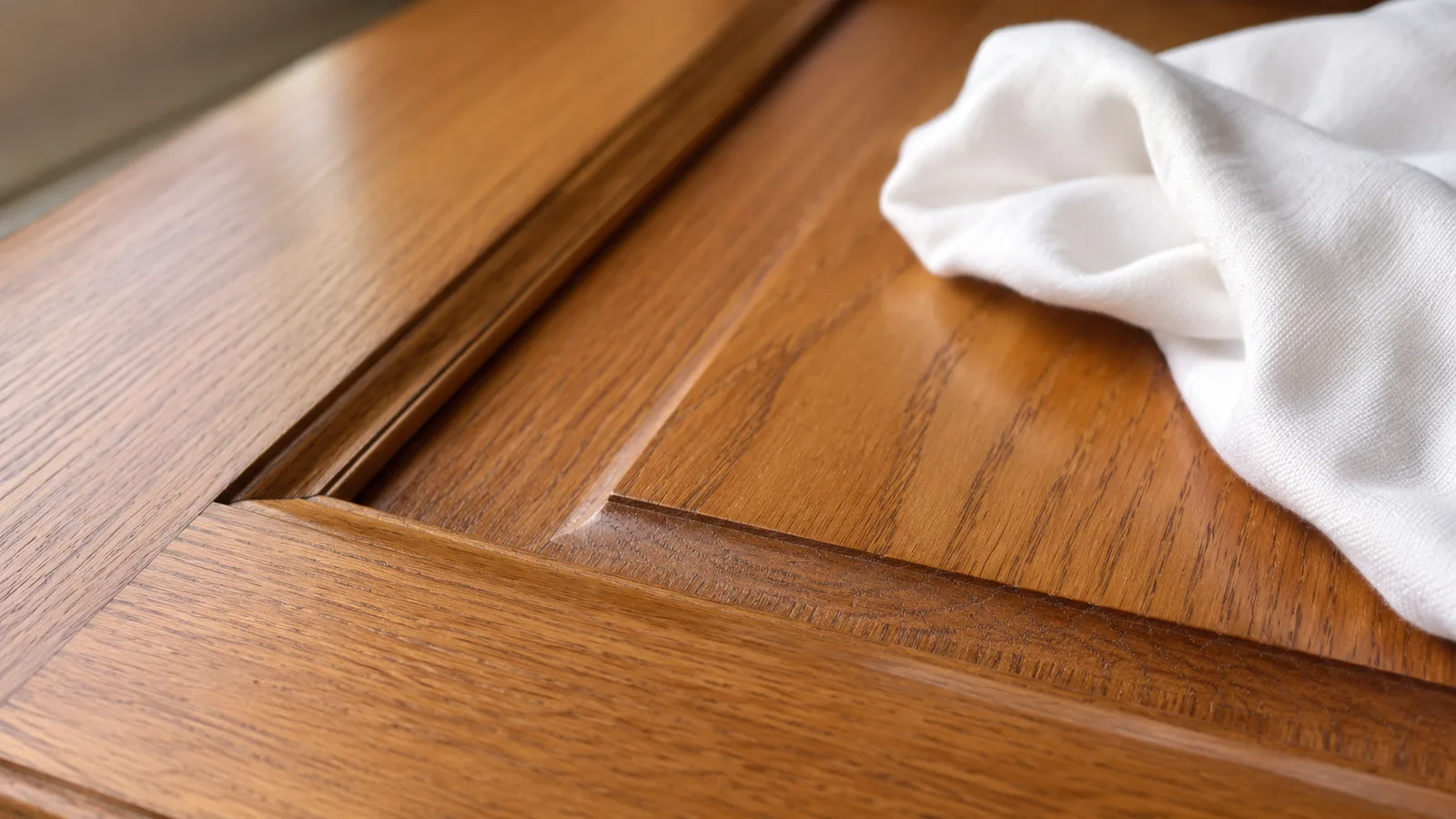
A drawerless base is often the cabinet at the end of a run or beside a bin, so its door picks up the kind of mess that happens below the counter: mop splash at the toe kick, a drip from a bag carried past, fingerprints where there is no drawer pull to grab. Fabuwood’s care guidance is short and worth following exactly. Blot a wet spill rather than wiping it across the surface. Use mild cleaners only. Never spray a cleaner directly onto the wood; put it on a soft cloth first.
The veneered panel needs one extra habit. The recessed edge where the panel meets the frame is a small ledge, and water or cleaner that runs down the door collects there. Dry that edge with the corner of the cloth after cleaning. Standing water on any wood finish is what eventually leaves a mark, and the edge of a panel is where it stands longest.
Wipe along the grain, not in circles, especially on the stiles and rails. It lifts dust out of the grain rather than pushing it in, and it leaves no swirl in the topcoat. Skip abrasive pads and melamine sponges on a stained door; they can dull the clear coat in patches. The cabinet cleaning guide has the full routine.
What goes behind a door with nothing above it
The reason to choose a drawerless box is usually what goes inside. With no drawer box above, a pull-out can use the full height of the cabinet. The waste units have their own full-height-door builds: GHZ TC15FHD BLUM at $617.50, GHZ TC18FHD BLUM at $734.50 and GHZ TC21FHD BLUM at $809.25, on the trash pull-out page. For the 9″ and 12″ boxes, narrow base pull-outs for oils, trays or cleaning bottles start at GHZ TDPO-B9 BLUM for $672.75; the rest are on the pull-out organiser page.
Order the pull-out against the exact cabinet code, not a width you measured, and check the 12″-deep boxes separately: most base pull-outs are built for a 24″-deep cabinet. The clear opening behind the frame is not published; if a specific item has to fit, send it to us and we check it before the order goes in.
If you need something other than one tall door
If a drawer at the top would be useful after all, the same widths with a drawer are on the single-door page. From 24″ up, the full-height doubles give you two tall doors. For daily cooking storage, a three-drawer bank is the better tool. Side panels and fillers for the open end of a run are on the decorative accessories page, and the finish as a whole is on the collection page.
Common questions
- Are these cabinet doors solid wood or MDF?
- Both. The frame is solid wood, four pieces ¾″ thick and 2½″ wide joined with mortise and tenon. The recessed centre panel is ⅜″ MDF with a real wood veneer face, which is why grain shows through the stain.
- What wood species is this stained door made of?
- Fabuwood does not publish a species for the frame or the veneer, so we do not name one. Order a door sample to see the actual grain and colour.
- Why does the centre panel look slightly different from the frame?
- The frame is solid wood with grain running two directions, and the panel is a veneer over MDF. They take the stain a little differently and reflect light differently. Fabuwood treats that kind of variation as normal for stained finishes.
- Do stained shaker doors crack at the joints like painted ones?
- The hairline cracks you see on painted doors happen where a continuous paint film bridges a joint that moves with humidity. A stain has no film of colour across the joint, so seasonal movement does not show as a crack in the same way.
- How much is a 12 inch deep base cabinet?
- The door-only 12″-deep boxes run from GH B09FD-12D at $266.50 to GH B21FD-12D at $390.00, and wider ones continue on the full-height double page up to 36″.
- How should I clean stained cabinet doors?
- Blot spills instead of wiping them across, use a mild cleaner on a soft cloth rather than spraying the wood, wipe along the grain, and dry the recessed edge around the panel.
Keep reading
The guides behind the numbers on this page.
- HDF Cabinet Doors: What High-Density Fiberboard Is
Engineered cores in doors, and why a panel is not made of solid wood.
- Parts of a Kitchen Cabinet: Every Component Named
Stile, rail, panel and face frame, named on a drawing.
- Cabinet Wood Species: Oak, Maple, Walnut & More
How different woods take a stain, for reading any grain.
- How to Clean and Care for Your Kitchen Cabinets
The cleaning routine for stained and painted fronts.
- Plywood vs MDF vs Particle Board Cabinets
Why the box is plywood while the door panel is MDF.


