

Delivery day for a Galaxy Horizon angled end: checking stained parts before they go in
Reviewed September 2026 · Captivating Cabinets
Prices quoted in this article were read off the grid on the review date; the live price grid on this page governs.
An angled end is a small order with a lot of faces. GH BRA24 at $588.25, and the GH BTL12 and GH BTR12 transitions at $419.25 each, arrive with skins, a panel, toe kick and molding, and every one of those pieces shows the stain on at least one side. In a Galaxy Horizon kitchen that makes the day they arrive the most useful day in the job: it is the one time every part of the end is on the floor together, in daylight, before anything is screwed to anything. This page is the check to run that day, which differences are simply how a stain behaves and which are damage, and why an angled face is the best place in the kitchen for a door that reads a shade off its neighbours.
What turns up for an angled end
The group has three cabinets. GH BRA24 is a 24″ base return angle, the piece that turns the end of a run through 45°, with an adjustable shelf inside; a spare shelf, AS-BRA24, is $64.35 under loose parts. GH BTL12 and GH BTR12 are 12″ base transitions, a left and a right, $419.25 each, for stepping from the run into the angle. Whether the BRA24 itself is handed, the listing does not say; tell us which side the room is on and we will confirm.
Around those cabinets, the end usually needs some of these, all under decorative accessories: GH SK BASE, a base end skin, $62.40; GH BEP, a base end panel, $149.50; GH TK8 toe kick, $55.90 per eight feet, which has two angles to turn; GH TKC toe kick cap, $7.80; and GH OCM8 outside corner molding, $62.40 per eight feet, where an exposed edge needs covering. That is up to five boxes of stained parts for one end, possibly arriving on separate pallets, and every one of them faces the room.
The check to run before you sign

Our return policy sets the rules, and they are strict because carriers’ claim windows are strict. The short version, in the order it happens:
- Inspect every box before signing the delivery receipt. Count them against the packing list.
- Note any visible damage on the receipt itself, specifically: "Box 3 corner crushed", not "damaged".
- Photograph damaged packaging from all sides, then the product before and after unpacking, with close-ups and the box labels.
- Report all damage, including concealed damage found on unpacking, with photos within 5 days of delivery and before installation.
- Keep every box and all the packing until the claim is settled.
For an angled end, add one step of your own. Unpack the end parts together, lean them side by side against a wall near a window, and look at them in daylight and then again under the kitchen’s own lights. That is the moment to find anything worth raising, while the claim window is open and before the installer has cut a skin to length.
Normal stain variation, or something to report?
This is the part most buyers of a stained kitchen are not told in advance. Fabuwood’s spec book says that because of the nature of wood and the complex finishing process, stained finishes may show variations in colour "which are considered normal", and its warranty says wood varies in colour, texture and grain and that this is not a defect. So some of what you see on delivery day is not a fault, and the answer to it is placement, not a claim. The table sorts the common cases.
| What you see | Normal or report it? | What to do |
|---|---|---|
| One door a shade warmer or cooler than the next | Normal for a stain | Place it on the angled face, where light falls differently anyway (see below) |
| More figure or wavier grain in a centre panel than in the frame around it | Normal: the panel is MDF with a wood veneer face, the frame solid wood | Nothing. It is what makes a stain look like wood |
| A skin or panel whose grain runs a different way from the doors | Usually an orientation question, not a fault | Check which edge is up before cutting; panels at an end normally run grain vertical |
| A chip, dent, crushed corner or split | Damage | Photograph it and report it inside the 5-day window |
| A scuff or rub mark on a face | Report if it came in the box; touch up if it happened on site | The $62.40 Touch Up Kit (stick, marker, scraper), not a spray can |
| A pale line on an edge someone has just cut | Not damage: it is the raw substrate under the stain | Touch-up marker along the edge before it is fixed in place |
The honest summary: tone and grain differences are how a stain comes, and a door a shade different from its neighbour will not be replaced as defective. Physical damage will be handled. Know which is which before you ring anyone. Our guide to skin panels and gables explains what each finishing part is for.
Why a 45° face is kind to a stain

Two doors side by side in the same plane are the harshest test a stained finish ever faces. They take the same light at the same angle, and the eye compares them directly. Any step in tone between them shows.
An angled end removes that test. It turns the run through three faces, the front, the 45° face and the side, and each one meets the window at a different angle. Even perfectly matched parts read as three slightly different tones, because the light is different on each; the eye takes that as shading, the way it reads the sides of a box. A door that is fractionally warmer than its neighbour disappears into that shading on the angle, where on the front of the run it would have been noticed.
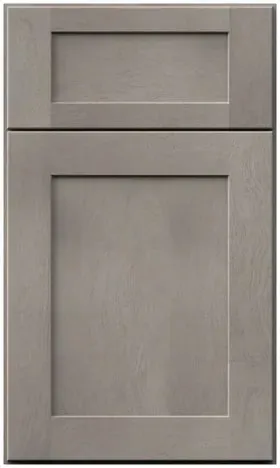
This finish in particular moves with its light. Fabuwood describes it in one place as a grey stain with soft pink undertones and in another as misty greys with silvery undertones, and its own caption on a Houzz project calls grey "almost chameleon-like". So if delivery day turns up one door that reads warmer than the rest, put it on the angle. If it turns up two, the second goes on the side of the run least seen from the room’s main doorway.
Fitting the end without undoing the check
An installer fitting an end will cut the toe kick at two angles, scribe the skin to the wall and trim the outside corner molding. Each cut opens a line of paler, unstained material. On this light stain it is less stark than on a dark one, but it is still a line. Touch up every cut edge before the part is fixed, while it is easy to reach, and keep the kit in the kitchen afterwards. Because stains are not sold in spray cans, the marker and fill stick are the whole repair system for the life of the kitchen.
Two practical points. Fix the end panel or skin before the countertop goes on, since the stone overhang makes the top edge hard to reach later. And fix the outside corner molding last, once the panel and the angle base are both plumb, so it covers a true edge rather than an assumed one. The end panels and fillers guide covers scribing, and panels in this stain are under side panels.
Ordering the end as one package
Order the cabinets, skins, panel, toe kick and molding for an end together, on the same order as the run they finish, so the stained parts share a batch and a delivery. The free design service lists every part for an angled end, left or right, on the quote; a designer replies within one business day, with the full design and quote in 24 to 48 hours. Every base in the finish is under base cabinets and the whole stain is on the collection page. If something on delivery day needs a second opinion, call (609) 900-3358 before you sign.
Common questions
- Is it normal for stained cabinet doors to be slightly different colours?
- Yes. Fabuwood’s spec book says colour variations in stained finishes are considered normal, and its warranty treats variation in colour, texture and grain as natural to wood rather than a defect. Place a door that reads a shade off on an angled or side face rather than beside its twin.
- What should I do if cabinets arrive damaged?
- Note the damage on the delivery receipt before signing, photograph packaging and product, keep all packaging, and report all damage, including concealed damage found when unboxing, within 5 days of delivery and before installation.
- What is a return angle base cabinet?
- A base that turns the end of a run through 45°. In this finish it is the GH BRA24 at $588.25, with an adjustable shelf. The GH BTL12 and GH BTR12 transitions, $419.25 each, are the left and right pieces that step a run into an angled end.
- Which way should the grain run on a cabinet end panel?
- Normally vertical, matching the stiles of the doors beside it. Check which edge is up before the panel is cut, because on a stain the grain direction shows, and a panel cut the wrong way round cannot be turned afterwards.
- How do I fix a cut edge on a stained cabinet part?
- With the Touch Up Kit, $62.40, which Fabuwood describes as a stick, marker and scraper. Stains are not sold in spray cans, so touch up every site-cut edge before the part is fixed in place.
Keep reading
The guides behind the numbers on this page.
- Cabinet Skin Panels and Gables
What each finishing part at an end is for, and which one your end needs.
- Cabinet End Panels, Scribe Molding & Fillers Explained
Scribing a skin to a wall that is never quite straight.
- Parts of a Kitchen Cabinet
Every part on the packing list, named, so the delivery count is quick.
- Kitchen Cabinet Samples: How to Order & Evaluate
Judging a stain in daylight and lamplight, the same check delivery day needs.
- Brown Kitchen Cabinets: Stains, Shades & Pairings
How stains behave on wood, from the brown end of the range.


