

Plan the worktop first: what goes on top of a Galaxy Horizon easy reach corner, and what goes inside
Reviewed September 2026 · Captivating Cabinets
Prices quoted in this article were read off the grid on the review date; the live price grid on this page governs.
Most corner pages talk about the inside of the box. This one starts on top of it, because an angled corner changes the worktop more than it changes the storage. GH ERB33 at $838.50 and GH ERB36 at $848.25 take 33″ or 36″ along each wall and turn one door to face the room at 45°, and the counter they carry is the deepest, least-reached stretch of surface in the kitchen. Left to itself that stretch becomes the place where the mail, the fruit bowl and the appliance nobody put away gather. Planned, it is a workstation with its own storage directly underneath. What follows is how to plan it in a Galaxy Horizon kitchen: the job, the storage below, the wiring and the slab.
The corner counter is the deepest shelf you own

Along a straight run a countertop is about two feet deep, and an adult can reach the backsplash without stretching. At an inside corner the two runs overlap, and the far corner of the worktop sits well beyond comfortable reach from anywhere you can stand. The diagonal box underneath does nothing to change that: its door faces you square-on, but the counter above it is still the same deep square.
That depth is the reason corners collect clutter. Anything pushed back there is out of the way and out of mind, so things drift into it and stay. The fix is not a different cabinet. It is to give the corner a job that suits deep, rarely-reached surface: something tall that stands at the back, is plugged in permanently and is used where it stands. Put a job there, and the storage under it follows.
Four jobs that suit an angled corner
These are the four uses we see work, with what lives on the counter, what the box below should hold, and what to tell the electrician before the walls close. This is our planning advice; the cabinet listing publishes neither the shelf spacing nor the door opening, so confirm those against the appliance before you commit.
| The station | On the worktop | In the box below | Ask the electrician for |
|---|---|---|---|
| Coffee | Espresso machine or brewer at the back, grinder beside it | Beans, filters, descaler, spare mugs on the upper shelf | An outlet at the back of the corner, not on the side wall where the cord crosses the worktop |
| Baking | Stand mixer parked at the back, head up | Mixing bowls, the mixer attachments, flour and sugar bins on the floor of the box | An outlet reachable with the mixer pulled forward to work |
| Small-appliance parking | Toaster or air fryer, used where it sits | The appliance you use weekly rather than daily | An outlet per appliance, so nothing runs through a power strip in a corner |
| Charging and the family drop | A tray for phones, keys and post, pushed to the back | Batteries, chargers, the takeaway menus, the manual drawer nobody admits to | An outlet with USB, and a note that this corner is not a food-prep zone |
Pick one. A corner asked to be both coffee station and mail tray becomes neither. And whatever sits there, check the wall cabinet above it: a tall appliance at the back of the corner needs clearance under whatever hangs there, and steam from a kettle or a coffee machine should not be venting straight into the underside of an upper.
Storing the heavy things right under where they are used
This is where the diagonal box earns its price over a blind corner. It opens its whole footprint when the door swings, with fixed shelves running into the corner and nothing that turns or slides. A stand mixer, a stack of mixing bowls or a bin of flour can live directly below the spot where they are used, and nothing has to be carried across the kitchen. For a heavy appliance, that short trip is the whole point.
Two cautions from experience. Keep the heaviest item on the floor of the box rather than the shelf, so it slides out at knee height instead of being lifted from waist height out of a deep corner. And measure the appliance against the door opening before you plan around it: the angled door is narrower than the footprint, and a stand mixer that fits the box does not always fit through the door. The listing does not give the clear opening, so ask us for it with the model number in hand.
Our guide to types of base cabinets shows this box beside the blind and rotating corners, and the space-saving guide covers risers and bins for the back of a deep shelf.
Choosing the worktop with the grey-taupe door underneath
The corner shows more uninterrupted countertop than anywhere else in an L, so it is where the slab is judged. It is also, in many kitchens, where a fabricator puts a seam. Ask where the seam will fall before you fall in love with a heavily veined stone.
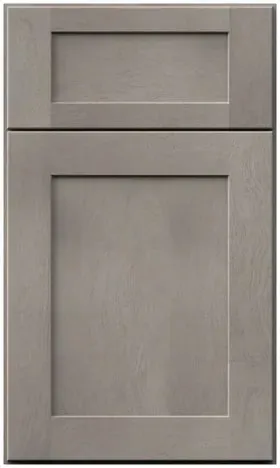
On colour, this finish gives you more room than most, and the pairings Fabuwood itself photographs with it are a useful short list: black countertops, marble, a marble backsplash and a black marble one, stainless steel, and gold or copper accents. One homeowner with this stain chose a granite whose veining picked up the cabinet colours. The one thing to do before choosing is to hold the door sample flat against the actual slab, at the corner, at two times of day. A kitchen designer who sells this finish says it reads warm or cool depending on the furnishings around it, and the countertop is the largest of those furnishings. A warm cream stone will pull it towards taupe; a cool white will pull it towards grey.
The door samples page has the $35.00 sample, and our grey cabinets guide covers undertones in general.
The two sizes, and what else goes on the order
The two boxes are $9.75 apart, so choose by the wall, not the price. The ERB33 needs 33″ along each wall from the inside corner and the ERB36 needs 36″; both are 34½″ high. On a short leg, the ERB33 leaves three more inches for the cabinet beside it; on a long one, the ERB36 gives a wider door and a deeper corner counter to put a station on. Carcass-only versions sit under loose parts at $539.50 and $546.00, for a job that hangs its own doors; confirm what ships in that version first.
Alongside the box: GH TK8 toe kick at $55.90 per eight feet, which has to turn two 45° angles at the front of this cabinet rather than one square corner, and a GH TKC cap at $7.80 where the run ends. A $62.40 Touch Up Kit belongs on the same order, since a stain cannot be sprayed from a can and the kit is its only repair. Against the rotating corner, the lazy Susan LSB33 at $1,030.25 is $191.75 more than the ERB33, and the blind corner boxes start lower but hide part of themselves.
Putting the corner and its worktop on one drawing
Send us both wall lengths and say which station you want the corner to be, and the free design service will draw the box, the upper above it and the outlet position together. A designer replies within one business day, and the full 3D design with a quote follows within 24 to 48 hours. Every other base in this stain is under base cabinets, the whole finish is on the collection page, and (609) 900-3358 reaches us if you would rather talk it through.
Common questions
- What should I put on a corner countertop?
- One working station: coffee, baking, small-appliance parking or a charging drop. The corner counter is the deepest and least-reached surface in an L, so it suits something tall that stays plugged in at the back and is used where it stands, with its supplies in the cabinet directly below.
- Will a stand mixer fit in an easy reach corner cabinet?
- It usually fits the box; check it against the door. The angled door is narrower than the footprint, and the listing does not publish the clear opening, so send us the mixer’s dimensions and we will confirm before you order.
- What is the difference between the ERB33 and ERB36?
- The ERB33 takes 33″ along each wall and the ERB36 takes 36″. They are $838.50 and $848.25, just $9.75 apart, so choose by the wall lengths. The larger one gives a wider door and a bigger corner counter.
- Where should the outlet go in a kitchen corner?
- At the back of the corner, where the appliance will stand, so cords do not cross the worktop. Decide which station the corner will be before the electrician roughs in, because the outlet is the one part of the plan that is hard to move later.
- What countertop goes with a grey-taupe stained cabinet?
- Fabuwood photographs this finish with black countertops, marble and stainless steel. Hold the door sample flat against the actual slab at the corner, at two times of day, because this stain leans warmer or cooler depending on what surrounds it.
- Is an easy reach corner better than a blind corner for storing appliances?
- Usually, yes. The whole footprint opens when the door swings and the shelves are fixed, so a heavy appliance can sit on the floor of the box and slide out at knee height, directly below where it is used. A blind corner buries part of itself behind the next cabinet, which is the wrong place for anything heavy you use weekly.
Keep reading
The guides behind the numbers on this page.
- Types of Base Cabinets
The angled box beside every other base shape and size.
- Gray Kitchen Cabinets: Finding the Right Shade
Undertones, and why the slab you choose pushes a grey warm or cool.
- Important Kitchen Dimensions to Know
Counter depth, upper clearance and the numbers a corner station depends on.
- Space-Saving Cabinet Solutions
Risers and bins for the far end of a fixed corner shelf.
- Kitchen Layouts Explained
Where corners fall in each layout, and how many a plan has to solve.


