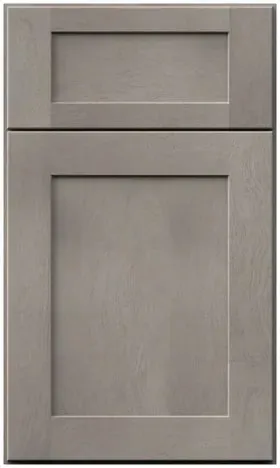
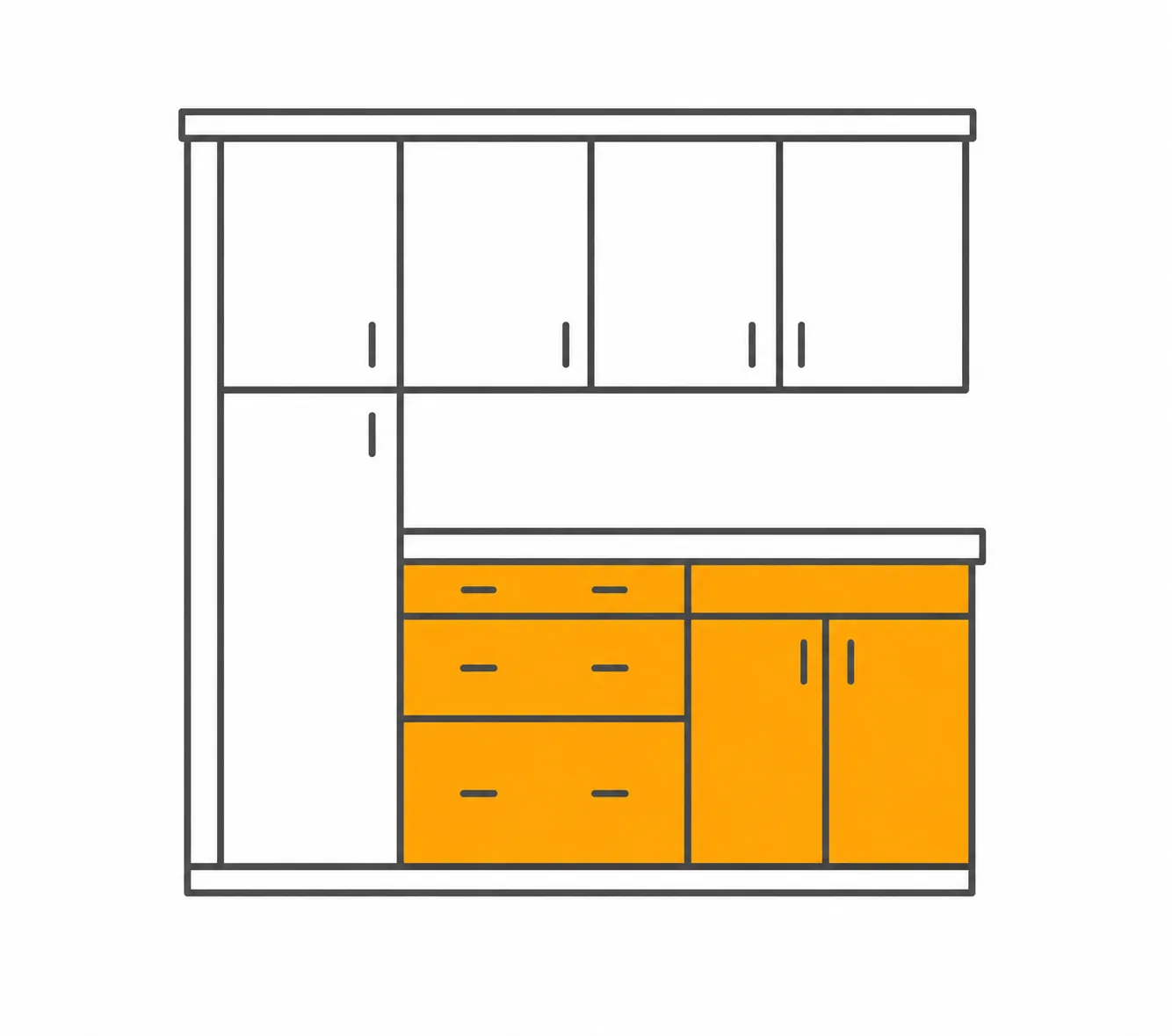


Morning, noon and overcast: Galaxy Horizon double door base cabinets on a sunlit wall
Reviewed September 2026 · Captivating Cabinets
Prices quoted in this article were read off the grid on the review date; the live price grid on this page governs.
The widest cabinets in a base run tend to end up in the brightest part of the room. A long wall under a window, the run beside a patio door, the stretch that faces the garden: none of those walls carries upper cabinets, so they fill with two-door boxes and a counter. A Galaxy Horizon double door base cabinet in that position is the largest stained surface in the kitchen, lit directly. It is also the place where this finish is most changeable, because it is a light grey-taupe that takes its cue from the light around it. This page is about that wall: how the colour moves across a day, what sun does to a stain over years, and how to test for both before you order.
Eight widths, and why they gather under windows
A window wall is where the plan has run out of places for uppers, so it is where the storage has to come from the bases. Wide two-door boxes do that cheaply per inch. Each is 34½″ high and 24″ deep, with a drawer tier across the top and two full-overlay doors below, the drawers on ⅝″ dovetailed boxes and Blum Tandem plus Blumotion runners.
| Width | Cabinet · price | Drawer tier | On a window wall |
|---|---|---|---|
| 24″ | GH B24 · $471.25 | Two fronts | Fills the pier between two windows |
| 27″ | GH B27 · $516.75 | Two fronts | Under a narrow casement |
| 30″ | GH B30 · $555.75 | Two fronts | Centred under a standard 30″ window |
| 33″ | GH B33 or GH B33SDF · $633.75 | Two fronts, or one | Same price either way |
| 36″ | GH B36 or GH B36SDF · $676.00 | Two fronts, or one | Same price either way |
| 39″ | GH B39 · $718.25 | Two fronts | The widest box a roll-out is not listed for |
| 42″ | GH B42 · $757.25 | Two fronts | One box under a wide picture window |
| 48″ | GH B48 · $815.75 | Two fronts | The widest in the line |
Two notes on the table. The SDF versions put one long drawer front across the top instead of two, at no extra cost, and on a bright wall a single front makes the drawer line read calmer because there is one fewer vertical joint catching light. And roll-out trays are listed up to 36″ only, which matters if the window wall is also your pan store; more on that below. Prices are our displayed figures on the review date.
A grey-taupe that changes with the weather

Fabuwood’s own descriptions of this finish do not agree with each other, and that is a clue rather than a mistake. The door-style page calls it a grey stain with soft pink undertones. A design card on the same site speaks of soft taupe tones. The finish’s own page describes misty greys with silvery undertones. Its published colour value, #989089, is a light warm grey, with a touch more red than blue in it, so taupe is the fairest single word. It is not a blue-grey, whatever older posts elsewhere say.
What reconciles the three descriptions is light. A homeowner on Houzz who put this stain in her kitchen in 2022 said that on a cloudy day the cabinets can look cold or dull, and on a sunny day they look warm. A kitchen designer in the same thread, whose showroom sells Fabuwood, said it can read warm or cool depending on what surrounds it. Fabuwood’s own copy for the same stain on another door says it shifts with light, and that is the pattern: warm, direct sun brings out the taupe and the pinkish cast, and flat grey daylight pulls it toward a quiet silver.
On a window wall you get both, every day. Morning light through an east window is warm and low; the same cabinets at two in the afternoon, lit by a bright overcast sky, will look cooler and flatter. North-facing rooms tend to get steady, cool light all day and will usually show the silvery side of the finish; south- and west-facing rooms spend more time on the warm side. That is general light behaviour, not a published fact about this stain, which is why the test below matters more than any rule of thumb.
Sun on a stain: the warranty, and uneven exposure
Fabuwood’s warranty is explicit that colour change from UV light and sunlight is not a defect, and it says finishes may darken or lighten over time. We have not found any report of this particular stain fading or yellowing; we also cannot tell you it will not change. The honest position is that a wood finish in a sunny window will age, and that you should plan for it rather than hope against it.
The thing that makes sun damage noticeable is rarely the overall change. A run that ages evenly just looks like itself. What shows is a difference: the stretch that got the sun next to the stretch that did not, or a rectangle on a door where something leaned against it for a summer. Those are the patterns to avoid.
- Keep the doors clear. A bin, a dog bed, a stool or a bag of recycling parked against the same door every day shades a shape onto it. Move things around, or give them a home that is not against a cabinet face.
- Filter the strongest sun. Sheers, a blind lowered at the brightest hours, or a UV-filtering window film cut the light the finish sees without darkening the room much. That is general advice for any wood finish, and it also protects floors and upholstery.
- Treat the whole wall the same. If one window gets a blind and the next does not, the two stretches of cabinet will age differently. Consistency matters more than strength.
- Think before mixing ages on this wall. A box added in five years will be the newest, least sun-touched door on the brightest wall in the house. If the plan might grow, put the extra box on the first order; the single-door article covers that in detail.
Two doors side by side in direct light
A two-door box puts a pair of stained panels next to each other with only the face frame between them, and side light from a window is the light that shows grain most. Each door is five separate pieces of wood around a veneered centre panel, and each takes the stain in its own way, so in raking sun you will see the figure of each panel and a small difference between the two. Fabuwood calls that normal for its stained finishes, and it is the look you buy a stain for.
Where it helps to know this is in placing the widest boxes. A 42″ or 48″ box has doors close to two feet wide each, and in low evening sun the two panels can read as distinctly different. Two 24″ boxes in the same space give four narrower doors, and the variation between four smaller panels reads as texture rather than as a pair that does not match. It costs more, GH B24 twice at $942.50 against GH B48 at $815.75, but it also buys roll-outs that fit, which the widest boxes do not get.
Testing a sample at the window it will face

A $35.00 door sample is the only way to settle how this finish behaves on your wall, and the way you hold it matters. Most people lay a sample flat on the counter, where it catches light from above like a tabletop. Your cabinets will be vertical, below the counter edge, lit from the side by the window. Prop the sample upright on the floor against the wall where the cabinets will go.
- Look at it first thing in the morning, at midday and in the last hour of daylight, from where you will stand at the sink or counter.
- Look again on an overcast day. This is where the finish is coolest, and some people find it flatter than they expected. Better to find that out now.
- Put the countertop sample on the floor above it and the flooring sample below. The grey-taupe is pulled warmer or cooler by what is around it as much as by the light.
- If you are torn, order the Nickel sample too. It is a paint, opaque and slightly lighter and more neutral, #A1A19A against this stain’s #989089. Seeing the two together shows whether you want grain and warmth or a flatter, steadier grey. The grey shades guide lays out the wider range.
What to keep behind the doors on a bright wall
The window wall is often a long way from the range, so it tends to become the store for things used weekly rather than hourly: serving bowls, the big roasting pan, appliances that live out of sight. A door box suits that. For anything heavier or used more often, a roll-out tray brings the back of the cabinet out into the light: GHZ ROD-B24 BLUM E at $214.50, up to GHZ ROD-B36 BLUM E at $240.50, with the high-sided H versions from $263.25 to $286.00. They are listed only up to 36″, so on a wall of 39″ to 48″ boxes nothing rolls out. All are on the roll-out page.
How many shelves ship in a given width is not on the listing, and neither is the clear opening behind the doors. If a particular item has to fit, tell us what it is and we check it against the current spec sheet before the order goes in.
When the wide door box is the wrong cabinet
If the window wall has the sink on it, the box under the bowl is a sink base, not one of these. If this is where you cook, a three-drawer bank beats any door box. If you would rather have no drawer line at all, the full-height doubles give you the whole face as two doors and cost $68.25 to $191.75 less at matching widths. The finish itself is on the collection page, and a wall of windows is exactly what the free 3D design service can model in your own light direction before you commit.
Common questions
- Do stained kitchen cabinets fade in sunlight?
- Wood finishes can change with long sun exposure. Fabuwood’s warranty treats colour change from UV and sunlight as not a defect and says finishes may darken or lighten over time. We have not seen reports of this stain fading, but uneven exposure is the thing to avoid.
- Is this finish a blue-grey?
- No. Fabuwood describes it as a grey stain with soft pink or taupe undertones, and its published colour value, #989089, is a light warm grey. It can look silvery on an overcast day, which may be where the blue-grey idea comes from.
- Why do my grey cabinets look warm in the morning and cool in the afternoon?
- Because the light changes. Low, direct sun is warm and brings out taupe and pink undertones; bright overcast or north light is cool and pulls the same finish toward silver. A light stain shows that shift more than a darker finish does.
- How much is a 36 inch double door base cabinet in this finish?
- GH B36 shows at $676.00, and GH B36SDF, the same box with one long drawer front, is also $676.00. The 30″ is $555.75 and the 48″, the widest, is $815.75.
- Can I get a roll-out shelf in a 42 or 48 inch base cabinet?
- Not from this catalogue. Roll-out trays are listed up to 36″ wide, from GHZ ROD-B24 BLUM E at $214.50 to GHZ ROD-B36 BLUM E at $240.50. For a long window wall with trays, two narrower boxes work better than one very wide one.
- How should I test a cabinet sample for a sunny kitchen?
- Stand it upright where the cabinets will go, not flat on the counter, and look at it morning, midday, evening and on an overcast day, with your countertop and floor samples beside it.
Keep reading
The guides behind the numbers on this page.
- Gray Kitchen Cabinets: Finding the Right Shade
Why this stain sits with the warm greys, and how light moves every grey.
- Kitchen Cabinet Samples: How to Order & Evaluate
The full sample routine, including the morning and evening check.
- How to Clean and Care for Your Kitchen Cabinets
The everyday routine that keeps a sunlit run even.
- Types of Base Cabinets: Sizes & Standard Dimensions
Where the two-door box sits among the other base configurations.
- Free 3D Kitchen Design
A wall of windows drawn with the light coming from the right side.


