

Galaxy Horizon diagonal sink base cabinets: what it is like to stand at a corner sink every day
Reviewed September 2026 · Captivating Cabinets
Prices quoted in this article were read off the grid on the review date; the live price grid on this page governs.
Plans show a corner sink from above, where it looks tidy: a bowl tucked into the angle, counter running away on both sides. The person using it sees it from a different position, standing in the corner with two walls converging on the shoulders and the tap further away than usual. A Fabuwood Galaxy Horizon diagonal sink base is a complete, assembled corner cabinet in two versions, GH DSB36 and GH DSB36FD, both $617.50. Before choosing between them, it is worth knowing what the corner is like to work in, since that is what decides whether the layout gets used or put up with.
Where your body ends up

At a straight sink, the front of the counter is a line and you stand square to it. At a corner sink, the front is a short angled face set across the corner, and the counter behind it deepens into a triangle toward the wall. Your feet go in front of the angled door; your hips meet the angled face; everything else is further away than at a straight sink. The bowl sits back in that triangle, so the far edge of the bowl and the faucet behind it are a longer reach than anywhere else in the kitchen.
That extra depth is the whole ergonomic story, and it has consequences. Scrubbing a large pan, lifting a full pot out of the bowl and reaching the faucet handle all happen at arm’s length rather than close to the body. People of average height rarely mind. Shorter cooks, anyone with a bad back, and anyone who spends a long time at the sink notice it within a week. If that describes the household, test it before committing: put tape on the floor and a box on the counter at the right distance in the current kitchen and stand there for five minutes doing dishes in the air.
Choosing a bowl for a sink you stand back from
Because the corner already puts the bowl further away, the bowl itself should not add to the stretch. Three choices make the most difference, and all of them are made before the cabinet is ordered, because the sink maker’s template decides what fits a 36″ corner.
Depth first. An extra-deep bowl is popular for hiding dishes, but at a corner every extra inch of depth is an inch further down at the end of an already long reach. A moderate depth is kinder to the back. Then the layout of the bowl: a single large bowl lets a pan lie flat without being tipped over a divider, while a double bowl in a corner often leaves the far half almost out of reach. Last, the shape of the rim. Corner sinks made specially for the angle (two bowls set at ninety degrees to each other, one on each wall) exist, but they need a check against the cabinet’s actual opening, which the listing does not publish; send us the model and we will confirm it before you buy. An ordinary rectangular bowl turned to face the angled front is the simplest, most flexible option, and the easiest one to replace in twenty years.
Task by task: what the angle changes, and what helps
Most of the drawbacks of a corner sink can be designed around once they are named. The table sets them out as a cook would meet them over a day.
| Task | What the corner does | What helps |
|---|---|---|
| Turning the tap on and off | The faucet sits deep in the triangle, often a long reach over the bowl | A single-lever faucet with the handle on the side nearest you, or a pull-down spray that comes to you |
| Rinsing and stacking | Counter on both sides at an angle: plenty of landing space, but at odd angles | Dirty dishes on one leg, clean on the other, and keep that habit fixed |
| Loading the dishwasher | The dishwasher sits on one leg, so its open door lands beside the corner rather than in front of you | Keep a short counter between corner and dishwasher so the open door does not trap your feet |
| Putting dishes away | The plate cupboard is often on the far side of the dishwasher | Plates and glasses in the first upper or drawer on the dishwasher side |
| Cleaning the counter behind the bowl | The deep triangle collects crumbs and water and is hard to reach | A small shelf, soap dispenser or tray there, so it holds something rather than just gathering spills |
| Opening the cabinet | The door opens toward where you stand | Step back before opening; for daily access, keep things in the front half |
Two people, one corner
A corner sink is a one-person station, and that is not always a drawback. The person at the bowl occupies the corner and both legs of the counter stay open, so a second cook can prep on one side and a third can unload on the other without anyone standing behind anyone else. In a small L-shaped kitchen this can work better than a straight sink run, where the sink user blocks a long stretch of counter.
Where it fails is when the second person needs the sink too. There is no room to share a corner bowl, and anyone reaching past the person at the sink has to lean across the angle. Households where two people cook together every evening usually do better with a sink on a straight wall and a second prep bowl elsewhere. Our kitchen layouts guide shows how the work triangle changes in an L or a U when the sink moves into the corner.
DSB36 or DSB36FD, chosen by what goes underneath
The two versions are the same box at the same price, with a different face. GH DSB36 puts a door under a false drawer front, so the drawer line running along both legs carries across the corner. GH DSB36FD has a single full-height door, which gives a taller opening. Both are pre-assembled with Blum soft-close hinges, on the ½″ veneered plywood box. Choose by what will actually live under the bowl, because the corner cavity is deep and awkward and the opening decides what gets in.
- Only the trap and a few cleaning bottles: GH DSB36. The false front keeps the drawer line unbroken, which matters most when the drawers either side are in daily view.
- A water filter canister, a tall bin or a bucket that has to stand upright: GH DSB36FD. The full-height door clears taller items and makes the deep back corner easier to reach with an arm.
- A disposal plus a bin: the full-height door again, and plan to keep the bin in the front half of the cavity, since the back is a long reach from the angled door.
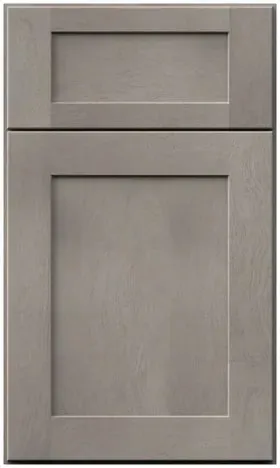
One point specific to this finish. The angled door is the only front in the kitchen that faces the room at forty-five degrees, and it is the door hips and knees meet every time someone stands at the sink. On a stain, knocks tend to show as small light scuffs on edges rather than paint chips; the touch-up kit ($62.40) handles those with a marker or fill stick, and Fabuwood notes that stained finishes have no spray-can option.
Five checks before the corner is final
- Stand in the corner of your current kitchen, or a friend’s, and time a real washing-up session. Five minutes tells you more than any drawing.
- Choose the sink and the faucet before the cabinet, and check the faucet’s reach and handle position from where you will stand, not from above.
- Decide which leg the dishwasher takes and leave counter between it and the corner, so its door does not open across your feet.
- Decide what goes under the bowl, then choose DSB36 or DSB36FD on the size of the opening it needs.
- Plan the counter behind the bowl as a surface for something, whether soap, a plant or a tray, rather than an empty triangle.
The alternatives from this page’s side
If the tape test says no, the sink moves to a wall and the box becomes a standard sink base ($386.75 to $572.00) or an apron-front farm sink cabinet ($806.00 to $825.50), and the corner goes back to storage. If the answer is yes but a factory box cannot fit, because the corner is out of square or something immovable sits in it, the diagonal sink front at $149.50 is the face for a corner framed on site. The whole finish is in the collection, and a free 3D design will show the corner at eye level, which is the view that matters.
Common questions
- Is a corner sink comfortable to use?
- For short tasks and a solo cook, usually yes. The catch is reach: the bowl and faucet sit back in the deep triangle of counter, so everything is further from the body than at a straight sink. Shorter users and people who spend a long time at the sink feel it most, so test the distance before committing.
- Where should the faucet go on a corner sink?
- Wherever the person at the sink can reach it easily without leaning over the bowl. A single-lever faucet with the handle toward the user, or a pull-down spray, makes the extra depth of a corner much less noticeable.
- Where does the dishwasher go with a corner sink?
- On one leg of the L, with a short stretch of counter between it and the corner so its open door does not land where you stand. Keep plates and glasses on that side too, so the route from bowl to dishwasher to cupboard stays short.
- Can two people work at a corner sink?
- Two people can work beside it well, since the person at the corner leaves both counter legs free. Two people cannot comfortably share the bowl itself. Households that wash up together every night often prefer a sink on a straight wall.
- Which holds more under the sink, DSB36 or DSB36FD?
- The box is the same; the full-height door on GH DSB36FD gives a taller opening, which suits a filter canister, a tall bin or a bucket. GH DSB36 has a door under a false drawer front and keeps the drawer line continuous. Both are $617.50.
Keep reading
The guides behind the numbers on this page.
- Kitchen Layouts Guide
How a corner sink changes the work triangle in an L or U.
- Important Kitchen Dimensions Before Buying Cabinets
The clearances that decide whether you can stand comfortably at the corner.
- Types of Base Cabinets
Where the diagonal sink base sits among the corner options.
- Space-Saving Cabinet Solutions
What to put in the corner instead if the sink goes back on a wall.


