

Brass, white oak and white quartz: the materials that meet a Galaxy Indigo 2 drawer base cabinet
Reviewed September 2026 · Captivating Cabinets
Prices quoted in this article were read off the grid on the review date; the live price grid on this page governs.
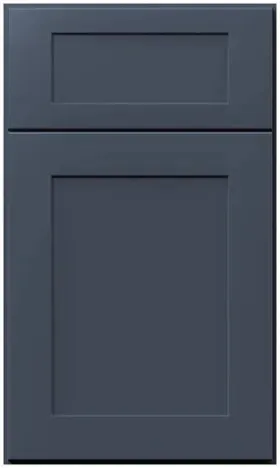
Of every box in a navy kitchen, this is the one that sits right under the counter edge with nothing between them, so it is where the colour gets judged against everything else in the room. A Galaxy Indigo 2 drawer base cabinet carries two deep dovetailed drawers behind two tall five-piece fronts, and it comes in 24″, 30″ and 36″. The storage is the same as in any finish. What changes with a slate navy is the list of materials that have to agree with it, and that is what this page works through.
Three widths, each one a single sheet of navy below the counter
The SKUs are GI DB24-2 at $724.75, GI DB30-2 at $835.25 and GI DB36-2 at $1,017.25. All three stand 34½″ high and 24″ deep on a ½″ veneered plywood box, with ⅝″ solid-wood dovetail drawers on Blum Tandem plus Blumotion runners, and they arrive pre-assembled. The 30″ and 36″ are the cooktop widths; the 24″ is the heavy drawer at the prep end.
Take away the toe kick and there is roughly 30″ of front, split into two panels of about 15″ each. On the 36″ box that is two wide recessed panels framed by 2½″ stiles and rails, painted a flat, opaque slate navy with no grain to break it up. It is the largest uninterrupted piece of the colour at counter height, and your countertop overhang casts its shadow straight onto the top rail. Whatever sits above it, beside it or underfoot is read against it first.
What countertop goes with navy cabinets?

The counter edge is a line drawn directly on top of the two-drawer front. On Indigo the line needs contrast to exist at all, because at #404754 or so the paint is already deep enough that a dark stone meeting it reads as one mass. Here is how the usual choices behave against it.
| Countertop | What happens at the edge | Our read |
|---|---|---|
| White marble-look quartz, soft gray veining | A crisp pale line over the navy; the gray veins pick up the gray in the paint | The classic partner, and the safest |
| Warm white or cream quartz, little veining | Softer edge; the warmth pulls the navy slightly toward its violet side | Good with Linen or Dove on the perimeter |
| White oak or maple butcher block | Warm wood against a cool paint, the strongest temperature contrast on the list | Best on an island top; oil it before it meets water |
| Concrete-gray or mid-gray quartz | Low contrast in value and temperature; both surfaces go flat | Works only with brass pulls doing the lifting |
| Black or charcoal granite, soapstone | The edge disappears into the navy; the island reads as one dark block | Avoid over this finish unless that block is the point |
Order the stone or quartz sample before the cabinets and put it on top of a door sample so the edge sits where the counter will. The undertone test in our countertop, backsplash and flooring guide works on navy too: a warm-veined slab beside a cool paint either looks deliberate or looks like two purchases, and it is obvious within a minute.
Brass, nickel or black: which metal a slate navy front wants
Two tall fronts means two pulls, or on the 36″ often two pairs, all at hand height on the most-used face of the island. The metal decides whether the drawer reads warm or cool, and on navy the three common choices come out very differently.
- Satin or brushed brass: the partner most navy kitchens end up with, because a warm metal on a cool paint is a contrast of temperature as well as value. Unlacquered brass darkens with handling, which on navy looks like age rather than dirt.
- Polished or satin nickel, stainless: a cool metal on a cool paint. It reads crisp and quiet, and it matches stainless appliances. Choose it when the room already has plenty of warmth from wood or a cream counter.
- Matte black: nearly the same value as the paint, so from across the room the pull almost vanishes. Close up it is fine; from the dining table the drawer looks handle-free. Pick it only if that is the look you want.
Buy one pull before you buy thirty and hold it on the sample under the island light. A finish that looked warm in a showroom can go greenish against a gray-blue paint.
White oak, not orange: the wood that lives beside navy
The floor, the stools and any open shelving are the other big surfaces near this cabinet, and wood is where navy kitchens most often go wrong. Blue and orange sit opposite each other on the colour wheel, so a red oak or honey-stained floor, cherry stools or an orange-toned laminate makes the island loud in a way nobody planned.
Pale, cool-leaning woods do the opposite: white oak, natural maple, ash, a light rift-sawn floor. They warm the navy without fighting it. If you want wood cabinetry in the same kitchen, the Galaxy Natural Oak finish is the Galaxy stain built for that job, on open shelves, a tall pantry column or the perimeter. Gray-washed plank floors go the other way and make the whole room cold; they need a cream counter and brass to recover.
The white on the far side of the island

Most Indigo islands face a white perimeter, and the Galaxy line gives three choices. They behave differently opposite navy, and it is the drawer front that you see them against.
- Frost is the crisp, bright white. It gives the sharpest contrast and the most graphic kitchen, and it is the one that makes the navy look its bluest.
- Dove is a softer, warmer off-white. The contrast is gentler and the navy looks slightly deeper beside it. It is the pairing we draw most for this island.
- Linen is beige. It warms the room most and brings out the faint violet in the paint under yellow light. That suits some rooms, but check it at night before you commit.
If it comes down to Frost or Dove, our Frost vs Dove comparison covers how the two whites differ. Whichever white you choose, keep the counter consistent across both runs so the island and the perimeter are clearly one kitchen.
Is Galaxy Indigo blue or purple? It depends on the bulb
Fabuwood describes the finish as a deep navy with violet undertones. Off the swatch it is a grayed, dusky blue, and in daylight or under neutral light that is exactly how it looks. The violet only appears in warm light, and island pendants are usually the warmest lights in a kitchen.
Under a 2700K bulb the tall fronts of this cabinet can go muddy and lean faintly purple, especially at night with no daylight to balance them. At 3000K the navy holds, and at 3500K it reads cleanly blue-gray. We usually suggest 3000K pendants over an Indigo island, 3000K to 3500K under-cabinet light on the perimeter, and a dimmer on the pendants rather than a warmer bulb. It is also the one dark finish where a bright room matters: navy darkens a kitchen less than black cabinets do, but only if light actually reaches the fronts.
Test the sample with its three companions
A navy door sample on its own tells you very little. Put it on the floor where the island will stand, lay the countertop sample on top, rest one pull on the top rail and a plank of the flooring at its foot, then look at the group under the actual pendant bulb after dark. If all four still agree at that point, order.
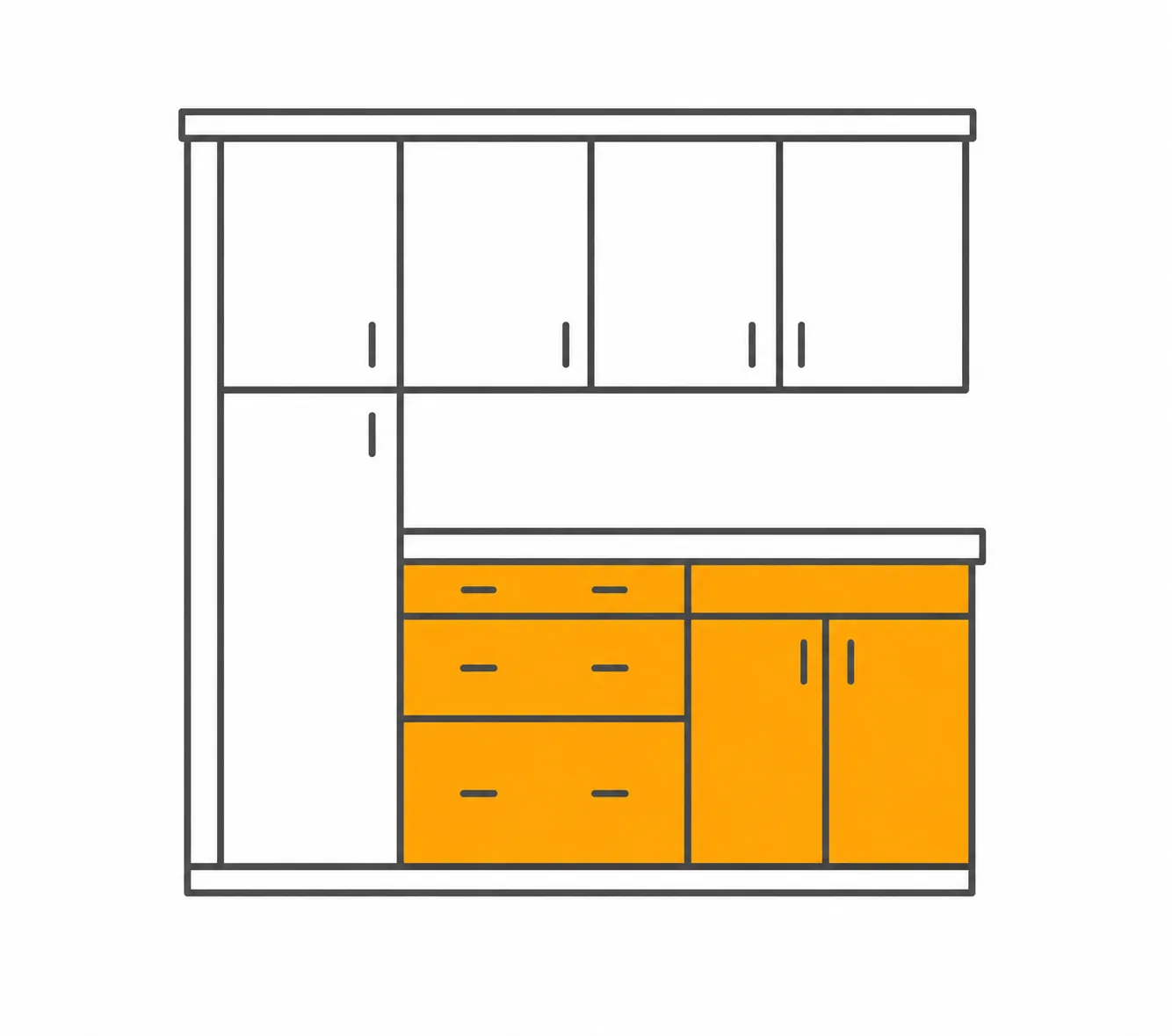
The design service draws the island with your cooktop, pulls and counter noted on the elevation, usually within 24–48 hours. The rest of the island comes from the three-drawer banks and the base cabinet lineup, and every finish in the line is on the Galaxy Indigo collection page.
Common questions
- What countertop goes best with navy blue cabinets?
- A white marble-look quartz with soft gray veining is the classic choice, because it gives the navy a crisp edge and the veins echo the gray in the paint. Warm whites and white oak butcher block also work. Black or charcoal tops are the risky choice: the edge disappears and the island reads as one dark block.
- Should hardware on navy cabinets be brass or nickel?
- Brass is the most common choice, because a warm metal gives contrast in both value and temperature. Nickel or stainless reads crisper and cooler and matches stainless appliances. Matte black is so close to the paint in value that it nearly disappears from a distance. Hold one pull on a door sample under your own lights before you order a full set.
- What wood floor goes with navy cabinets?
- Pale, cool-leaning woods such as white oak, natural maple and ash. Red oak, cherry and honey stains are orange-toned, and orange sits opposite blue on the colour wheel, so the kitchen gets loud. Gray-washed floors swing the other way and make the room feel cold.
- Is Fabuwood Galaxy Indigo blue or purple?
- Blue: a muted, grayed slate navy. Fabuwood mentions violet undertones, and under a warm 2700K bulb the paint can lean faintly purple, but in daylight and at 3000–3500K it reads as navy. Judge the door sample under your own bulbs at night.
- How much does a navy two-drawer base cost in this line?
- $724.75 for GI DB24-2, $835.25 for GI DB30-2 and $1,017.25 for GI DB36-2, pre-assembled, with dovetailed ⅝″ solid-wood drawers on Blum soft-close full-extension runners. The product grid above shows current prices.
- Is Galaxy Indigo a glossy finish?
- No. It is a flat, opaque paint in a low matte-satin sheen with no wood grain showing. It is not a high-gloss finish, and it looks the same from every angle rather than reflecting the room.
Keep reading
The guides behind the numbers on this page.
- How to Match Kitchen Cabinets With Countertops, Backsplash and Flooring
The undertone test to run before a warm-veined slab goes over a cool navy.
- 27 Kitchen Cabinet Ideas for Every Style and Budget
The navy-island-and-white-perimeter layout, alongside the alternatives.
- Fabuwood Cabinet Colors: The 2026 Guide to Every Finish
Where Indigo sits among the Galaxy whites, grays and stains.
- Kitchen Cabinet Styles and Color Trends for 2026
Why blue lowers and brass pulls keep turning up in new kitchens.
- Cabinet Wood Species: Oak, Maple, Walnut & More
Which woods lean cool enough to sit beside navy without clashing.
- Kitchen Island Clearance Guide
Aisle widths for the working face where this drawer opens.
- Kitchen Cabinet Samples: How to Order & Evaluate
Checking a sample against a countertop sample and a floor plank, not on its own.


