

Navy lowers, no uppers: wide drawerless bases under open wood shelves
Reviewed September 2026 · Captivating Cabinets
Prices quoted in this article were read off the grid on the review date; the live price grid on this page governs.
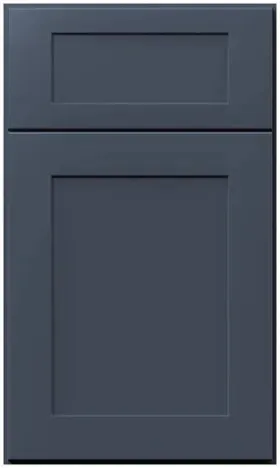
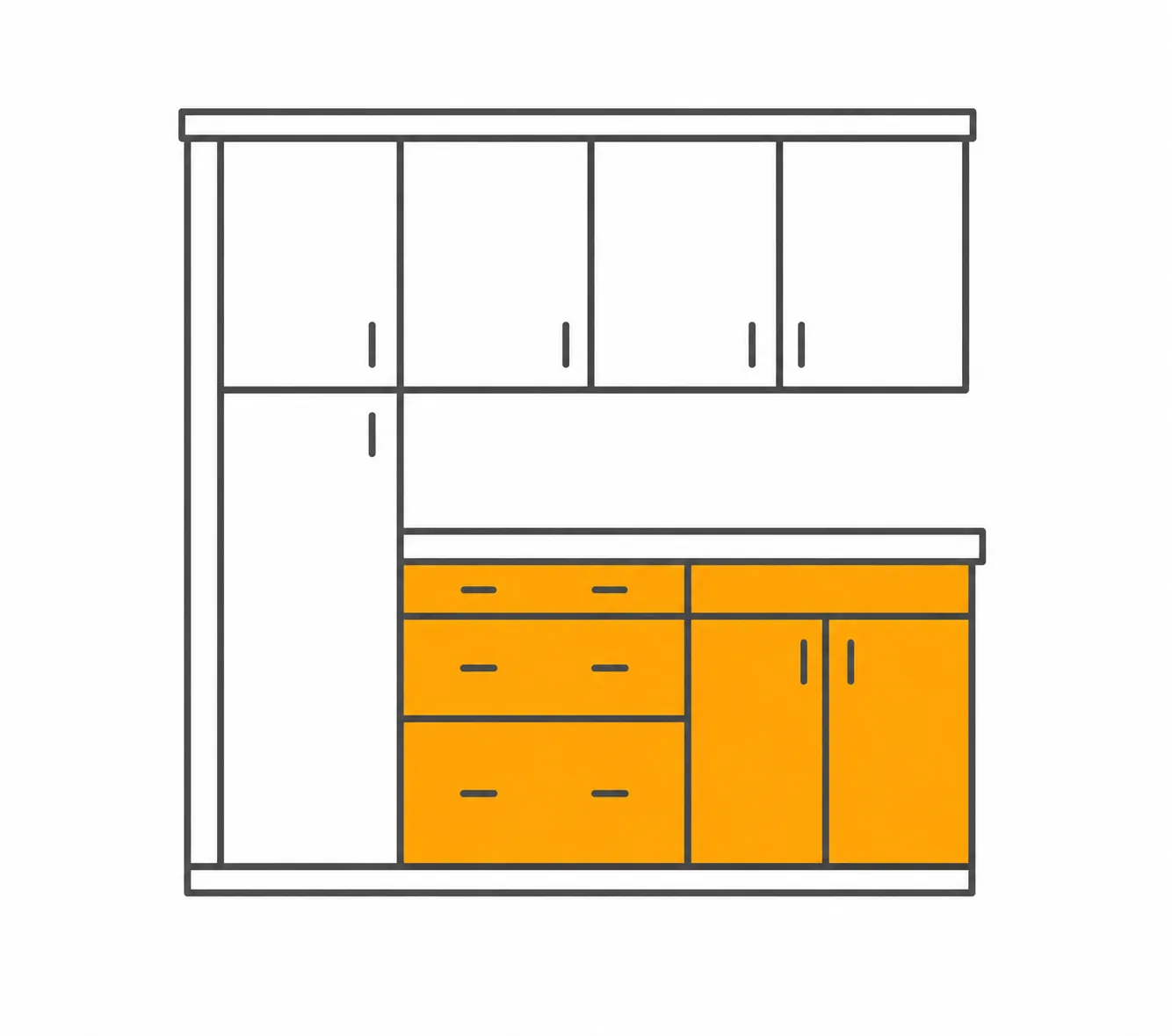
One of the most-requested navy kitchen looks is also one of the least storage-friendly: a blue lower run, a pale wall, and a couple of white-oak shelves where the wall cabinets would have been. Galaxy Indigo full height double door base cabinets — two doors, no drawer tier, 24″ to 39″ wide — are what makes that wall work, because they are the bulk storage that has to absorb everything the missing uppers used to hold.
Taking the wall cabinets off one wall
Dropping the uppers is a design choice with a cost. Navy lowers under open shelves look light and furnished; the blue sits low, the wall stays pale, and the shelves carry a few plates and plants. But a 30″ wall cabinet in this finish — GI W3030, $383.50 — can hold most of a household’s everyday dishes, and a wall that loses three of them loses a lot of cupboard. That storage does not vanish from the kitchen’s needs. It moves down, into the boxes on this page and the drawers beside them.
So the plan works in one direction: decide what used to live up there, then give each thing a place below. Most of it fits in wide drawerless boxes; some of it belongs in drawers; a little of it goes on the shelves as display. The next section does that sorting.
It helps to be honest about what open shelves hold. Two shelves across a 6-foot wall carry the handful of things you use every day and want to see — the mugs, a stack of bowls, a jar or two — and not much more, because everything on them collects kitchen grease and dust and gets washed more often than it would behind a door. Treat them as display with a little daily use, and let the navy boxes below do the storing.
Where the upper-cabinet storage goes, item by item
This is how we would rehouse the contents of a typical row of wall cabinets on a navy wall with no uppers.
| What used to be up there | Where it goes now | The part (our price) |
|---|---|---|
| Everyday plates and bowls | A deep drawer near the dishwasher, or a roll-out in a wide box | GI DB30 · $845.00, or GI B30FD · $461.50 with a roll-out at $227.50 |
| Glasses and mugs | The open shelf, if you use them daily; otherwise a roll-out | A standard roll-out, $214.50 to $240.50 by width |
| Serving platters and big bowls | On edge or stacked in the bare wide box | GI B36FD · $490.75 |
| Dry goods and tins | A roll-out with taller sides so nothing tips | GI ROD-B36 BLUM H · $286.00 |
| Things used twice a year | The back of a 39″ box, behind two doors | GI B39FD · $526.50 (no 39″ roll-out is listed) |
| Display pieces | The shelves, and only a few of them | — |
The pattern: anything used daily wants to come out to you, so it goes on a roll-out or in a drawer; anything bulky and occasional can sit in a bare box. Tall-sided roll-outs (the “H” versions, about $50 more than the standard ones) are the better choice for tins and jars. The trays are on the roll-out drawer page, the drawer banks on the three-drawer page.
Six widths, with a standard or tall-sided roll-out
Each box is 34½″ high and 24″ deep with two full-overlay doors and no drawer tier; five of the widths also come 12″ deep. Roll-outs are listed for 24″ to 36″ boxes. The totals below are box plus one tray.
| Width | Bare box | + standard roll-out | + tall-sided roll-out | 12″-deep box |
|---|---|---|---|---|
| 24″ | GI B24FD · $403.00 | $617.50 | $666.25 | $396.50 |
| 27″ | GI B27FD · $442.00 | $659.75 | $708.50 | $429.00 |
| 30″ | GI B30FD · $461.50 | $689.00 | $741.00 | $442.00 |
| 33″ | GI B33FD · $468.00 | $698.75 | $750.75 | $455.00 |
| 36″ | GI B36FD · $490.75 | $731.25 | $776.75 | $477.75 |
| 39″ | GI B39FD · $526.50 | none listed | none listed | not made |
All 35% under Fabuwood list as read on the review date. Order the tray on the same line as the box it goes in, so it is sized to that cabinet. If two trays are on your list for one box, price the drawer base at that width first: Indigo makes one at 24″, 27″, 30″, 33″ and 36″, and a drawer box usually does the job better than a pair of trays behind doors.
What wood goes with navy cabinets, and what fights it

The shelves are usually wood, and the wood is the other colour in the composition, so pick it with the navy in hand.
White oak is the natural partner. Its pale, slightly golden tone warms a cool blue without competing with it, and it looks right as floating shelves, a butcher-block counter or the floor. Maple in a natural finish works the same way, a little plainer. Red oak and cherry push further toward orange, which sits opposite blue on the colour wheel: the contrast is strong and lively, fine in small doses, loud as a whole floor under a navy run. Walnut is the one to be careful with; a dark brown beside a dark blue gives little contrast, and the two can read as one heavy band. If you want the wood in the cabinets too, Galaxy Natural Oak is the pale oak finish in the same line. The wood species guide compares the grains and tones.
The wall above a navy run
With no uppers, the wall becomes a surface in its own right. A warm white or a soft off-white paint keeps the room bright and gives the navy something to stand against. A full-height backsplash in a white marble-look quartz or a glazed tile carries light down to the counter and is easy to wipe behind shelves. Keep the shelf wood and the counter from fighting: if the shelves are oak, a white or soft-veined counter usually looks better than a wood top as well.
The practical items are the same whatever the look. Shelves need solid fixing into studs or blocking, planned before the wall is closed; the range hood needs its own space and venting route; and outlets land at the backsplash rather than hiding under a wall cabinet. A navy wall with no uppers is also a place where the wall cabinets in this finish can still earn a spot — a single run on the adjacent wall often covers the storage the shelf wall gave up. Our design service can lay out the split before anything is ordered.
Wider than 39″ means the double door bases with a drawer; narrower and drawerless is the full-height single page; and the full navy finish is on the Galaxy Indigo collection page.
Common questions
- Can you have navy base cabinets with open shelves and no uppers?
- Yes, and it is a popular look, but the storage from the wall cabinets has to go somewhere. Plan drawers or roll-outs for daily dishes and wide drawerless boxes for bulky items before taking the uppers off the plan.
- What wood goes with navy blue cabinets?
- White oak is the classic partner: pale and slightly golden, it warms the blue without competing. Natural maple works similarly. Red oak and cherry give a strong orange-blue contrast. Walnut is dark enough to merge with navy into one heavy band.
- How much storage do you lose without upper cabinets?
- A lot, one wall at a time. A single 30″ wall cabinet can hold most of a household’s everyday dishes. Replace that capacity below with roll-outs in wide boxes — from $617.50 for a 24″ Indigo box with one tray — or with drawer bases.
- Does a 39 inch base cabinet take a roll-out?
- No 39″ roll-out is listed for Indigo. GI B39FD, at $526.50, is the widest drawerless box and is best used bare, for large or occasional items behind two doors.
- What countertop goes with navy cabinets and wood shelves?
- Usually a white or soft-veined marble-look quartz. It bounces light onto the navy fronts and keeps the wood shelves as the only wood tone. A butcher-block top also works, but not in a different wood from the shelves.
- Is a tall-sided roll-out worth the extra cost?
- For tins, jars and bottles, yes. The tall-sided H version costs about $50 more than the standard tray — $286.00 against $240.50 at 36″ — and keeps upright items from tipping when the tray moves.
Keep reading
The guides behind the numbers on this page.
- Cabinet Wood Species Compared: Oak, Maple, Walnut and Acacia
Which wood tone to put on the shelves over a navy run.
- 27 Kitchen Cabinet Ideas
Navy lowers, open shelves and the other ideas that trade storage for looks.
- Space-Saving Cabinet Solutions
The roll-outs and inserts that make lower boxes do an upper’s job.
- Wall and Tall Kitchen Cabinets: Sizes and Buying Guide
What a row of wall cabinets holds, before you decide to drop it.
- How to Match Kitchen Cabinets, Countertops, Backsplash and Flooring
The counter and splash that sit between navy boxes and oak shelves.
- Kitchen Layouts Explained, Single-Wall to G-Shaped
Which wall in your layout can give up its uppers.
- Kitchen Cabinet Styles and Color Trends for 2026
Where navy and wood sit among this year’s kitchens.


