

Sixteen painted edges at knee height: keeping a Galaxy Indigo 4 drawer base cabinet looking new
Reviewed September 2026 · Captivating Cabinets
Prices quoted in this article were read off the grid on the review date; the live price grid on this page governs.
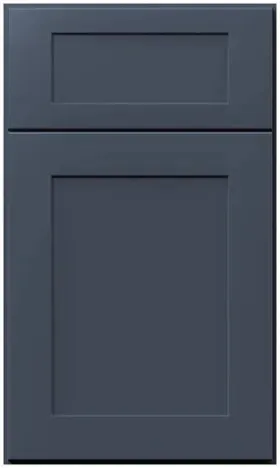
Four short fronts stacked in one narrow box make this the cabinet with the most painted edge per foot of wall, and the bottom drawer sits a few inches off the floor. A Galaxy Indigo 4 drawer base cabinet comes in 15″, 18″ and 21″ and it is a good cabinet. But a saturated navy paint behaves differently from a white one or a stain, and it is worth knowing how before the first scuff.
Four fronts, sixteen edges, and why the edge is where paint fails

The three sizes are GI DB15-4 at $780.00, GI DB18-4 at $799.50 and GI DB21-4 at $832.00. Each has four five-piece fronts about 7½″ tall, with solid-wood frames around ⅜″ MDF centre panels, painted and factory-finished. Every front has four outside edges plus the inner profile around its recessed panel, so a single box presents sixteen outside edges between knee and ankle.
Paint is thinnest on an edge and takes the hardest knocks there: a pot handle, a vacuum head, a shoe. On a white front a small chip shows the pale primer and wood beneath and hardly anyone notices. On a flat slate navy the same chip shows as a pale fleck, easy to see from standing height. It is the one real maintenance difference between this finish and a white one, and most of the advice below comes back to it.
What a slate navy paint shows, and what it hides
Navy is not a hide-everything colour, and it is not a show-everything colour either. It sits in the middle, with a pattern that is worth knowing in advance.
| Mark | On Indigo | On a white paint |
|---|---|---|
| Grubby fingerprints, food smudges | Mostly hidden | Shows as a gray patch by the pull |
| Skin oil on a clean front | Can show as a faint sheen in raking light | Rarely visible |
| Dust | Shows as a pale film on the ledges | Hidden |
| Flour, sugar, dried water spots | Shows clearly | Hidden |
| Edge chip | Pale fleck | Barely visible |
| Black shoe scuff on the bottom drawer | Hidden | Shows |
The takeaway: navy is easy on the everyday handling marks that make white kitchens look tired, and hard on anything pale, whether dust, flour, mineral spots or chips. A four-drawer bank in a baking corner will need wiping more often than one beside the range.
The dust ledges a recessed panel makes
A shaker front is a frame around a panel set slightly back, so the top edge of each bottom rail forms a small inward ledge. A four-drawer bank has four of these stacked one above another, plus the top edge of every front. Dust and crumbs settle on them, and on navy they collect into a pale line you notice when the light comes in low from a window.
Clean them the dry way first. Run a soft, dry microfiber cloth or a clean soft paintbrush along each ledge once a week, so dust never gets damp enough to smear. Only wipe with a damp cloth afterwards, and never the other way round.
Cleaning painted navy cabinets without leaving shiny patches

Indigo is a low matte-satin sheen, not a gloss, and the biggest risk to a low sheen is polishing it by accident. Rub one spot hard and it turns shinier than the rest of the front, and on a dark colour that patch catches the light from across the room.
- Dry-dust the ledges and edges first.
- Wipe with a soft cloth dampened in warm water and a drop of mild dish soap, wrung out until it is barely wet.
- Wipe along the length of the rail or stile, never in circles, and do not concentrate on one spot.
- Dry straight away with a second cloth, paying most attention to the bottom edge of each front, where water runs down and sits.
Keep melamine sponges (the "magic eraser" type) away from this finish. They are a fine abrasive and burnish a matte paint in one pass. Also avoid ammonia and bleach cleaners, abrasive pads and wax-based furniture polish. Our cabinet care guide covers the full routine, and the matte finishes guide explains why low-sheen paint marks this way.
The touch-up kit: what it fixes and what it does not
Fabuwood sells a matched Galaxy Indigo touch-up kit at $62.40. It is designed for the chip problem above: a pale fleck on an edge or corner, a nick from a pot handle, a scratch through to the primer. Clean the spot, let it dry, and build the colour up in thin coats with the tip of the brush, letting each coat dry before the next. A dab that is too heavy leaves a raised blob that catches light worse than the chip did.
It is not for a scrape across the middle of a panel, water damage along a bottom edge, or a front that has been knocked out of shape. Those are replacement-part questions, and whether a part is available in this finish is something to confirm with your designer rather than assume.
Where to put it so the bottom drawer survives
The top three drawers of this box take little abuse. The bottom one, a few inches above the toe kick, is where the wear happens. A little care with placement prevents most of it.
- Keep it away from the pet bowls, the mop and bucket corner, and the spot where school bags get dropped. Those are the three most common sources of edge chips at ankle height.
- At the end of a run beside a walkway, give it a finished side: a GI SK BASE skin at $62.40 or a GI BEP end panel at $149.50. Hips and bags catch an exposed end, and a panel takes that wear instead of the box.
- Next to a dishwasher, let the steam clear before you wipe. A warm, wet bottom edge is where paint is most easily marked.
- Choose pulls that stand at least an inch off the front, so fingernails and rings grip the metal rather than the paint.
The Blum runners help too. The soft-close stops each front a fraction short and settles it, so the fronts do not slam against the frame the way unsprung drawers do. That impact is what chips painted edges on older cabinets.
Inserts sized to the three boxes
Only the top drawer of each box usually needs an insert. At 15″ and 18″, the GI CD-15/18 cutlery tray is $201.50; the 15″ also takes GI DCD-15 BLUM, an inner drawer on its own runners, at $354.25. The 18″ adds GI KCUP-18 ($224.25) and GI DCD-18 BLUM ($429.00). The 21″ takes GI CD-21/24 ($273.00), GI KCUP-21/24 ($266.50) or GI DCD-21 BLUM ($468.00). A tray also keeps metal utensils from rattling against the drawer box, which counts for more in a narrow box that gets opened constantly. Everything else in the finish is on the cabinet accessories page.
Put the kit on the first order
Add the touch-up kit when you order the cabinets, not after the first chip. It comes matched to this finish, and a chip fixed the week it happens is almost invisible. Galaxy ships pre-assembled in about 2 weeks. When the boxes arrive, photograph the edges of each front before installation so any shipping mark is documented.
If you have not seen the colour in person yet, the door sample is $35.00 and final sale. The rest of the run starts from the base cabinet lineup or the Galaxy Indigo collection, and the design service will draw it for you.
Common questions
- Do navy kitchen cabinets show dust and fingerprints?
- Dust, yes: it shows as a pale film on the ledges and top edges, especially in low light from a window. Grubby fingerprints, much less than on white. Clean skin oil can leave a faint sheen visible at an angle. Flour, dried water spots and edge chips are the marks navy shows most.
- How do you clean painted navy cabinets?
- Dry-dust the ledges first, then wipe with a soft cloth barely dampened with warm water and a drop of mild dish soap, working along the rails rather than in circles. Dry straight away. Avoid melamine "magic eraser" sponges, ammonia, bleach, abrasive pads and wax polish, all of which can leave shiny patches.
- Can chipped navy cabinets be touched up?
- Yes. Fabuwood makes a Galaxy Indigo touch-up kit, $62.40, for small chips and edge nicks. Apply thin coats with the brush tip and let each dry. Larger damage is a replacement-part question for your designer.
- Is a hairline line at the joint of a painted cabinet door a defect?
- Usually not. Five-piece painted doors are made from separate pieces of solid wood that move slightly with humidity, and that can show as a fine line where a rail meets a stile. It is more visible on dark paint. Keep indoor humidity steady, and ask your designer how the warranty treats it if it opens noticeably.
- What sizes does the navy four-drawer base come in?
- 15″, 18″ and 21″: GI DB15-4 at $780.00, GI DB18-4 at $799.50 and GI DB21-4 at $832.00, all 34½″ high and 24″ deep. From 24″ up, drawer bases come as two- or three-drawer units.
- Is Galaxy Indigo glossy or polished?
- No. It is a flat, opaque paint in a low matte-satin sheen with no grain. That low sheen is why a hard-scrubbed spot can turn shinier than the rest of the front, so clean it gently.
Keep reading
The guides behind the numbers on this page.
- How to Clean and Care for Your Kitchen Cabinets
The full cleaning routine, including what never to put on a painted front.
- Matte Cabinet Finishes: Pros, Cons & Care
Why a low sheen burnishes, and how to avoid it.
- How Long Do Kitchen Cabinets Last?
What decades of use do to a painted finish compared with a stained one.
- Soft-Close vs Self-Closing Cabinet Drawers
The runner that stops four fronts slamming into their frame.
- Fabuwood Cabinet Accessories: Lazy Susans, Trash Pull-Outs, Drawer Inserts and Blind Corners
The top-drawer inserts listed for these widths, explained.
- Cabinet End Panels, Scribe Molding and Fillers Explained
The end panel that takes the knocks at the end of a run.
- What Dovetail Drawers Tell You About Cabinet Quality
The pale drawer box you see every time a navy front opens.


