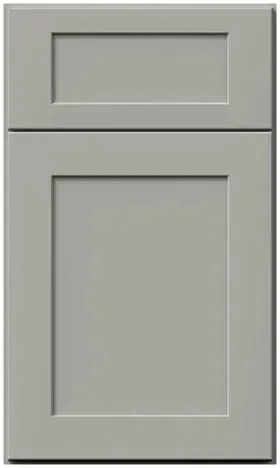


The inch that makes the run fit: fillers, and why you order more of them than the plan shows
Reviewed September 2026 · Captivating Cabinets
Cabinets are manufactured in three-inch steps. Rooms are built by people with a tape measure and a bad day, and they finish at 142¾ inches. Everything on this page exists to absorb the difference — a strip of finished wood, ordered in the same batch as the doors, cut on site to whatever the wall turned out to be. It is the least interesting part in the kitchen and the one most likely to hold up an install, because it is cheap enough to forget and specific enough that a piece from the hardware store will not do.
Count the gaps before you count the cabinets

Most people arrive at this page because a designer put one line on the quote and they want to know what it is. The better question is how many lines there should be, and the answer on a normal kitchen is more than one. Walk the plan and mark every one of these:
- Every point where a run dies into a wall. Almost never flush, because plaster is not plumb and drywall corners are built up.
- Every inside corner where two runs meet at ninety degrees — one filler minimum, sometimes one on each leg.
- Every appliance opening. A range, a dishwasher and a fridge all want a little air and a little tolerance either side, and that tolerance is a filler.
- The upper run, separately from the base run. Uppers and bases rarely land on the same wall dimension once a window or a return is in the way.
- The tall run. A pantry or oven tower against a wall usually needs a full-height strip, and it is the one most often left off.
- Anywhere a run stops beside a doorway, an arch or a radiator — that leftover inch is visible from the next room, not just from the kitchen.
On a plain L-shaped kitchen that is typically three to five pieces; on a U with an island and a tall run, closer to eight. The plan you were sent will show fewer, because a plan is drawn to nominal dimensions and the tape has not been on the wall yet.
What a filler actually buys you at a corner or a wall return
This is the part that gets skipped, and it is why a filler is functional rather than cosmetic. Every door and drawer front in this line is full overlay: the face covers the box and hangs past its edge rather than sitting inside a frame. That is what makes the run read as one continuous plane — and it is also what puts the moving part of the cabinet in the way of whatever is next to it.
At an inside corner, run A’s door or drawer opens straight into the space in front of run B. With no filler the two faces are in the same plane, so A’s drawer front catches B’s door, or A’s pull collides with B’s pull, or the drawer will not travel far enough out to clear the corner at all — which means a full-extension runner behaves like a half-extension one for the life of the kitchen. Three inches is the usual minimum we specify there, and more if the pull projects or if the corner box is a blind unit that already relies on its opening being unobstructed.
At a wall return the problem is hinge-side rather than pull-side. These boxes run Blum Compact Clip concealed hinges with a 110-degree opening. Push the hinge side tight against plaster and the door cannot swing through its arc — it stops at maybe seventy degrees, and at seventy degrees you cannot get a roll-out past it or lift a stack of plates squarely out of a wall cabinet. A one-and-a-half to three inch strip fixes that permanently for less than a pack of pulls.
Beside an appliance the number comes off the appliance. A fridge door has to open past ninety degrees before its bins will pull out; a range wants its handle clear of the face beside it. Send the elevation in for a free 3D design and it comes back with the fillers dimensioned rather than assumed.
The four families, and which height each one belongs to
Fillers are catalogued by the run they belong to, because the height is the part you cannot cut wider. Base fillers are supplied at base height and are the only ones with no height in the code. Wall and tall fillers carry their height as the trailing digits — GN WF336 is 3 inches wide by 36 high. Overlay fillers are the same idea with a faced front.
| Family | Widths and heights | Price range | Where it goes |
|---|---|---|---|
| Base — GN BF3, BF6 | 3″ and 6″ wide, base height | $26.00 – $43.55 | Wall returns and corners in the base run |
| Wall — GN WF330 to WF642 | 3″ and 6″ wide, 30/36/39/42″ high | $26.00 – $78.00 | The same gaps one storey up, matched to the upper height |
| Tall — GN TF396, TF696, TF3120 | 3″ and 6″ wide, 96″ and 120″ high | $84.50 – $156.00 | Beside a pantry or oven tower, floor to top |
| Overlay — GN OLF330 to OLF642 | 3″ and 6″ wide, 30″ up to 96″ high | $71.50 – $230.75 | Where the gap should read as a deliberate line, not a patch |
One number in that table is worth a second look. The 3-inch overlay filler at 96 inches, GN OLF396 at $230.75, costs more than the 6-inch tall filler at the same height, GN TF696 at $152.75 — which tells you exactly what the premium buys. Not wood: a faced front made the same way as a door.
Height matching matters more than people expect on the wall run. Order a 30-inch filler beside 36-inch uppers and you have a three-inch strip of wall showing at the top of the gap, at eye level, for the life of the kitchen. The upper heights in this line are set out in the wall and tall sizing guide.
When a three-inch gap is worth more than a strip of wood
Two upgrades are worth knowing about before you default to a flat piece. The first is the overlay version above: same gap, faced front, so the join reads as part of the design rather than as something closing a mistake.
The second turns the gap into storage. Filler pull-outs are catalogued as cabinet accessories rather than decorative parts, and they are a real piece of hardware rather than a trick: GNK SPO-BF3 is $334.75 for a 3-inch pull-out, GNK SPO-BF6 is $380.25 at 6 inches, the Blum-runner versions are GNK SPO-BF3 BLUM at $585.00 and GNK SPO-BF6 BLUM at $695.50, GNK TBPO-BF3 is $432.25, and the slim GNK SSPO-BF1-1/2 is $1,313.00. They live on the cabinet accessories page.
The honest test is whether the gap is somewhere you would actually use. A 3-inch pull-out beside the range earns its money for oils and spices; the same part at the far end of a run nobody stands at is $334.75 for a drawer you will open twice. Note too that the box has to be planned for it — a pull-out needs its own carcass depth and a clear swing, which is an order-day decision rather than something to add later.
One thing about a filler in a mid-tone at an inside corner
An inside corner is the darkest square foot of any kitchen. No matter how the lighting is planned, the return wall shades it, the two runs shade each other, and nothing under the uppers throws light directly into it. A filler sitting in that corner therefore reads a step darker than the doors either side of it — which on a white kitchen is a shadow and on this grey is closer to a second colour.
That is an argument for keeping corner fillers at three inches rather than letting them grow to six because it made the layout maths easier. A narrow strip in shadow disappears; a six-inch one is a visible band, and that is the one place the overlay version pays for itself, because a faced front catches the same light the doors do. How this mid-tone behaves across a room’s worth of lighting is covered in finding the right shade of grey.
How many to order, and what happens if you get it wrong
Order every filler the plan shows, then add one spare of each width you are using. The spares are $26.00 and $43.55 at base height; the cost of not having one is a second delivery on a job that is otherwise finished. Tall fillers are the exception, because at $84.50 to $156.00 a spare 96-inch strip is real money and a tall gap can usually be measured properly before the order goes in. Measure that one; guess the rest generously.
Everything here is finished in the same run as the doors, ships pre-assembled with the rest of the order in seven days to three weeks, and carries the Fabuwood limited lifetime warranty on a KCMA-certified, AWI Premium Grade box. Order it with the cabinets, not after them. The full trim range is on the decorative accessories page, the fillers themselves are here, and the cabinets they are closing gaps between are on the collection.
Common questions
- How wide should a kitchen cabinet filler be?
- Three inches is the working minimum at an inside corner, because that is roughly what it takes to get a full-overlay door or drawer front clear of the run turning the corner. At a plain wall return you can go narrower — one and a half to three inches is normal. The exact number comes off the elevation, since it depends on the pull you have chosen as much as on the cabinet.
- Do I really need a filler at a corner?
- Almost always. Without one, the drawer front on one run catches the door or the pull on the other, so the drawer never reaches full extension and the door never opens past about seventy degrees. That is a permanent loss of function, not a cosmetic issue, and a $26.00 part fixes it.
- What is the difference between a base filler, a wall filler and a tall filler?
- Only the height they are supplied at. GN BF3 and BF6 are base height. Wall fillers carry the upper height in the code — GN WF336 is 3 inches by 36 high — and must match the uppers beside them or a strip of wall shows at the top. Tall fillers are 96 or 120 inches for a pantry or oven tower.
- What does an overlay filler do that a plain one does not?
- It has a faced front built like a door, so the gap reads as a deliberate vertical line rather than as a flat strip closing a mistake. GN OLF330 is $71.50 against $26.00 for the plain part. It earns the money most in a shaded corner, where a flat strip reads a shade darker than the doors and a faced one does not.
- How many fillers does a kitchen need?
- Three to five on a simple L, closer to eight on a U with a tall run and an island. Count wall returns, inside corners, appliance openings, the upper run separately from the base run, and anywhere a run stops beside a doorway. Then add a spare of each width.
- Can I use a filler as a spice pull-out?
- Yes, but it becomes a different part. Filler pull-outs are on the cabinet accessories page — GNK SPO-BF3 at $334.75 for a 3-inch unit, up to GNK SPO-BF6 BLUM at $695.50. The cabinet has to be planned around one, so it is an order-day decision rather than a later addition.
Keep reading
The guides behind the numbers on this page.
- End Panels, Scribe Molding and Fillers Explained
The three parts this page is confused with, separated properly.
- Cabinet Terminology and Abbreviations
What BF, WF, TF and OLF mean on a quote.
- Wall and Tall Cabinet Sizes
The upper heights a wall filler has to be matched to.
- Important Kitchen Dimensions Before Buying Cabinets
Measuring a wall properly is what decides the filler count.
- Why Blum Soft-Close Hinges Are Worth It
The 110-degree arc that a wall return has to leave room for.
- Full Overlay vs Partial Overlay vs Inset
Why a full-overlay door is the reason corners need clearance.
- Space-Saving Cabinet Solutions
If the three-inch gap is going to become a pull-out.
- Gray Kitchen Cabinets: Finding the Right Shade
How this mid-tone behaves in the shaded part of a room.


