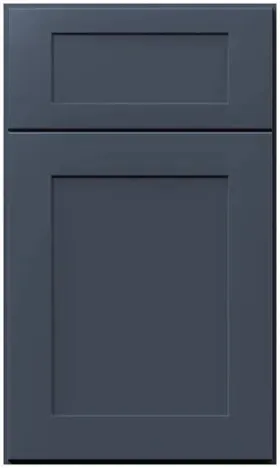


Forty-eight inches: the end of the board
Reviewed September 2026 · Captivating Cabinets
The base grid stops here, and it stops quietly: a blind corner at $767.00 and a standard base at $815.75, and nothing else. No sink base, no drawers, no shallow version, not even a full-height door box. Two SKUs, one of which is genuinely useful and one of which is the cheapest standard base you can buy by the inch and almost never the one you should.
Price per inch, nine inches to forty-eight
Set the standard base at every width against its own width and the economics of the whole board fall out in one column.
| Width | SKU | Displayed price | Per inch |
|---|---|---|---|
| 9 inches | B09FD | $273.00 | $30.33 |
| 12 inches | B12 | $364.00 | $30.33 |
| 15 inches | B15 | $377.00 | $25.13 |
| 18 inches | B18 | $409.50 | $22.75 |
| 21 inches | B21 | $432.25 | $20.58 |
| 24 inches | B24 | $471.25 | $19.64 |
| 27 inches | B27 | $516.75 | $19.14 |
| 30 inches | B30 | $555.75 | $18.53 |
| 33 inches | B33 | $633.75 | $19.20 |
| 36 inches | B36 | $676.00 | $18.78 |
| 39 inches | B39 | $718.25 | $18.42 |
| 42 inches | B42 | $757.25 | $18.03 |
| 48 inches | B48 | $815.75 | $16.99 |
Two things to take from that column. The curve is steep at the narrow end and then flat: you pay roughly thirty dollars an inch for the first twelve inches and about nineteen for everything from 24 up. That is because a cabinet's cost lives in its ends, its face frame, its doors and the labour of assembling it, none of which change much with width. And the flat section has a bump at 33 inches, where the box goes to two doors and two drawer fronts.
The bottom row is the cheapest inch of standard base on the board at $16.99. Buying the whole kitchen in 48s would be, on paper, the cheapest way to cabinet a wall — the same arithmetic runs across the rest of the catalog if you want to check it against the sink and drawer families. It would also be a bad kitchen.
Why the cheapest inch is usually the wrong buy
A 48-inch box takes two 24-inch doors. That is the width of a dishwasher, swinging into your aisle, twice. It is more door than most rooms can give up, and it is more door than most hinge sets stay perfectly aligned on without adjustment.
Then there is what happens inside. A 48-inch-wide, 24-inch-deep cavity is eight square feet of floor with a shelf over it, and everything in it migrates backwards until the only way to find anything is to kneel down and reach past what is in front. Narrow boxes and drawer banks are more expensive per inch precisely because they solve that, and solving it is what a kitchen is for.
The rule we use: wide boxes for storage you access occasionally, narrow boxes and drawers for everything you touch daily. Cost per inch is the wrong number to optimise on a wall you will use twice a day for fifteen years.
What is not made at 48 inches
Everything else. There is no 48-inch sink base — the widest is 42. There is no 48-inch drawer bank; drawers stop at 36. No apron sink cabinet, which stops at 36. No easy reach or lazy Susan, which also stop at 33 and 36. No 12-inch-deep version, which stops at 36. Not even a full-height door box, which stops at 39.
So a plan that specifies 48 inches of anything other than a standard base or a blind corner is a plan that has to change. That is not a complaint about the range; it is what happens when a family of boxes reaches the width at which its mechanisms and its bearing stop making sense.
The mistake at this width
Buying width to save money on a tight budget. It is a real temptation — the per-inch column above makes it look like free money, and on a whole-kitchen quote the saving reads as several hundred dollars. What it actually buys is fewer, larger, less usable compartments, and the difference shows up on day one rather than in year five. If the budget is the binding constraint, the levers worth pulling are the finish, the accessory count and how many drawer banks you specify — not making the boxes bigger.
Common questions
- What is the widest base cabinet you can buy?
- Forty-eight inches, as either a standard base at $815.75 or a blind corner at $767.00. Nothing on the base board is made wider, and most families stop well short of it.
- Is a 48-inch base cabinet cheaper per inch?
- Yes — $16.99 an inch, the lowest of any standard base, against about $30 an inch at nine and twelve inches. That is because a cabinet's cost sits in its ends, doors and assembly rather than its width.
- Can I put a sink in a 48-inch base cabinet?
- Not from the sink base family — it stops at 42 inches. A wider sink run has to be built from a 36 or 42-inch sink base with fillers or a narrow neighbouring box either side.
- What does BLB48/51 mean?
- A blind corner base that closes either a 48-inch or a 51-inch leg of the corner, depending on how far the box is pulled away from the corner during install, with filler behind it.
- Are there 48-inch drawer bases?
- No. The widest drawer bank made is 36 inches. To get 48 inches of drawers, use two banks side by side — a 21 and a 27, or two 24s.
Keep reading
The guides behind the numbers on this page.
- Cabinet price list
Run the per-inch arithmetic yourself across the sink, drawer and corner families.
- What a 10x10 kitchen costs
The benchmark that shows what widening boxes actually saves on a whole quote.
- How much do kitchen cabinets cost?
The levers that genuinely move a budget, none of which is box width.
- Types of base cabinets
What you give up when a run is built entirely from the widest boxes.
- Kitchen dimensions guide
Aisle and reach dimensions, which are what a 24-inch door tests.
- Framed versus frameless cabinets
Construction changes how much of a wide box you can actually get at.