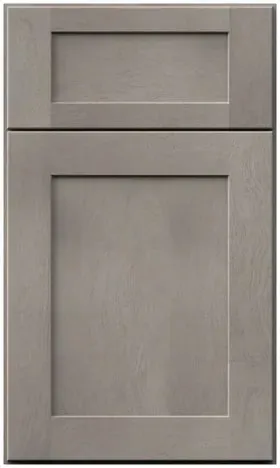


One wide Galaxy Horizon box or two narrow ones: pricing the same stretch of wall both ways
Reviewed September 2026 · Captivating Cabinets
Prices quoted in this article were read off the grid on the review date; the live price grid on this page governs.
Any stretch of wall between 24 and 39 inches can be filled two ways: with one two-door cabinet that spans it, or with two single-door boxes set side by side. Plans default to the wide box, and most of the time that is right, but the reasons are worth knowing, because they are partly about money and partly about what a joint looks like on Galaxy Horizon. A stain lets every face frame show its own grain, so the place two boxes meet is visible in a way it is not on a flat paint. Here is the arithmetic for each width, the case for fewer joints, and the handful of jobs where two singles are still the better buy.
The same frontage, priced as one box and as two
Every row below fills the same width of wall at the same height. The left column is the single two-door box; the right is the cheapest pair of single-door boxes that makes up the same width. Displayed prices on the review date, 30 inches tall, which is the height most runs use under an 84-inch line.
| Frontage | One two-door box | Two single-door boxes | The pair costs |
|---|---|---|---|
| 24″ | GH W2430 — $364.00 | GH W1230 ×2 — $455.00 | $91.00 more |
| 27″ | GH W2730 — $377.00 | GH W1230 + GH W1530 — $461.50 | $84.50 more |
| 30″ | GH W3030 — $383.50 | GH W1530 ×2 — $468.00 | $84.50 more |
| 33″ | GH W3330 — $403.00 | GH W1530 + GH W1830 — $507.00 | $104.00 more |
| 36″ | GH W3630 — $422.50 | GH W1830 ×2 — $546.00 | $123.50 more |
| 39″ | GH W3930 — $526.50 | GH W1830 + GH W2130 — $568.75 | $42.25 more |
The wide box wins on price at every width, by between about forty and a hundred and twenty-five dollars. That is roughly what one extra side panel, one extra back and one extra set of hinges cost, which is what the pair is really buying. At 42 inches tall the gap is similar: GH W3642 is $620.75 against $708.50 for two GH W1842, and GH W3042 is $526.50 against $650.00 for two GH W1542.
The row to look at twice is the last one. The 39-inch box is the widest two-door cabinet on the wall and it is priced noticeably above its neighbours: GH W3930 costs $104.00 more than the 36-inch GH W3630 for three more inches of width. That narrows the gap to a pair of singles to $42.25, close enough that the other considerations below can reasonably tip it. At 42 inches tall the same thing happens, GH W3942 at $724.75 against $770.25 for GH W1842 and GH W2142 together. Every two-door size and height is on the double door wall page; the single-door grid is on the single door wall page.
What a joint looks like when the grain shows

Picture the front of a run. Every framed cabinet has a face frame, with a vertical stile at each side. Where two boxes are screwed together, the stile of one sits tight against the stile of the next, so a joint between boxes reads as a doubled stile with a fine line down the middle. Inside a single two-door box there is no such joint; the two doors close onto one frame.
On a paint, that line is the whole story. The coating is opaque and uniform, so two stiles from two boxes read as one slightly wider stile and nobody notices. On a stain the grain shows through, and Fabuwood’s spec book says colour variation between parts is normal for its stained finishes. Two stiles from two boxes are two separate pieces of solid wood with two grain patterns, and they can take the colour a shade differently. Most of the time the difference is slight. It is still a difference the paint does not have, and every extra box on a wall adds one more place for it.
The doors themselves are no exception to that, to be fair. The two doors on a wide box are also two pieces, each with a solid wood frame around a ⅜-inch centre panel Fabuwood specifies as MDF with a veneer face, and they will not be identical either. The point is not that one box is perfect and two are not. It is that fewer joints means fewer places where two tones meet in a straight vertical line at eye level, and that is the line the eye picks up first. How a face frame is built, and why the stiles doubling up at a joint is normal, is set out in the framed cabinet guide.
Five jobs where two singles are still the better buy
The wide box is the default. These are the situations where we would draw a pair instead, and each is a real reason rather than a preference.
- A step in the height. If a soffit, a beam or a window head drops the ceiling partway across the width, a single box cannot follow it. Two singles can be different heights and meet at the step.
- Glass on one half only. A single door converted for glass beside a solid one is a common way to show a few pieces without committing a whole bay. Glass options and the frames that accept it are on the glass door page; confirm the specific glass-ready door with us before ordering, because the listings describe an open frame that accepts glass rather than a finished glazed door.
- Access up a stair or through a narrow door. These cabinets ship pre-assembled. A 39-inch-wide, 42-inch-tall box is a two-person carry and a two-person lift onto a ledger; two narrower boxes can be carried and hung by one installer with a prop.
- Centring something on a split. If you want the joint itself to line up with a feature below — the middle of a window, a sink, a range — two singles put a vertical line exactly where you choose. A wide box puts the meeting of its doors there instead, which may or may not be the same place.
- Very different jobs behind each door. One side for everyday glasses and the other for medicines, kept well apart, is easier with two boxes, because each can have its own shelf spacing without a shared shelf running across.
If none of those apply, buy the wide box. It is cheaper, it is one fewer thing to level, and it puts one fewer joint in a stained run.
Choosing among the two-door widths
Six widths are stocked: 24, 27, 30, 33, 36 and 39 inches. The 24- to 36-inch widths come in the full set of heights from 12 inches up to 42, though the 27-inch has only the 15- and 18-inch short sizes; the 39-inch comes only at 30, 36, 39 and 42 inches tall. A few observations from the grid, at 30 inches tall:
From 24 to 30 inches wide the price barely moves — $364.00, $377.00, $383.50 — so on a run where the width is flexible, the 30 is almost free against the 24. From 30 to 36 it moves by $39.00, still modest. The step from 36 to 39 is the expensive one, as above. If the wall gives you 39 inches, a 36-inch box with a 3-inch filler (GH WF330, $26.00) is a real alternative at $448.50 all in, against $526.50 for the 39. The filler is also the part that absorbs any error in the wall, which on a stained run is where you want the adjustment to live.
Extra shelves are sold by width if the bays are not the spacing you want: AS-W24 at $37.05, AS-W30 at $45.50, AS-W36 at $60.45 and AS-W39 at $62.40. Fabuwood does not publish how many shelves each height ships with, so ask us for the box you are buying if the count matters. The size grid for all uppers is in the wall and tall sizes guide.
Ordering the wide boxes and the parts around them
Every two-door upper is the same Allure build as the rest of the finish: a ½-inch veneered plywood box with a natural wood-veneer interior, ¾-inch adjustable shelves, a solid wood face frame, and Blum soft-close hinges with quick release. The doors are hung at the factory and the box arrives assembled, in about 2 weeks for Galaxy.
Order everything for the wall at once so it ships from one run: the boxes, a finished skin for any exposed side (GH SK W30 through GH SK W42, $50.05 each), crown if the run stops short of the ceiling (see the crown molding page), light rail for under-cabinet lighting at GH LRM, $149.50, and a spare filler at each height. Hold a door sample against the wall before you commit; it is $35.00 and it shows the grain at the scale of a real door. For a drawing of the run with every joint marked, ask for a free 3D design: a designer replies within one business day and the full design and quote follow within 24 to 48 hours. Trade buyers go through Captivating Pro, and the rest of the finish is on the collection page.
Common questions
- Is one 36-inch wall cabinet cheaper than two 18-inch cabinets?
- Yes. In this finish at 30 inches tall, GH W3630 is $422.50 and two GH W1830 boxes are $546.00, a difference of $123.50. The single wide box is cheaper at every width from 24 to 39 inches.
- Why do joints between cabinets show more on stained cabinets?
- Where two framed cabinets meet, two face-frame stiles sit side by side. On paint the colour is uniform, so they read as one. On a stain each piece shows its own grain and can take the colour slightly differently, which Fabuwood describes as normal, so the joint can read as a line between two tones.
- When should I use two single-door wall cabinets instead of one double?
- When the ceiling steps partway across the width, when you want glass on only one side, when a large pre-assembled box will not go up the stairs or through the door, or when you want the split to land exactly on a feature below.
- What sizes do double-door wall cabinets come in?
- Widths of 24, 27, 30, 33, 36 and 39 inches. Heights run 30, 36, 39 and 42 inches across all widths, with shorter 12- to 24-inch sizes in most widths for use over a fridge or a range.
- Is a 39-inch wall cabinet worth it?
- It is the priciest width for what it adds: GH W3930 is $104.00 more than the 36-inch GH W3630 at 30 inches tall. A 36-inch box with a 3-inch filler covers the same wall for $78.00 less, and the filler can be trimmed to fit.
Keep reading
The guides behind the numbers on this page.
- Framed Cabinets: Face Frame Construction, Overlays and Sizing
What a face frame is, and why two boxes meet stile to stile.
- Wall & Tall Kitchen Cabinets: Sizes & Buying Guide
The whole upper grid, width by height, for planning the run.
- Cabinet End Panels, Scribe Molding & Fillers Explained
The filler that turns a 36-inch box into a 39-inch opening.
- Glass Cabinet Doors: Buying Guide
For the one half of a pair you might want to show off.
- How Free 3D Kitchen Design Works
Send a sketch and a few photos; the drawing that comes back counts every part.


